Agent Observability: Tracing Decisions You Have to Answer For
You cannot operate what you cannot see, and an agent is harder to see than almost any system you have operated, because its behaviour is non-deterministic, its decisions are made by a model, and the same input can produce different paths on different passes. When an agent does something you have to answer for, a wrong action, a strange decision, a failure, you need to see exactly what it did and why, and if you did not capture that when it happened, you cannot reconstruct it afterward. Agent observability is the capability to see what an agent did and why, through tracing that captures its decisions, and it is foundational because an agent you cannot see is an agent you cannot debug, evaluate, govern, or answer for. The trace is what makes the agent’s behaviour visible enough to operate.
If you operate agents, observability determines whether you can understand what the agent does, and an agent without adequate observability is a black box that behaves non-deterministically and cannot be seen into when it matters. The agent’s decisions, the actions it takes, the reasoning behind them, are what you need to see to operate the agent, and capturing them through tracing is what makes them visible. Understanding what agent observability requires and why it is foundational is what lets you operate agents as systems you can see rather than black boxes you can only hope about.
Why agents are hard to see
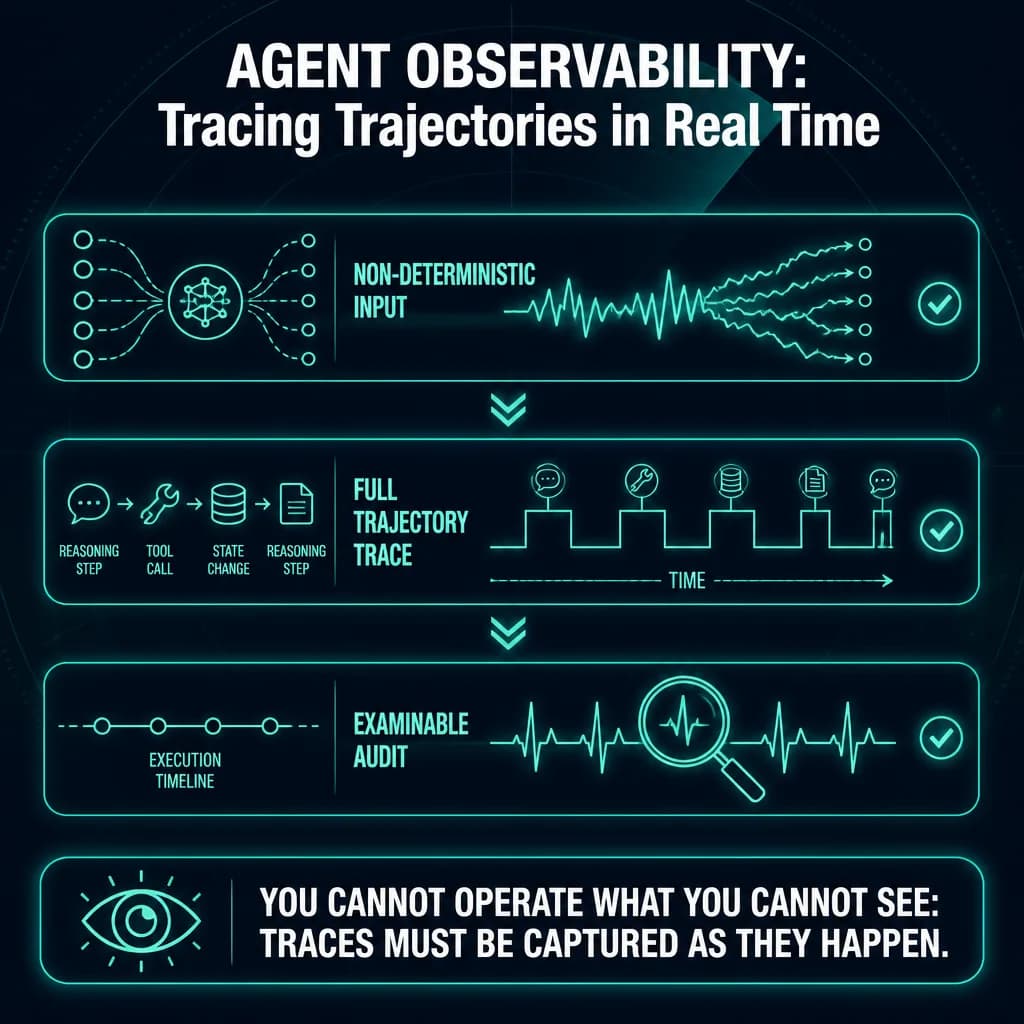
An agent is harder to observe than conventional software because of what it is, a non-deterministic system whose behaviour emerges from a model’s decisions rather than from deterministic logic. Conventional software behaves deterministically, so its behaviour can be understood from its code and reproduced from its input, and an agent’s behaviour is non-deterministic, so the same input can produce different behaviour and the specific behaviour on a given operate cannot be reproduced from the input alone. This means you cannot understand what an agent did by reasoning about its code or repeating its input, because the behaviour is not determined by those, which is why the agent’s actual behaviour on a given operate has to be captured when it happens or it cannot be reconstructed.
The agent’s behaviour is also complex, involving reasoning, tool calls, and multiple steps, which means there is a lot to see and the behaviour unfolds through a trajectory rather than a single computation. Understanding why an agent produced a particular outcome requires seeing the whole trajectory, the reasoning and tool calls and intermediate steps that led to it, because the outcome emerged from the trajectory and cannot be understood from the outcome alone. This is compounded when the agent has retrieval, memory, and tools, each of which affects the agent’s behaviour and has to be seen to understand it. Agents are hard to see because they are non-deterministic, so their behaviour cannot be reconstructed from the input, and complex, so their behaviour unfolds through a trajectory that has to be captured in full to be understood, which is why observing an agent requires capturing its behaviour as it happens rather than reasoning about it afterward.
What agent observability requires
Agent observability requires capturing the agent’s behaviour as it happens, through tracing that records the full trajectory, so the agent’s behaviour can be seen and understood after the fact. The trace captures the agent’s decisions, the actions it takes, the reasoning or basis for them, the tool calls it makes and their results, and the intermediate steps, so that the whole trajectory is recorded and can be reconstructed and walked through. This is the trajectory tracing that underlies debugging, evaluation, and governance, and it is what makes the agent’s behaviour visible, because the recorded trajectory is what you examine to understand what the agent did and why.
The trace has to be complete enough to reconstruct the behaviour, because a trace that captures only part of the trajectory leaves gaps where the behaviour cannot be understood, and it has to be examinable, so an engineer can open a trajectory and walk through it to understand what happened. This observability is foundational because so much depends on it: debugging the agent requires seeing what it did, evaluating the agent requires the trajectories to score, governing the agent requires the audit trail the trace provides, and answering for the agent’s decisions requires the record the trace captures. The observability is the substrate all of these rest on, which is why it is foundational and has to be built, capturing the agent’s full trajectory as it happens so the behaviour is visible for all the purposes that depend on seeing it. Agent observability requires complete, examinable tracing of the agent’s trajectory, captured as it happens, which is what makes the agent’s behaviour visible enough to operate.
The trade-off, and observability as foundational
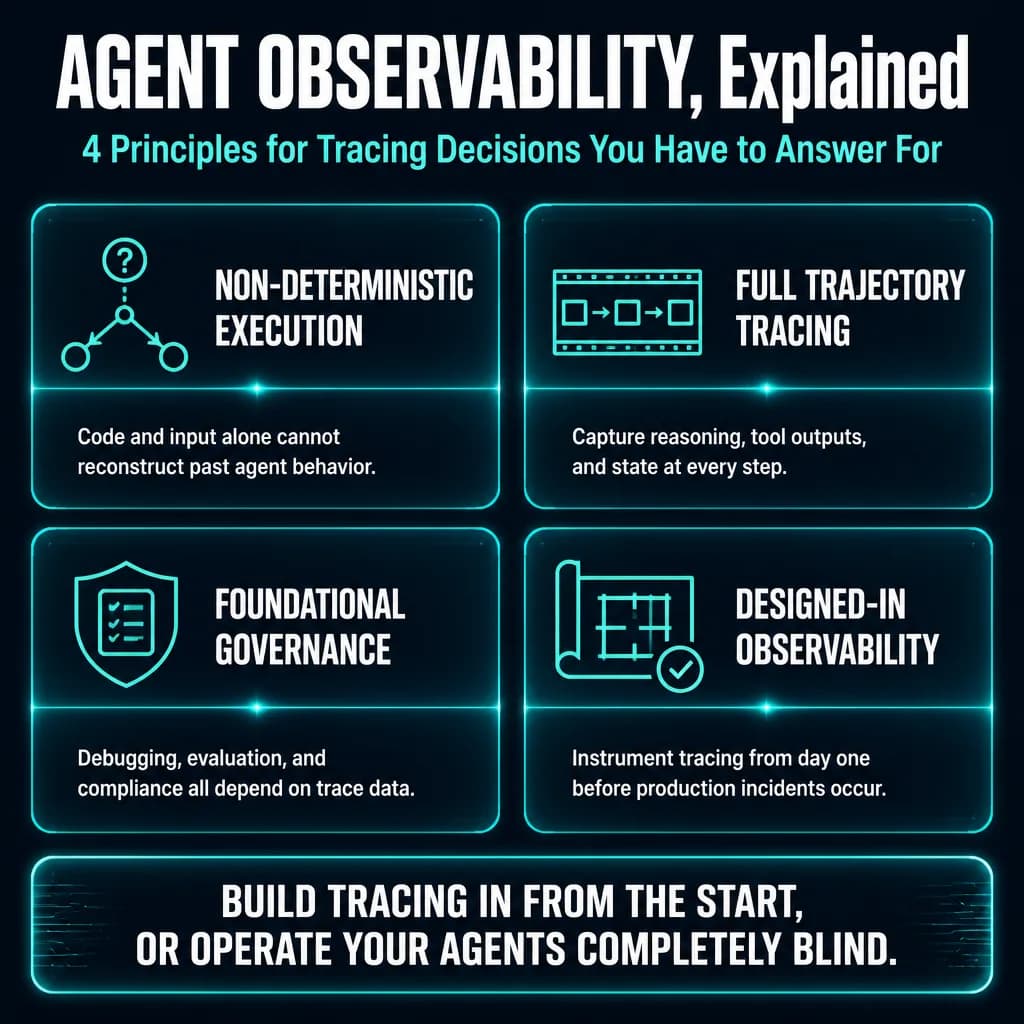
Observability costs engineering and storage, and naming that trade-off keeps it in perspective. Capturing the agent’s full trajectory as it happens is meaningful storage and the engineering to instrument the agent to record its behaviour, more than operating the agent without tracing, and it is a cost that produces no visible feature, which makes it easy to underinvest in. The cost is justified because observability is foundational, and an agent without it cannot be debugged, evaluated, governed, or answered for, which means the observability is not optional overhead but the substrate that makes operating the agent possible, and skipping it does not save the cost but defers it to the moment you need to see what the agent did and cannot.
The observability has to be built before it is needed, which is the point teams miss, because you cannot reconstruct the behaviour of a trajectory that was not traced when it happened, so an agent operated without observability cannot retroactively produce the traces of behaviour already past. This connects to observability as designed-in, a foundational part of the agent’s operation that has to be in place from the start, because the trace of the agent’s behaviour can only be captured as the behaviour happens. An agent deployed without observability and then found to need it, to debug a failure, to answer a question, to evaluate its behaviour, cannot produce the traces retroactively, which is why observability has to be designed in from the start, capturing the agent’s behaviour as it happens so the traces exist when they are needed. Building observability in, so the agent’s trajectory is captured as it happens, is what ensures the behaviour is visible when you need to see it, which is what makes the observability’s cost worth paying before the need arises.
Where it almost broke
We operated an agent without adequate observability, operating it with minimal tracing that captured little of its behaviour, and when the agent did something we had to understand, a failure we needed to debug, a decision we had to explain, we could not, because the behaviour had not been captured when it happened and could not be reconstructed afterward. The agent was a black box that had behaved non-deterministically, and without the trace of what it had done, we could not see into it, so we were left unable to debug the failure, explain the decision, or understand the behaviour, because the observability that would have made the behaviour visible had not been built.
The correction built observability. We instrumented the agent to capture its full trajectory as it happened, the decisions, actions, reasoning, tool calls, and intermediate steps, recording the behaviour completely and examinably so a trajectory could be opened and walked through. We built the observability in as a foundational part of the agent’s operation, so the traces existed when we needed them. The agent’s behaviour became visible, because the trace now captured what it did and why, letting us debug the failures, explain the decisions, and understand the behaviour that had been opaque. The lesson was that agents are hard to see and observability is foundational, and building the tracing that captures the agent’s behaviour as it happens, before it is needed, is what makes the agent’s behaviour visible enough to operate.
See the agent or operate blind
The reframe that makes agents operable is capturing their behaviour as it happens through tracing, so the non-deterministic, complex behaviour is visible enough to understand. Agent observability is the capability to see what an agent did and why, through complete, examinable tracing of its trajectory, and it is foundational because debugging, evaluation, governance, and answering for the agent’s decisions all rest on it. An agent you cannot see is a black box that behaves non-deterministically and cannot be reconstructed when you need to understand it.
The teams that operate agents well are the ones that built observability in from the start, captured the agents’ full trajectories as they happened, and could see what the agents did and why when it mattered. Agents are hard to see, and their behaviour cannot be reconstructed from the input or the code, which means the trace has to capture the behaviour as it happens or it is lost. Seeing the agent, through the observability that captures its behaviour before you need to examine it, is what turns an agent from a black box you can only hope about into a system you can debug, evaluate, govern, and answer for, which is the difference between operating the agent and operating blind.
Related: Agentic AI
Tell us the number you need to move.
…outcomes that survive scrutiny.