Agent Orchestration Patterns: Sequential, Parallel, and When to Use Each
Somewhere between the first working agent and the third one, a particular ambition takes hold: build a system of specialised agents that coordinate, delegate, and collaborate. A planner agent that hands subtasks to worker agents, a critic agent that reviews them, a manager agent that decides what happens next. It demos like the future. Then it reaches real workloads and you discover you have built a distributed system where every node is non-deterministic, and you are debugging emergent behaviour across five models at once. The orchestration was supposed to make the system more capable. Mostly it made it harder to reason about.
The decision that actually governs whether a multi-step system holds up is unglamorous: which agent orchestration pattern matches the task in front of you. Get the topology right and coordination disappears into the background. Get it wrong, usually by reaching for more coordination than the task needs, and you spend your engineering budget taming complexity you introduced yourself.
Sequential is the default, and the default is underrated

The simplest topology is a sequential chain: step one produces an output, step two consumes it, and so on down the line. It feels too basic to discuss, which is exactly why teams skip past it toward something more sophisticated. They should not. Most tasks that look like they need coordinating agents are actually a pipeline wearing a costume.
Sequential orchestration has one decisive property: state flows in a single direction, so the system is inspectable. When step four produces a wrong result, you open the trace, walk back through three prior steps, and find where it went wrong, because there is exactly one path it could have taken. That property is worth more in production than almost any capability you would gain from a fancier topology. The cost is latency. Steps operate one after another, so total time is the sum of every step plus its tool calls, and your p99 inherits the slowest link in the chain. For a task where each step genuinely depends on the previous one’s output, that latency is the task itself, and the framing of it as waste sits well outside what it is doing.
The trap is forcing genuinely independent work into a sequence out of habit. If step two does not need step one’s output, chaining them serially is latency you are paying for nothing.
Parallel is a throughput tool, not a coordination strategy
When subtasks are independent, summarise ten documents, check one claim against five sources, operate the same extraction across a batch, parallel execution is the obvious win. Fan the work out, operate it concurrently, gather the results. You collapse the latency of N sequential steps into roughly the latency of the slowest single one, which on a fan-out of any width is a large saving.
Parallelism buys throughput by spending two other things. The first is cost concurrency: ten parallel model calls cost the same in tokens as ten sequential ones, and they hit your rate limits and your spend all at once, and a fan-out wide enough to be useful is a fan-out wide enough to trip a quota. The second, subtler one is the aggregation problem. Independent branches produce independent outputs, and something has to reconcile them. If two branches disagree, two documents imply contradictory facts, the aggregation step now carries the real complexity of the system. Parallelism does not remove the hard reasoning. It relocates it to the join, where it is easy to underestimate.
The honest rule: parallelise when branches are truly independent and the aggregation is simple. The moment branches need to see each other’s intermediate state, you do not have parallel work. You have sequential work you are pretending is parallel, and the pretense will surface as a race condition.
The pattern most teams reach for too early
Beyond sequential and parallel sits the topology everyone wants: the orchestrator-worker pattern, where a coordinating agent dynamically decides which sub-agents to invoke, in what order, based on intermediate results. This is genuine multi-agent orchestration, and it is occasionally the right answer, for open-ended tasks where the steps genuinely cannot be known in advance.
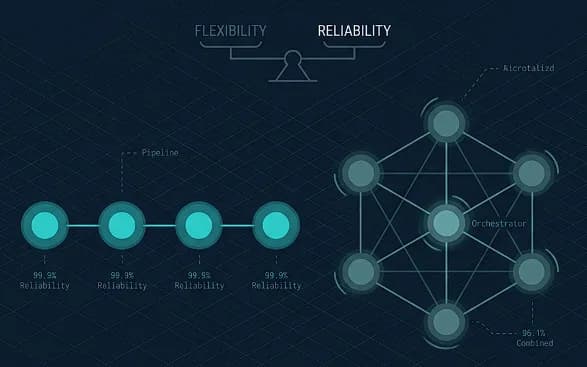
It is also where most over-engineering lives. A dynamic orchestrator means the control flow itself is now non-deterministic, decided by a model at runtime. You have added a coordination layer that is itself a source of compounding error: the orchestrator can misroute, loop, or hand a worker the wrong context, and now you are debugging the thing that directs the workers alongside the workers themselves. Reliability math is unforgiving here. Every agent in the loop multiplies into the end-to-end success rate, so a five-agent system where each agent is 95% reliable lands near 77% before the workers have done anything hard.
Our position, stated plainly: most “multi-agent systems” should be a deterministic pipeline with one model-driven step, and the swarm of coordinating agents sits well outside what the task requires. Reserve dynamic orchestration for tasks whose structure is genuinely unknowable at design time, and even then, bound it. Cap the steps, constrain which workers can be called, and make the orchestrator’s decisions traceable. Dynamic control flow is a cost you pay for flexibility you can prove you need, and the default framing sits well below what it costs.
What this costs to operate
Every topology has an operational signature, and choosing one is choosing what you will debug. Sequential gives you the cleanest traces and the worst latency. Parallel gives you throughput and the hardest aggregation logic. Dynamic orchestration gives you flexibility and a non-deterministic control plane that is, by far, the most expensive of the three to evaluate, observe, and govern, because you cannot write a fixed test suite against an execution graph that changes per input.
Whatever the topology, the same instrumentation has to hold underneath it: full trajectory tracing so any execution can be replayed, idempotent side-effecting actions so a retried branch does not double-fire, and evaluation that scores the whole path alongside the endpoint. The topology decides the shape of the system. The instrumentation decides whether you can operate it.
Where it almost broke
A document-processing system we operated started life as an ambitious orchestrator-worker design: a coordinator that read each incoming document, decided which specialist extractors to invoke, and assembled the results. It worked in testing. In production, the coordinator occasionally misclassified a document type and routed it to the wrong extractor, which returned plausible-but-wrong fields that the assembly step accepted without complaint. The failure was in the dynamic routing layer we had introduced for flexibility the workload did not actually need, and the workers themselves sat well outside where the fault lived.
We collapsed it. Document type was deterministically detectable up front, so we replaced the model-driven coordinator with a typed router and operated a fixed sequential pipeline per type, parallelising only the genuinely independent field extractions within each. The system got simpler, faster, and dramatically easier to evaluate, and the misrouting failure mode disappeared entirely, because we had removed the runtime decision that caused it.
The discipline in agent orchestration is subtractive, and the additive framing sits well below what actually holds up. The strongest systems are the ones where someone asked, honestly, whether the task needed coordination at all, and removed every degree of freedom it did not. A sequential pipeline you can read beats a multi-agent system you can only hope about.
The question to put to any orchestration design before it ships is not “how cleverly do these agents collaborate?” It is the plainer one underneath: what is the simplest topology that does this task, and what specifically about the workload justifies anything more? If you cannot name the justification, you already have your answer.
Related: Agentic AI
Tell us the number you need to move.
…outcomes that survive scrutiny.