Agentforce, Examined: What CRM-Native Agents Change About Customer Operations
Customer operations leaders have spent a decade assembling a service stack that mostly works and never quite integrates. A CRM holds the record of truth, a separate contact centre platform handles voice, a chatbot vendor covers deflection, and an integration layer keeps them approximately synchronised. Every automation initiative encounters the same wall: the agent that answers the customer cannot see or safely change the record that governs the answer.
CRM-native agents attack that wall directly. Placing the agent inside the platform that already holds customer data, permissions, and business logic removes the integration layer from the critical path. Agentforce is the clearest expression of this approach, and the architectural argument behind it deserves examination on its own terms.
What platform-native placement actually changes
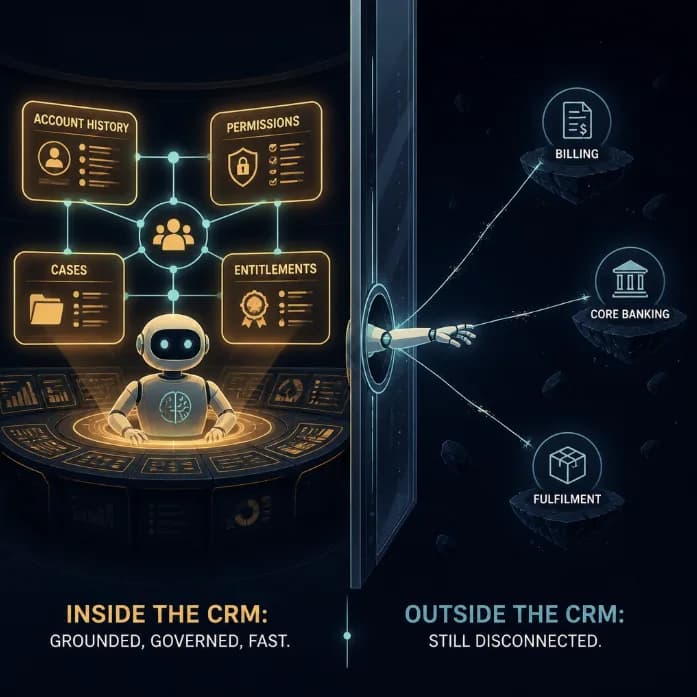
Three constraints dissolve when the agent lives where the data lives.
Grounding stops being an engineering project. The agent reads account history, entitlements, open cases, and order state from the system of record without a synchronisation pipeline that drifts. Anyone who has debugged stale context in a bolted-on chatbot understands what this removes.
Permissions inherit automatically. The platform’s existing sharing model, field-level security, and role hierarchy govern what the agent can see and do, so the agent operates under controls that were already reviewed and audited. Rebuilding that model correctly in an external system is a multi-quarter effort that most organisations execute imperfectly.
Action becomes governed by design. The agent invokes the same flows, validation rules, and approval processes that human users trigger, which means a case update or a refund passes through the controls the business already defined. That is a materially better starting position than an agent holding raw API credentials.
For regulated industries, this matters more than any capability comparison. Data residency follows the platform’s existing commitments, audit trails write to the platform’s log, and the governance review starts from an approved baseline.
The boundary of the graph
Every advantage above depends on the customer context living inside one vendor’s data model, and in most enterprises it does not.
The billing system is separate. Core banking, policy administration, or the claims platform is separate. Fulfilment, logistics, and the product telemetry that explains why the customer is calling are all separate. A native agent reaches those systems through the same integration work that external agents require, and the elegance of the native model degrades in proportion to how much of the answer sits outside the graph.
Practitioners see this early. The agent resolves the questions answerable from CRM data, and the escalations that remain are precisely the ones with the highest handling cost, because they span systems. Deflection rates look excellent in the first review, and average handling time for the remainder rises, since the easy contacts left the queue. Any business case that models cost per contact without accounting for that mix shift will overstate the return.
The second boundary is architectural commitment. Building your customer operations agent layer inside a CRM platform means the orchestration logic, the agent definitions, and the operational tooling live in that vendor’s environment. The switching cost is real and it compounds. That is a legitimate choice with clear benefits, and it should be made deliberately by people who understand the horizon they are accepting.
Enterprise implications

Governance inheritance is the strongest reason to adopt, and it requires the underlying model to be correct. Sharing rules written for human users with human judgement behave differently when an autonomous agent traverses them at scale, and organisations routinely discover permission breadth they were unaware of. Auditing the sharing model before enabling agents is not optional.
Human oversight needs to be designed as a system property. Confidence thresholds, defined escalation paths, and mandatory approval for actions with financial or regulatory consequence belong in the agent design from the start. Voice channels raise the bar further, since a spoken interaction leaves less room for a customer to catch an error before it commits. Our approach to multilingual voice agents in regulated operations treats escalation criteria and call-level audit as core architecture, and the same standard applies to any agent authorised to act on a customer record.
Evaluation is the control most programmes underbuild. Agent behaviour needs continuous assessment against defined criteria, including cases where the agent should have escalated and did not. Teams building toward governed autonomy in customer operations should stand up that evaluation loop before scaling volume.
The honest assessment of CRM-native agents is that they solve the integration and governance problem elegantly for the portion of customer operations that already lives in the CRM, and leave the harder cross-system portion roughly where it was. Mapping which of your high-cost contact types depend on systems outside the graph will tell you most of what you need to know about the return.
Related: Data Architecture
Tell us the number you need to move.
…outcomes that survive scrutiny.