Agentic Workflows vs Chatbots and RPA: What’s Actually Different
The word “agent” is attached to almost everything now, which has made it nearly useless as a description. A scripted chatbot is called an agent. A robotic process automation script is called an agent. A genuinely autonomous system that reasons and acts is called an agent too, and because the same word covers all three, enterprises buy one expecting another and discover the gap only in production. The confusion is expensive, because the three are different kinds of system with different capabilities, different failure modes, and different governance requirements, and treating them as interchangeable leads to both disappointment and risk.
Understanding what actually separates agentic workflows from chatbots and RPA is worth the effort, because the distinction determines what you can safely deploy and how you have to govern it. The differences are not marketing gradations. They are differences in how the system decides what to do, and that single property, who decides the next step, changes everything about how the system behaves and what it takes to operate it responsibly.
Chatbots and RPA follow paths someone else defined

A traditional chatbot operates on defined conversational paths. It recognises intents and responds with configured answers, and however sophisticated the language handling, the logic is a decision tree someone designed. When a user goes somewhere the tree does not cover, the chatbot fails or falls back, because it has no capacity to decide what to do in a situation it was not scripted for. Its behaviour is bounded by design, which makes it predictable and limited in equal measure.
Robotic process automation follows defined procedural paths. It executes a sequence of steps across applications exactly as configured: click here, copy this, paste there. It is fast and reliable as long as the environment holds still, and it is brittle in a specific way. When an interface changes or a step does not match what it expected, it breaks, because it is executing a script rather than understanding a goal. RPA does exactly what it was told, which is its strength and its ceiling.
Both share a defining property: the decisions were made in advance, by the people who built them. The chatbot’s responses and the RPA script’s steps are fixed at design time. The system at runtime is following a path, not choosing one. That makes both of them predictable, auditable in a straightforward way, and incapable of handling anything their designers did not anticipate.
Agentic systems decide at runtime
An agentic system is different in the one way that matters. It is given a goal and it decides how to achieve it, reasoning about the situation, choosing which actions or tools to use, adapting when something does not go as expected. The decisions are made at runtime by the system, within the bounds it was given, rather than fixed in advance by a designer. That is the actual dividing line, and everything else follows from it.
This runtime autonomy is what makes agents powerful. An agent can handle situations no one scripted, adapt to a changed interface, recover from an unexpected result, and pursue a goal through a path that was not laid out ahead of time. Our FORGE capability, for instance, operates real workflows across applications and repairs itself when a step or an interface changes, which is precisely the adaptability a rigid RPA script lacks. The agent understands the goal well enough to find another route when the first one breaks.
The same autonomy is what makes agents harder to govern. A system that decides its own steps can decide wrongly, can take an action no one anticipated, and can reach an outcome by a path that has to be reconstructed rather than read off a script. The predictability that made chatbots and RPA easy to audit is exactly what an agent gives up in exchange for its flexibility. This is why agentic systems need bounded action spaces, provenance captured as they operate, and engineered human boundaries, controls that a scripted system does not require because a scripted system cannot surprise you the way an agent can.
Choosing the right one, and the cost of choosing wrong
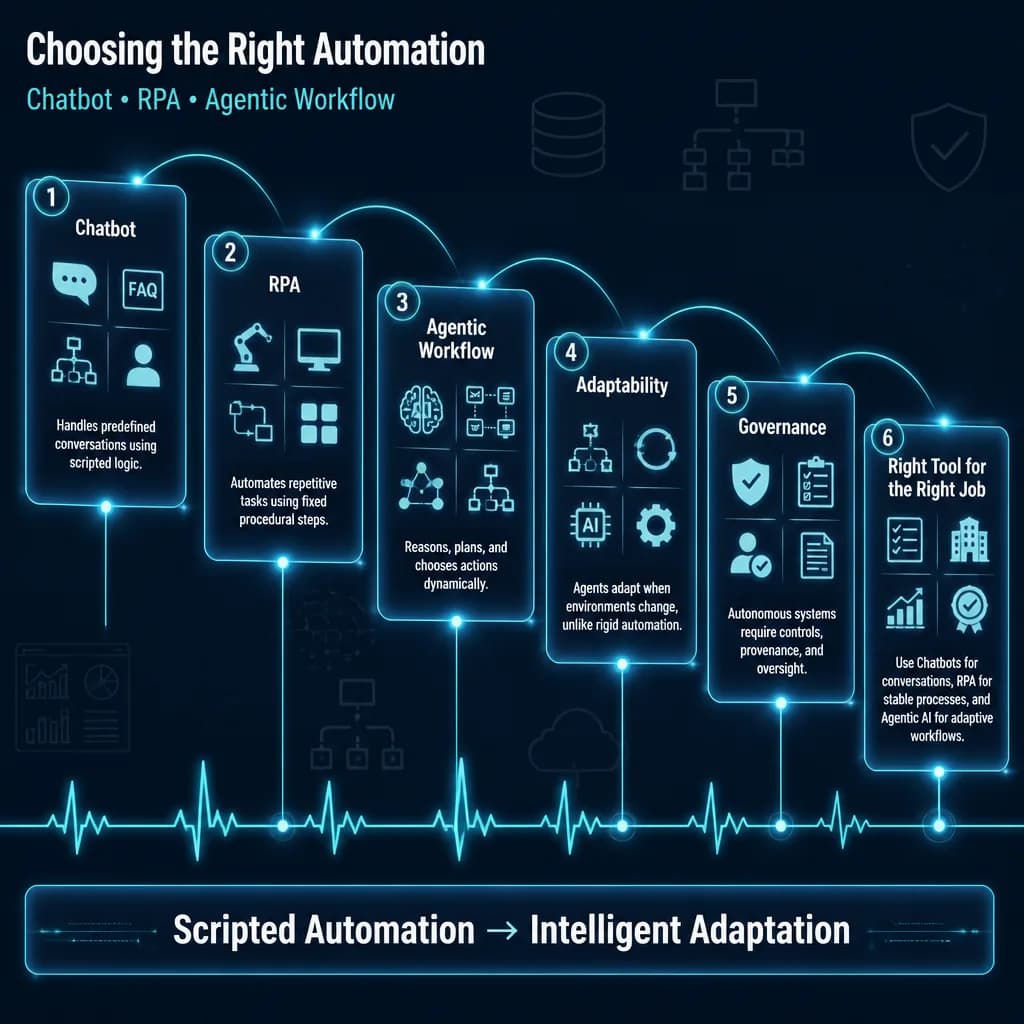
The practical consequence is that these are tools for different jobs. Where a process is stable, well-defined, and unchanging, RPA is often the right and cheaper choice, and reaching for an agent adds autonomy you then have to govern for no benefit. Where interactions follow predictable patterns and the value is in handling known intents at scale, a well-built conversational system may be exactly enough. Where the work genuinely requires adapting to situations that cannot all be anticipated, an agent earns its added governance burden.
The expensive mistake operates in both directions. Deploy a rigid RPA script where the environment keeps changing, and it breaks constantly and someone maintains it forever. Deploy an autonomous agent where a simple scripted system would have done, and you have taken on the governance load of runtime autonomy for a problem that never needed it. Matching the system to the job is the decision that matters, and it depends entirely on understanding which kind of system you are actually buying.
The near-miss to design against is an enterprise that buys an “agent” that is really a scripted chatbot, expecting it to adapt, and discovers in production that it fails on everything its script did not cover. Or the reverse: an enterprise that deploys a genuinely autonomous agent believing it to be as predictable as RPA, and is surprised when it acts in a way no one scripted, because no one built the controls that autonomy requires. The correction in both cases is clarity about what the system actually is before it is deployed.
The difference between agentic workflows, chatbots, and RPA comes down to who decides the next step, and that property determines the system’s power, its failure modes, and its governance. Buying one while expecting another is how enterprises end up disappointed or exposed. An operator who deploys the right system for the work is precise about the distinction, because runtime autonomy is a capability to be matched to the problem and governed accordingly, and only the right system, correctly governed, produces outcomes that survive scrutiny.
Related: About Us
Tell us the number you need to move.
…outcomes that survive scrutiny.