Agents vs Workflow Automation: Choosing the Right Tool for the Job
The word agent has become the default answer to every automation question, and a large fraction of the time it is the wrong answer. Many tasks that teams are building agents for are better served by traditional workflow automation, which is more reliable, cheaper, and easier to operate, and reaching for an agent because agents are the exciting option is how teams introduce non-determinism, cost, and operational complexity into problems that did not need any of them. Choosing between agents and workflow automation is a design decision that should be driven by the nature of the task, and the discipline is knowing when a task genuinely needs an agent and when a deterministic workflow is the better tool.
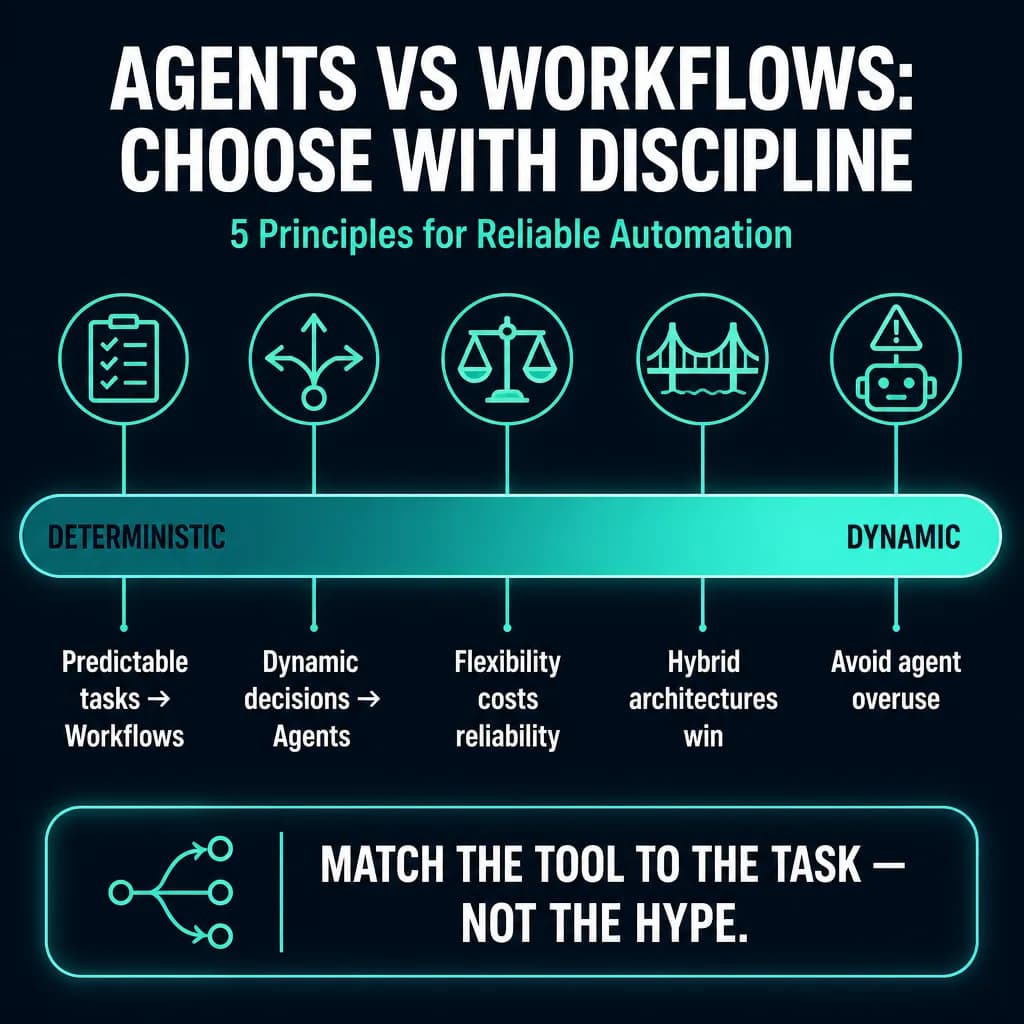
If you are deciding how to automate a task, the choice between an agent and a workflow is one of the most consequential you make, because it determines the reliability, cost, and operability of the result. An agent brings flexibility and the ability to handle open-ended tasks, at the cost of non-determinism and everything that follows from it, and a workflow brings reliability and predictability, at the cost of only handling tasks whose structure is known. Matching the tool to the task, rather than defaulting to the agent, is what produces automation that is reliable where it can be and flexible only where it needs to be.
What each tool actually is

A workflow automation executes a defined sequence of steps deterministically: given an input, it follows the same predictable path every time, producing the same output for the same input, which makes it reliable, testable, and easy to reason about. Its limitation is that it can only handle tasks whose structure is known in advance, because the sequence has to be defined, and a task that requires deciding what to do based on the situation, in ways that cannot be enumerated ahead of time, does not fit a fixed workflow. Workflow automation is the right tool for structured, predictable tasks, and the wrong tool for genuinely open-ended ones.
An agent uses a model to decide what to do, which lets it handle open-ended tasks whose structure is not known in advance, at the cost of the non-determinism that comes with a model making decisions. The agent can handle the task that a workflow cannot, the one requiring judgment and dynamic decisions, and it brings the full weight of agentic operational concerns: non-deterministic behaviour, the compounding-error problem, the need for evaluation and governance and incident response that a deterministic workflow does not require. The agent is the right tool for genuinely open-ended tasks and an expensive, less reliable tool for structured tasks that a workflow would handle better. The choice between them is a choice about the nature of the task, and getting it right requires assessing whether the task actually needs the agent’s flexibility or only appears to.
When each is the right choice
The task’s structure determines the right tool, and the key question is whether the task can be expressed as a defined sequence of steps or genuinely requires dynamic decision-making that cannot be enumerated in advance. A task with a known structure, even a complex one, where you can specify what to do in each situation, is a workflow task, and building it as an agent introduces non-determinism and cost for flexibility the task does not need. Many tasks that get built as agents are actually structured tasks in disguise, where the appearance of complexity hides a structure that could be enumerated, and recognising that structure is what lets you use the more reliable tool.
A task that genuinely requires deciding what to do based on situations that cannot be fully enumerated ahead of time is an agent task, where the flexibility of a model making decisions is actually necessary, and forcing it into a fixed workflow would fail because the workflow cannot handle the cases it did not anticipate. The discipline is distinguishing these honestly, which is the same subtractive discipline that governs orchestration, where the strongest design is often the one that removes the agentic complexity a task did not need. The strongest automation architectures frequently combine both, using deterministic workflows for the structured parts and reserving agentic decision-making for the genuinely open-ended parts, rather than making the whole thing an agent because part of it needed flexibility. This hybrid keeps the reliable parts reliable and pays the agentic cost only where the task requires it.
The trade-off, and the cost of the wrong choice
The choice between agents and workflows is a trade-off between flexibility and reliability, and naming it clearly is what prevents the reflexive reach for the agent. The agent is more flexible and less reliable, more expensive, and harder to operate, and the workflow is more reliable, cheaper, and easier to operate, and less flexible, and the right choice depends on which the task actually needs. A structured task built as an agent pays the agent’s full cost, non-determinism, evaluation, governance, incident response, for flexibility it does not use, which is waste, and an open-ended task forced into a workflow fails on the cases the workflow could not anticipate, which is a different failure. Both are the cost of choosing the wrong tool.
The cost of over-choosing the agent is the one teams incur most, because the agent is the exciting option and the reach for it is reflexive, and the result is structured tasks burdened with all the operational complexity of agents for no benefit. An organisation that builds agents for tasks that workflows would handle has taken on the full operational burden of agentic systems, the monitoring, the evaluation, the governance, the incident response, for tasks that a reliable deterministic workflow would have operated without any of it. Recognising that a task is structured and using a workflow is not a less sophisticated choice but a more disciplined one, because it matches the tool to the task and avoids paying for flexibility the task does not need. The sophistication is in choosing correctly, not in choosing the agent.
Where it almost broke
We saw an organisation building an agent for a task that had been framed as complex and open-ended, requiring the flexibility of a model to handle its many cases. Examining the task showed that it was actually structured: the cases, while numerous, could be enumerated, and the decision in each was specifiable in advance, which meant the task had a known structure that a deterministic workflow could handle. The organisation was building an agent, with all its non-determinism and operational overhead, for a task that a reliable workflow would have operated predictably and cheaply, because the task had been framed as needing agentic flexibility it did not actually need.
The correction reassessed the task’s real structure. We recognised that the bulk of the task was structured and built it as a deterministic workflow, reliable and cheap and easy to operate, and reserved agentic decision-making only for the genuinely open-ended part of the task where dynamic judgment was actually required. The result was a hybrid that was far more reliable and cheaper to operate than the all-agent approach would have been, because the structured majority operated as a predictable workflow and the agent’s cost was paid only where the task needed its flexibility. The lesson was that the reflexive reach for the agent burdens structured tasks with agentic complexity they do not need, and matching the tool to the task’s actual structure is the more disciplined choice.
Match the tool to the task
The reframe that produces reliable automation is choosing between agents and workflows by the nature of the task rather than defaulting to the agent because agents are exciting. Agents versus workflow automation is a trade-off between flexibility and reliability, and the discipline is recognising when a task’s structure is known well enough for a deterministic workflow and reserving the agent for the genuinely open-ended work that actually needs its flexibility. The reflexive reach for the agent burdens structured tasks with non-determinism and operational cost they never needed.
The teams that build reliable automation are the ones that assessed each task’s real structure, used deterministic workflows where the structure was known, and reserved agentic decision-making for the parts that genuinely required judgment, often combining both in a hybrid that is reliable where it can be and flexible only where it must be. Choosing the workflow for a structured task is the disciplined choice, not the unsophisticated one, because it matches the tool to the task. Reserving the agent for the tasks that actually need it is what keeps agentic complexity where it earns its cost and out of the tasks a reliable workflow would have handled better.
Related: Agentic AI
Tell us the number you need to move.
…outcomes that survive scrutiny.