AI Chatbots in Banking: What Separates a Production Assistant From a Demo
A demo answers a question. A production banking assistant makes a statement on behalf of a regulated institution, to a customer who may act on it, in a channel where every word is a record. That difference is the entire engineering problem. When a chatbot tells a customer their payment will clear by Friday, or explains why a fee was charged, or describes a product’s terms, it is not generating text. It is issuing a communication the bank is accountable for, to the customer, to the complaints process, and to a regulator who can ask, months later, why that answer was given and on what basis.
The demo is judged on whether the conversation feels good. Production is judged on what happens when the model is wrong, and on whether the system caught it before the customer did. Those are not the same test, and most assistants that impress in a sandbox fail the second one.
The constraint that owns the workflow

Customer communications in a regulated bank carry obligations that do not pause for a chat interface. Statements must be fair, clear, and not misleading. Anything that drifts toward a recommendation crosses into advice, which carries suitability requirements the chatbot was never authorised to meet. Account actions require the customer to be authenticated to a defined standard before anything moves. And the entire exchange has to be retained and reconstructable, because a conversation the bank cannot produce on request is a conversation the bank cannot defend.
So the binding constraint is not fluency. The assistant may only say things the institution can stand behind, and it must hand off cleanly the moment it cannot. A model optimised for sounding helpful will, under pressure, invent a plausible answer rather than admit a boundary. In a consumer channel that confident invention is the failure mode regulators care about most, because it is indistinguishable from good service right up until it causes harm.
Containment is a quality metric, not a cost metric
The number that decides whether an assistant survives in production is its containment rate, the share of conversations resolved correctly without a human, paired inseparably with its escalation safety. Read alone, containment is dangerous. A bot can contain ninety percent of conversations by confidently answering everything, including the things it should have escalated. High containment with unsafe escalation is not success; it is unmeasured harm with good-looking dashboards.
The metric that matters is correct containment: resolved, accurately, within policy, with everything outside that envelope routed to a person before damage is done. This reframes the goal. You are building a system that knows the edge of its own competence and treats that edge as a hard boundary.
Here is the position I would hold against a vendor selling on conversational quality: the hard part of a banking assistant is not generating the answer. It is engineering the refusal. Knowing what to withhold, when to stop, and how to escalate without dropping the customer’s context is where production value lives, and it is exactly the part a polished demo never shows you, because demos are scripted to stay inside the model’s comfortable middle.
What you actually have to engineer
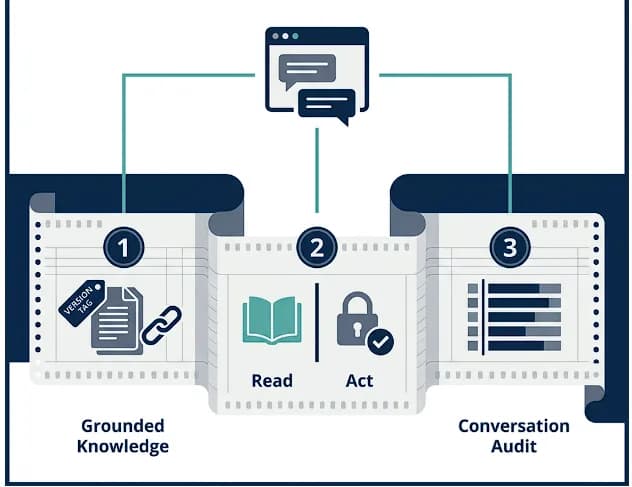
Three mechanisms carry the load, and none of them are the language model.
First, grounding. The assistant answers from the bank’s own governed knowledge, the current policies, product terms, and the customer’s actual account state, drawing on that source of record rather than the model’s parametric memory. Retrieval against an authoritative, access-controlled source means an answer can be traced to the document that justified it. An ungrounded model will state last year’s fee structure with total conviction; a grounded one cites the version of record. This is the discipline a governed institutional-knowledge engine like COMPASS exists to enforce: the answer and its source move together.
Second, the action boundary. Reading information and taking action are different risk tiers and must be governed separately. Telling a customer their balance is one thing. Moving money, changing a limit, or updating contact details is another, and those require authentication, explicit confirmation, and an action ledger that records what was done and why. The assistant should be generous with information inside its grounding and conservative with anything that changes state.
Third, evaluation against a rubric rather than a vibe. Before deployment and continuously after, the assistant has to be scored on whether it stayed accurate, in-policy, and inside its authority, held to that standard regardless of whether testers liked the tone. Trajectory-level evaluation, scoring the whole conversation rather than the final reply, is what turns “it seems good” into something a model-risk committee can sign.
Where it almost broke
An assistant handled balance and transaction queries cleanly for weeks. Then a customer in genuine distress asked, in a roundabout way, whether they should move their savings into a particular investment. The model, helpful by training, began to explain why that product looked suitable. That is regulated advice, and the bot had no authority to give it. The classifier that should have caught the intent had been tuned on transactional phrasings and missed the indirect one.
The fix was structural. An explicit policy boundary was drawn around advice-shaped intents, biased to escalate on ambiguity, with the customer’s context carried intact to the human who picked it up. Containment dropped a fraction of a point. The institution’s exposure dropped far more. Escalating a conversation you could technically have answered is not a failure of the system. Answering one you should have escalated is.
The gap between an AI chatbot in banking that demos well and one that survives production is the gap between a good answer and a governed one. Conversational polish is the easy ninety percent. The remaining ten, the boundaries, the escalations, the traceable grounding, the refusal to overstep, is the part customers and regulators actually feel, and it is the only part that determines whether the assistant earns its place in a live channel.
If you are evaluating an assistant, watch what it does at the edge of its knowledge, and treat the center as the easy case. The center is where every system looks competent. The edge is where you find out whether someone engineered for the day the model is confidently wrong, which is the day that decides whether the whole thing was an outcome that survives scrutiny.
Related: Banking & Financial Services · Reserve Bank Innovation Hub: Automated grievance workflows with natural-language access and a complete audit record · IndusInd Bank Limited: AI-Powered Knowledge Source-Based Process Training and Query Resolution
Tell us the number you need to move.
…outcomes that survive scrutiny.