AI for Bed Management: Discharge Predictions Hospitals Can Plan Around
At eight in the morning, the bed manager of a large hospital is looking at a queue of admissions in the emergency department and a ward census that says nothing about who will go home today. Discharges decide how the rest of the day goes. A bed freed at eleven absorbs an emergency admission before lunch. The same bed freed at six in the evening means a patient spends the afternoon on a trolley and a planned surgery may be postponed. AI for hospital bed management promises to tell the bed manager each morning which patients are likely to leave, and roughly when. The promise holds only if the forecast is accurate enough to plan around and trusted enough for the ward team to act on.
Why discharge timing decides hospital capacity
A hospital's capacity behaves like a tank with a tap at each end. Admissions arrive through the day, and discharges cluster in the late afternoon because each one waits on a chain of small tasks. The discharge summary needs a consultant's sign-off, the take-home medicines need dispensing, the bill needs clearing and the family needs to arrive. In Indian private hospitals, final approval from the insurer's TPA often adds hours to that chain for cashless patients.
When the chain is slow, the cost shows up elsewhere in the hospital. Emergency patients wait for beds on trolleys, and elective surgeries are cancelled on the day because no post-operative bed is free. Most bed managers forecast the day by phoning ward in-charges and asking who looks ready to go. That works in a small hospital. Across a network with hundreds of beds, it produces a forecast nobody can check and nobody owns.

Predicting discharges patient by patient
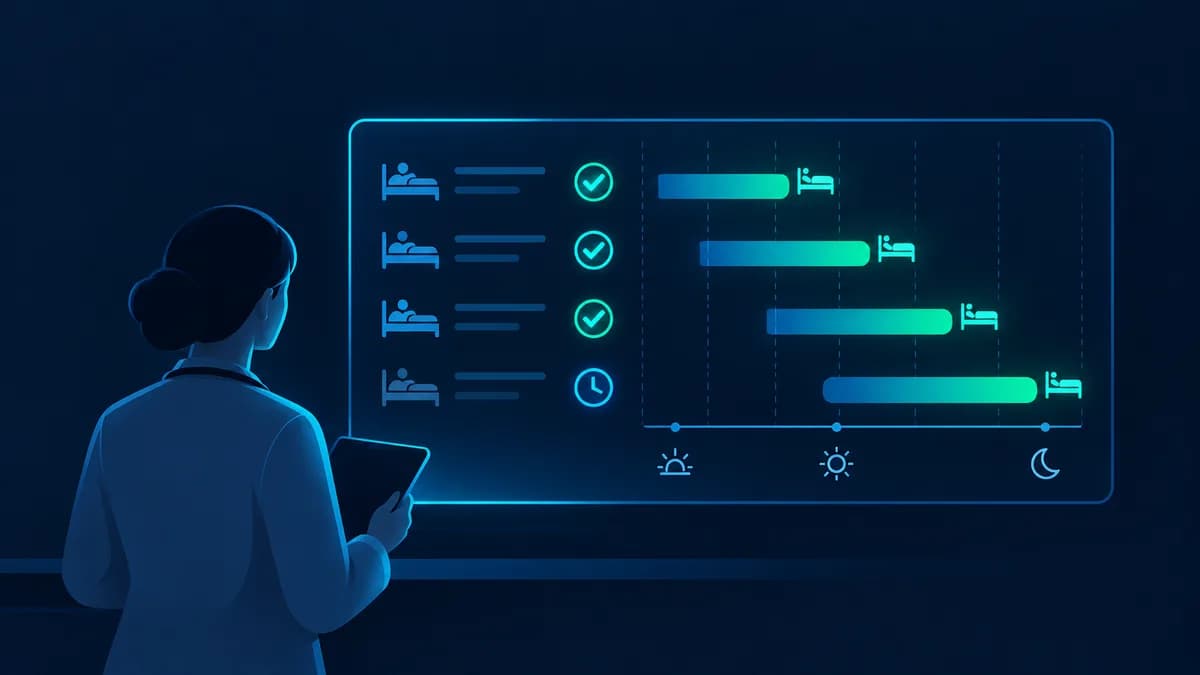
A useful model predicts at the level of the individual patient and then adds up. For each inpatient it estimates the probability of discharge today and tomorrow, along with a likely time window. The inputs are already in the hospital information system: the diagnosis and procedure, the length of stay so far against the typical stay for that case, recent trends in vitals and lab results, tests still pending, and orders such as physiotherapy clearance or a discharge-planning note. Summed across a ward, these become a forecast of how many beds will free up and when.
Calibration matters more here than ranking. A bed manager plans with expected counts of free beds. If the model forecasts thirty discharges across a ward block with a likely range of twenty-five to thirty-four, that range has to hold day after day before anyone stakes an elective list on it. A model that ranks patients well but overstates the total by a fifth produces a confident plan that fails at four in the afternoon.
The most valuable output is often the reason a likely discharge may slip. A patient who is clinically ready but waiting on a pending echo report, or on TPA approval, is a task someone can chase at ten in the morning. Surfacing those blockers early moves discharges forward in the day, and that shift frees more capacity than any improvement in the forecast itself.
Keeping the clinician in charge of the discharge
The model never decides that a patient goes home. That decision belongs to the treating clinician, and the system has to be designed so nobody mistakes a planning signal for a clinical judgement. The forecast goes to the bed manager and the ward in-charge for operational planning. Consultants see the pending tasks for patients they have marked as nearly ready, with no probability score to anchor their judgement.
Two safeguards keep operational pressure from leaking into clinical decisions. The first is monitoring readmissions within thirty days, by ward and by consultant, before and after the forecast goes live. A rise in early readmissions is the signal that discharges are being pulled forward too hard. The second is checking performance by payer category. A model trained on historical stays can learn that cash patients leave sooner than insured ones, and a forecast that encodes that difference invites the very pressure the hospital must avoid.
Validation has to cover the hospital's own seasons. A model back-tested only on a calm quarter will mislead during a monsoon surge in dengue admissions or a festival week when families delay collecting patients. Back-testing across at least a full year, ward by ward, shows where the forecast can be trusted and where the bed manager should rely on judgement instead.
The forecast that missed the new weekend roster
A hospital network operated its discharge forecast for four months with steady accuracy. Bed managers began accepting elective admissions on Saturday mornings based on the forecast range, and the routine held. Then the network changed its weekend consultant roster, with fewer senior reviews on Saturdays. Nobody told the model about the change.
The forecast continued to predict Saturday discharges at the old rate. Over two weekends, elective patients completed surgery and waited in recovery for ward beds that were still occupied. No patient came to harm, but theatre schedules slipped and the surgical teams lost confidence in the forecast quickly.
The correction treated operational change as a model input. Roster changes and other policy shifts are now logged and fed to the forecast, and its error is tracked daily by ward and by weekday. An alert fires when actual discharges fall outside the predicted range on consecutive days. The bed manager always sees the range beside the point estimate, so a wider band on an unusual day prompts caution instead of a fixed plan.
The bed manager at eight in the morning needs a number to plan around, along with the reasons some discharges may slip. AI can supply both, provided the hospital validates it against its own seasons and keeps every discharge decision with the clinician. For a hospital COO, the useful question is how accurate yesterday's discharge forecast was, ward by ward, and what the team did differently because of it. A forecast that can answer that, with readmissions watched alongside it, gives patient flow the outcomes that survive scrutiny.
Related: Healthcare & Life Sciences · Koita Foundation: An AI-powered knowledge hub with citation-backed retrieval across seven repositories
Tell us the number you need to move.
…outcomes that survive scrutiny.