AI for Investment Research: Faster Analyst Summaries You Can Audit
An investment analyst produces summaries constantly, of earnings, filings, research, market developments, distilling large volumes of source material into the concise assessments that inform investment decisions. AI can accelerate this dramatically, reading source material and generating summaries far faster than an analyst can, and the time saving is real given how much analysts read. The risk that defines this use is specific: a summary is a compression of source material, and a summary that distorts, omits, or fabricates relative to its source produces an assessment that misrepresents what the source actually said, and an investment decision built on a distorted summary is built on a misrepresentation. Because the summary’s value depends entirely on its fidelity to the source, an AI summary is only usable if the analyst can audit it against the source it came from. AI for investment research is the discipline of generating summaries faster while keeping them faithful to and auditable against the source material, because a summary an analyst cannot verify against its source is a risk, not a time saving.
The trap is the fluent summary that reads well and misrepresents its source. An AI summary is articulate and confident whether or not it faithfully reflects the source material, and an analyst moving fast, trusting the fluency, can carry a distortion or a fabrication into an assessment without catching it.
The constraint that owns the workflow
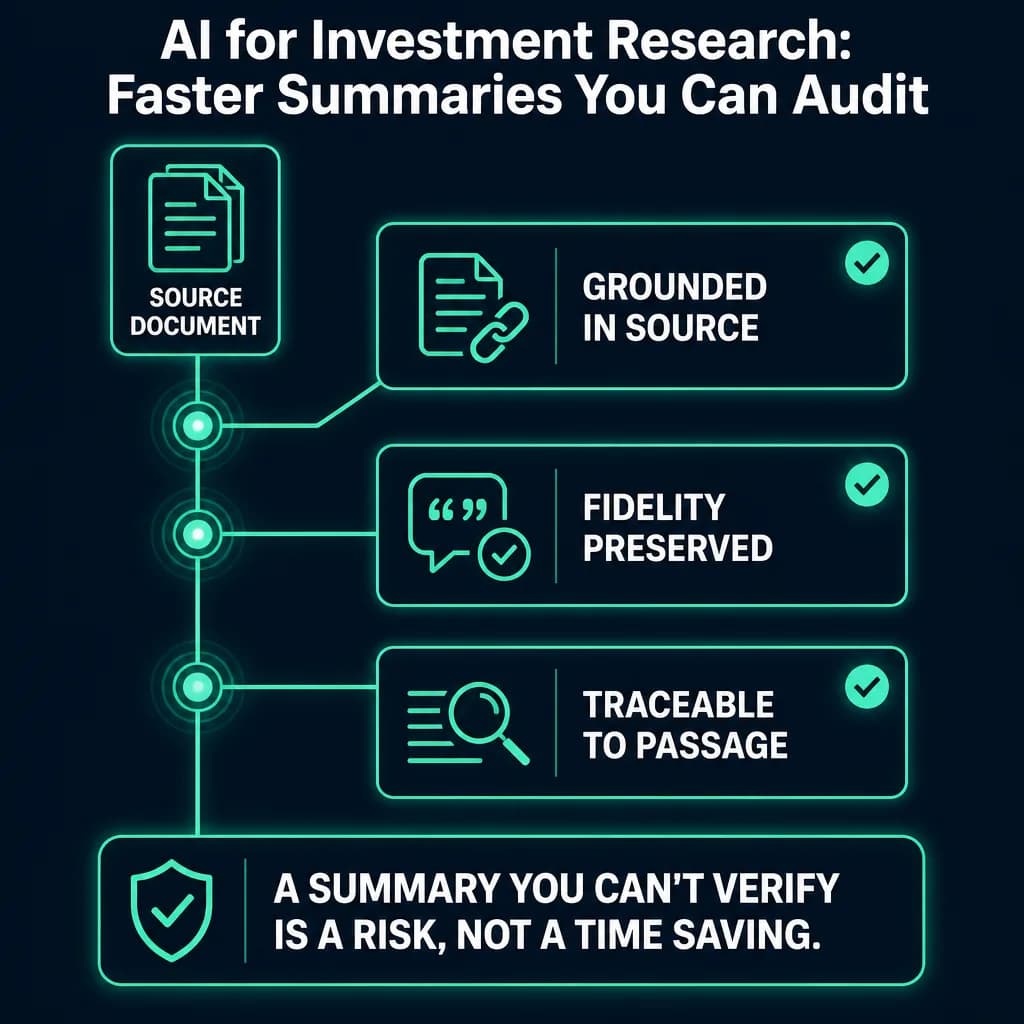
Investment research summaries sit under obligations around accuracy and substantiation. Research that informs investment decisions has to be accurate, and where it is shared or published it carries obligations around not being misleading and being substantiated. An analyst is accountable for the summaries and assessments in their work, so a summary that misrepresents its source is a defect the analyst owns. The basis for an assessment has to be traceable, so the analyst and the firm can stand behind what the research says. And the summary has to be reconstructable against its source, so a claim in a summary can be checked against the material it came from.
The failure modes come from the summary departing from the source. The distortion failure, where the summary shifts the meaning of the source, turning a hedged statement into a firm one or overstating a point the source made cautiously. The omission failure, where the summary leaves out material information from the source, producing a picture that is misleading by what it does not include. And the fabrication failure, where the summary includes something that is not in the source at all, a fluent invention that reads like a faithful summary point.
The position: fidelity and auditability, not just fluency, make a summary usable
Here is the stance I would hold. An AI-generated investment summary is usable only if it is faithful to its source and auditable against it, and a fluent summary the analyst cannot verify against the source is a risk rather than a time saving. The value of the summary is entirely in its fidelity to the source material, because a summary that distorts, omits, or fabricates misrepresents what the source said, and an analyst who cannot audit it against the source has to either trust it blindly, risking a distortion, or re-read the source, erasing the time saving. Auditability is what makes the summary’s speed usable, because it lets the analyst verify fidelity quickly.
The reasoning is about what a summary is for and how its failures hide. A summary exists to let the analyst grasp the source material’s content without reading all of it, and this only works if the summary faithfully represents the source, because a summary that distorts or omits or fabricates gives the analyst a wrong picture of what the source said, and they act on the summary believing it reflects the source. An AI summary’s failures are hard to catch because the summary is fluent, a distortion reads as smoothly as a faithful point and a fabrication looks like a genuine summary item, so the analyst cannot tell from the summary alone whether it is faithful. The only way to know is to audit against the source, which requires the summary to be auditable, tied to the source material so the analyst can check any point against where it came from. A summary that is not auditable forces the analyst to trust fluency, which is exactly what hides the distortions. So the engineering has to prioritise fidelity and auditability, keeping the summary faithful to the source and traceable to it, because a fast summary the analyst cannot verify is a liability that produces misrepresented assessments.
Engineering inside the constraint
The summary generation is grounded in the source material and built for auditability. The system summarises from the actual source material, generating summary points from the source’s content rather than composing from the model’s own knowledge, so the summary reflects what the source says. Each summary point is traceable to the part of the source it came from, so the analyst can audit any point by checking it against the source material, which is what makes the summary verifiable and its speed usable. This traceability is the core property, because it converts the analyst’s need to trust the summary into the ability to check it quickly.
The summarisation is engineered to preserve fidelity, keeping the hedging and qualification of the source rather than flattening cautious statements into firm ones, and to avoid omitting material information or introducing content not in the source. The system is configured to summarise what the source contains rather than to elaborate or infer beyond it, because a summary that adds interpretation the source does not support is a distortion. A governed knowledge engine like COMPASS that binds summary points to their source is what enforces this grounding and traceability, keeping each point tied to the material it came from.
Every summary and its source traceability are captured in a reconstructable record, so the analyst and the firm can verify and defend the research. The system is evaluated against an explicit standard for summary fidelity, measuring how faithfully summaries represent their sources and how often they distort, omit, or fabricate, operated repeatably as the model changes, which is the work a rubric-based evaluation engine like PRISM is built to carry, because a summarisation capability that drifts in fidelity produces misrepresentations silently. This connects to the broader discipline of verifiable AI outputs in financial research, where fidelity to source is the governing requirement. The analyst stays the accountable party, auditing and owning the summaries, with the AI accelerating the reading and distillation rather than replacing the analyst’s verification and judgment.
Where it almost broke
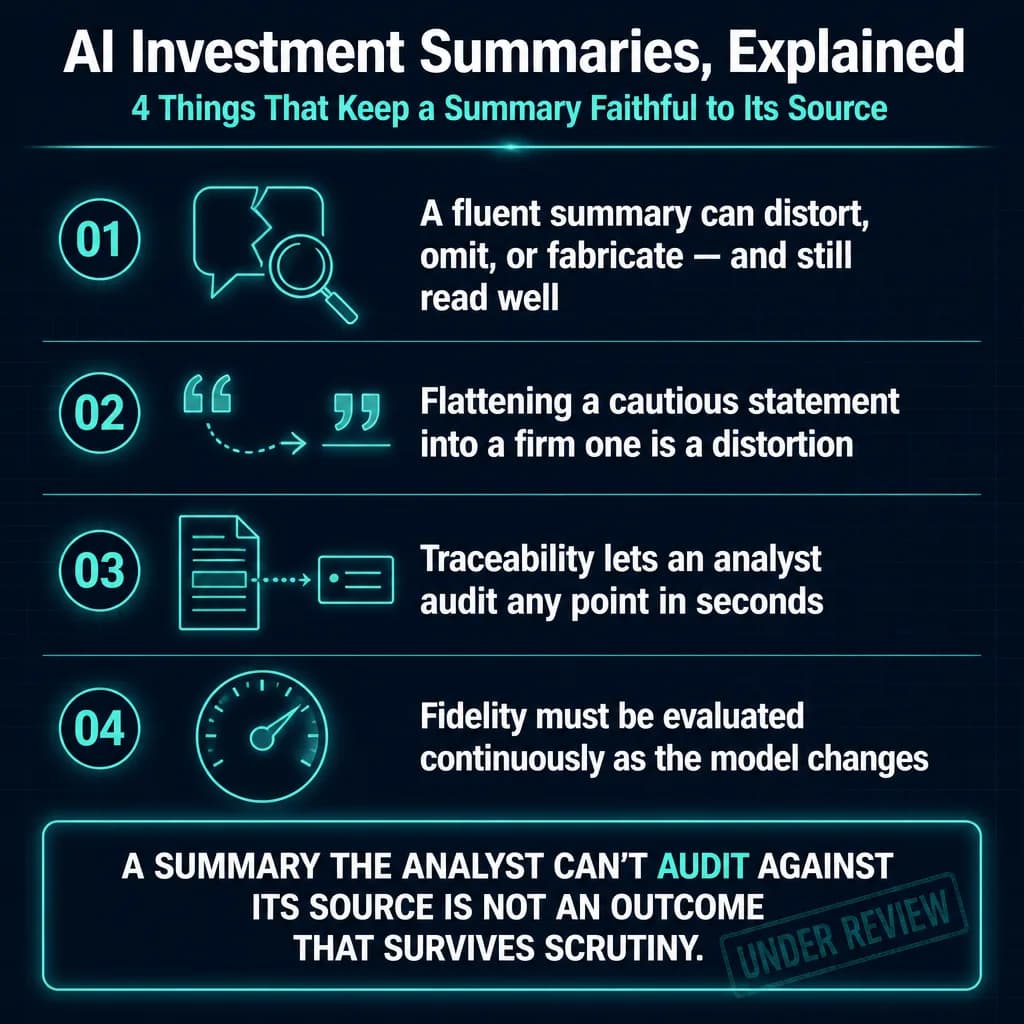
A firm deployed AI to generate research summaries, and analysts used it to distill source material quickly, appreciating the time it saved. The summaries were fluent and read well, and analysts came to rely on them. An analyst preparing an assessment used a summary of a source document that, the summary said, indicated a firm positive outlook, and built the assessment on that. The source had actually expressed a hedged, qualified view, and the summary had flattened the hedging into a firm statement, distorting the source’s meaning, and because the summary read as a confident faithful point and the analyst had not audited it against the source, the distortion carried into the assessment.
The summary was fluent and unfaithful, and the fluency had hidden the distortion. The fix was to ground the summaries in the source and make every summary point traceable to where it came from, so analysts could audit any point against the source quickly, and to engineer the summarisation to preserve the source’s hedging and qualification rather than flattening it. After the change, analysts verified summary points against the source in seconds rather than trusting fluency, and the distortions were caught. A research summary the analyst cannot audit against its source will carry distortions into assessments, because the fluency that makes the summary readable is exactly what hides its infidelity to the source.
AI for investment research can accelerate the constant summarisation that fills an analyst’s work, distilling large volumes of source material far faster than reading it all. That acceleration is only usable when the summaries are faithful to their sources and auditable against them, because a summary that distorts, omits, or fabricates misrepresents the source, and an investment decision built on a misrepresentation is built on a distortion the analyst never caught. Grounding summaries in the source and making every point traceable to it is what lets the analyst verify fidelity quickly, turning the speed into a genuine time saving rather than a hidden risk.
A firm deploying AI research summarisation should ask whether an analyst could audit any summary point against the source it came from, because a summary that cannot be verified forces the analyst to trust a fluency that hides its distortions. A research summary the analyst cannot audit against its source is not an outcome that survives scrutiny.
Related: Banking & Financial Services · Reserve Bank Innovation Hub: Automated grievance workflows with natural-language access and a complete audit record · IndusInd Bank Limited: AI-Powered Knowledge Source-Based Process Training and Query Resolution
Tell us the number you need to move.
…outcomes that survive scrutiny.