AI for Loan Default Prediction: Early-Warning Systems That Prioritise Collections
A loan that defaults rarely does so without warning. Borrowers show signs of stress before they miss a payment, and a lender that can read those signs early has options that disappear once the default happens, restructuring, outreach, a payment plan that keeps a struggling borrower on track. AI default-prediction models promise exactly this early warning, identifying the loans most likely to default before they do, so the lender can intervene while intervention still helps. The value is real, and the risk sits in what the lender does with the prediction, because a default-prediction system that drives collections activity is directing intervention at borrowers based on a model’s judgment about their likely difficulty, and doing that badly means either harassing borrowers who were not actually at risk or subjecting struggling borrowers to premature collections pressure that pushes them toward the default it predicted. AI for loan default prediction is the discipline of building early-warning systems that prioritise intervention effectively while respecting the fair-treatment obligations that govern how a lender may act on a borrower’s predicted difficulty.
The trap is treating the prediction as an end in itself. A model that predicts default accurately has done nothing useful until the lender acts on it well, and acting on it well means intervening in a way that helps the borrower and respects the rules, not simply escalating collections against everyone the model flags.
The constraint that owns the workflow
Acting on predicted default sits under the fair-treatment obligations that govern the lender’s relationship with borrowers, especially those in difficulty. Borrowers in or approaching financial difficulty are owed fair treatment, which includes forbearance and support where appropriate rather than escalating pressure. Collections activity is regulated in its conduct, so intervention driven by a prediction has to respect the rules on how borrowers can be contacted and treated. Acting on a prediction that a borrower will struggle means acting on a borrower who may be vulnerable, so the intervention has to be appropriate to the borrower’s actual situation. And the decisions have to be reconstructable, so the lender can show it treated borrowers fairly.
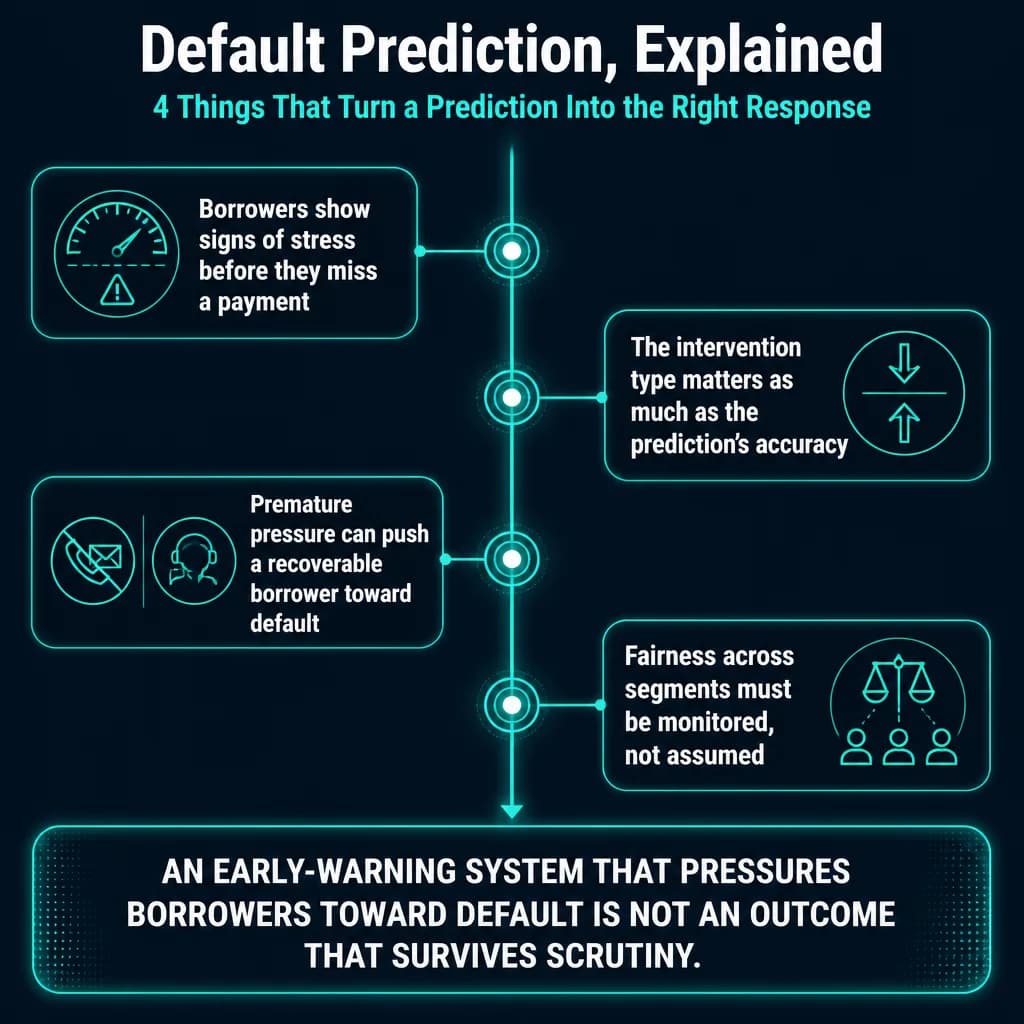
The failure modes span the prediction and the action. The premature-pressure failure, where the system directs collections pressure at a borrower based on predicted difficulty and that pressure pushes a borrower who might have recovered toward the default it predicted. The misdirected-intervention failure, where the prediction is wrong and the lender subjects a borrower who was not at risk to unwarranted collections activity. And the fairness failure, where the prediction model flags certain borrower groups disproportionately, directing intervention unevenly in ways that disadvantage some.
The position: predict to help, and the intervention type matters as much as the prediction
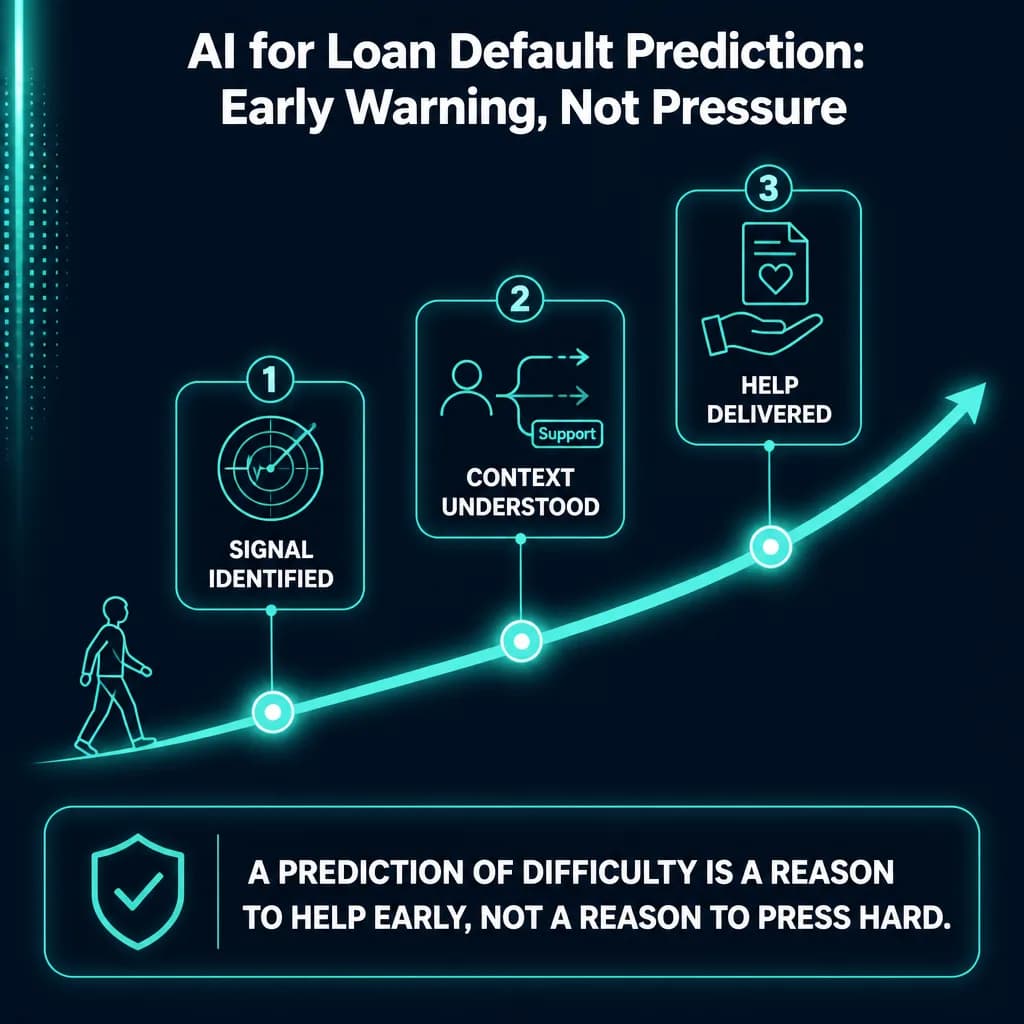
Here is the stance I would hold. The value of default prediction is in enabling early, appropriate intervention that helps borrowers stay on track, and the type of intervention the prediction drives matters as much as the accuracy of the prediction itself, because directing the wrong intervention at a predicted-difficulty borrower can cause the harm the prediction was meant to prevent. A system that predicts default well and responds with premature collections pressure has turned an early-warning capability into a mechanism for pushing struggling borrowers toward default, which is the opposite of its purpose. The prediction should trigger support and appropriate engagement, and the design has to ensure the intervention fits the borrower’s situation rather than defaulting to escalation.
The reasoning is about what happens when a lender acts on predicted difficulty. A borrower the model flags as likely to default is often a borrower under financial stress who might recover with support, or might be pushed further by pressure, and the intervention the lender chooses determines which. Early, supportive engagement, outreach, a restructuring offer, a payment plan, can help such a borrower stay on track, while premature collections pressure can accelerate the decline, damaging a borrower who might have recovered and potentially causing the default the model predicted. So the prediction is only valuable if it drives the right kind of intervention, and a system that routes predicted-difficulty borrowers straight into collections escalation has misused the prediction, treating a signal of possible difficulty as grounds for pressure rather than support. The engineering has to connect the prediction to appropriate intervention, distinguishing the borrowers who need support from those where other action fits, and respecting that a prediction of difficulty is a reason to help early, not a reason to press hard.
Engineering inside the constraint
The system predicts default risk and, critically, drives the prediction toward appropriate intervention rather than undifferentiated collections escalation. Borrowers showing early signs of difficulty are routed toward support and engagement, outreach, forbearance where appropriate, restructuring options, so the early warning enables help while help can still change the outcome. The intervention is matched to the borrower’s situation, distinguishing a borrower who needs support from cases where other action is appropriate, so the system does not apply uniform collections pressure to everyone it flags.
The intervention respects the conduct rules governing collections and the fair-treatment obligations owed to borrowers in difficulty, so acting on the prediction does not become a route to premature or inappropriate pressure. The prediction model is monitored for fairness across borrower segments, because a model that flags certain groups disproportionately directs intervention unevenly and imports bias into how borrowers are treated, and the monitoring treats an emerging disparity as a defect to investigate. Every prediction and the intervention it drove are written to a reconstructable record, so the lender can show it acted appropriately and treated borrowers fairly.
The system is evaluated against an explicit standard covering prediction accuracy and the appropriateness of the interventions it drives, and its fairness across segments, operated repeatably as the model changes, which is the work a rubric-based evaluation engine like PRISM is built to carry, so the system is judged not just on whether it predicts default but on whether it drives the right response. Human judgment sits on the intervention decisions for borrowers in difficulty, because deciding how to engage a struggling borrower is a judgment that has to account for the borrower’s actual situation and the fair-treatment obligations, which a person has to own.
Where it almost broke
A lender deployed a default-prediction model and connected it to its collections operation, so loans the model flagged as high default risk were routed into intensified collections activity earlier, on the logic that early action on likely defaults would improve recovery. The model predicted well, and collections engaged flagged borrowers sooner. A review found that for a segment of borrowers who were under temporary stress but likely to recover, the early, intensified collections pressure was counterproductive, adding pressure that pushed some of them toward the default the model had predicted, when earlier supportive engagement might have kept them on track. The system had turned an early-warning signal into a trigger for premature pressure, and the pressure was helping cause the outcome it predicted.
The prediction was accurate and the intervention was wrong, and the mismatch turned early warning into early harm. The fix was to change what the prediction drove, routing borrowers showing early difficulty toward support and appropriate engagement rather than intensified collections, matching intervention to the borrower’s situation, and keeping human judgment on how to engage borrowers in difficulty. The prediction kept identifying at-risk loans, and now it triggered help rather than pressure. A default-prediction system that drives premature collections pressure at borrowers who might recover can cause the defaults it predicts, because pressure on a struggling borrower is exactly what pushes them over.
AI for loan default prediction delivers its value by enabling early, appropriate intervention that helps borrowers stay on track, catching signs of difficulty while support can still change the outcome. That value depends entirely on what the prediction drives, because a system that routes predicted-difficulty borrowers into premature collections pressure can accelerate the very defaults it identifies, turning an early-warning capability into a mechanism of harm. Connecting accurate prediction to appropriate, fair intervention, support for the borrowers who need it rather than pressure that pushes them over, is what makes the early warning worth having.
A lender building default prediction should ask not just how accurately its model predicts but what intervention the prediction triggers and whether that intervention helps or harms the borrowers it flags. An early-warning system that pressures struggling borrowers toward the default it predicted is not an outcome that survives scrutiny.
This piece touches on financial difficulty and its consequences for borrowers. Anyone struggling with debt has the right to fair treatment and to ask their lender about forbearance and support options.
Related: Banking & Financial Services · Reserve Bank Innovation Hub: Automated grievance workflows with natural-language access and a complete audit record · IndusInd Bank Limited: AI-Powered Knowledge Source-Based Process Training and Query Resolution
Tell us the number you need to move.
…outcomes that survive scrutiny.