AI for Pharma Medical Information: Accurate Answers to Clinicians at Scale
At eleven at night, a nephrologist emails a pharmaceutical company's medical information team. She has a patient with reduced kidney function and wants to know whether the company's drug needs a dose adjustment, and whether there is any data in patients on dialysis. Further down the message, almost in passing, she mentions that the patient developed a rash after the previous dose. The medical information team owes her an accurate, balanced answer drawn from approved sources. It also owes the company's pharmacovigilance function a report of that rash. Pharma medical information AI can help with the first obligation only if it never lets the second slip.
What makes a medical information answer different
Medical information teams answer unsolicited questions from healthcare professionals about the company's products. Their answers are scientific, distinct from promotion. They draw on the prescribing information and the company's approved standard responses, and they present the evidence as it stands, including its gaps. When a doctor asks about a use the product is not approved for, a medical information team may provide balanced scientific information in reply, which a sales representative may never do.
The work has a regulatory spine. Every enquiry and response is documented, and every response must be traceable to its sources. Most importantly, enquiries often contain safety information. A doctor describing a side effect or a patient mentioning a reaction can each trigger a pharmacovigilance obligation, whatever the question they were actually asking.
Volume makes this harder each year. Enquiries arrive through email, phone, websites and field-force referrals, in several languages, and many teams answer them with a small group of pharmacists and physicians.

Grounded answers drawn only from approved sources
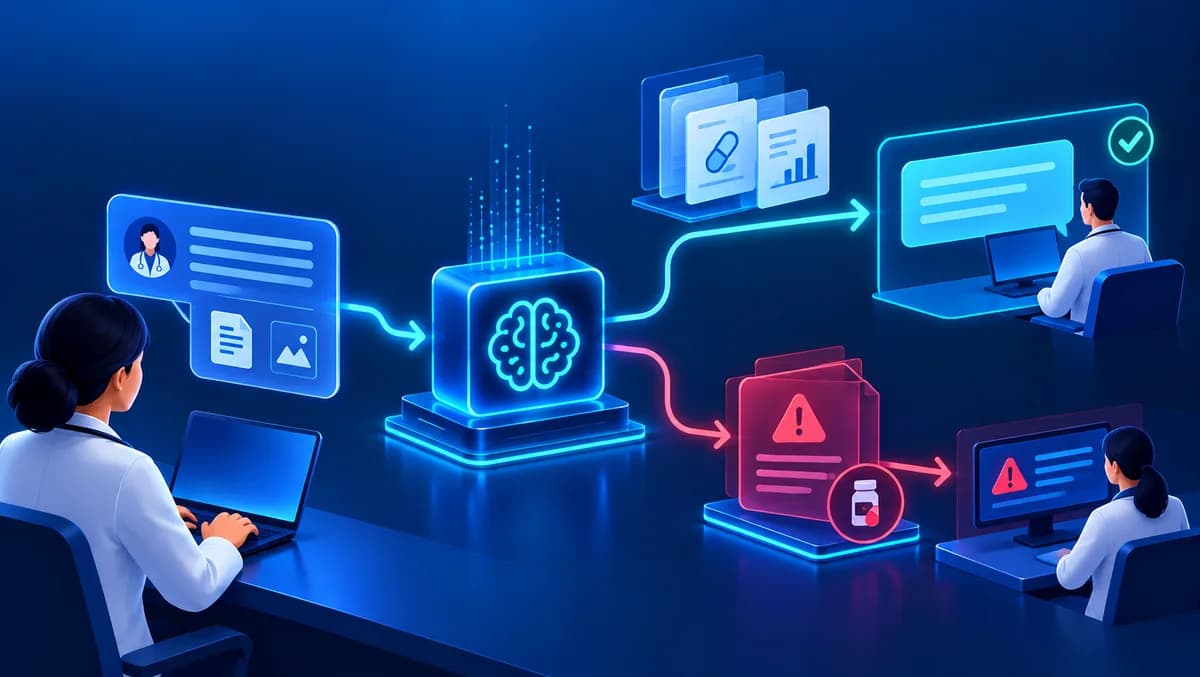
The assistant works from a closed corpus of approved documents, such as the current prescribing information and the company's standard responses. It never draws on open web content. Given an enquiry, it drafts a response from the retrieved passages and cites every statement to its source document and section.
The draft goes to a medical information professional, who reviews it against the sources before approving it. For the nephrologist, the draft would set out what the prescribing information says about renal impairment and note whether any dialysis data exists. Where the evidence is thin, the draft says so plainly instead of filling the gap with a plausible inference.
Version control matters as much as retrieval quality. When the prescribing information changes, the corpus changes the same day, and standard responses that cite the old version are flagged for review. An enterprise knowledge hub and reasoning engine such as COMPASS is engineered for this kind of work, answering from an approved body of knowledge and showing exactly where each answer came from.
Catching adverse events inside ordinary questions
The more important function of the system has nothing to do with drafting. Every enquiry, including its attachments, is screened for possible adverse events: an identifiable patient, a suspect product, an event and a reporter. Any enquiry that may contain one is routed to pharmacovigilance immediately, independent of the draft response, so a safety report never waits on a scientific reply.
Screening should be deliberately sensitive. A false alarm costs a pharmacovigilance associate a few minutes; a missed adverse event is a regulatory failure and, more importantly, lost safety information. The reviewer approving each response also confirms whether a safety event is present, and the medical information log is reconciled against pharmacovigilance intake every week.
The adverse event inside a dosing question
A company introduced assisted drafting for medical information and saw response times fall within weeks. Its adverse-event screening flagged enquiries that described side effects directly. An enquiry much like the nephrologist's arrived, framed entirely as a dosing question, with the rash mentioned in a subordinate clause near the end.
The screening model scored it below threshold, because the message's main subject was dosing and the event was described as background. The draft response itself was accurate and well sourced. The medical information pharmacist reviewing it read the full message, noticed the rash and opened a safety case the same morning, well within the required timeline.
The team made the screening independent of the enquiry's topic. Every sentence is now assessed on its own for the elements of an adverse event, and a mention of any reaction in a patient taking the product is enough to route the case. The reviewer's confirmation became a required field that cannot be skipped, and the weekly reconciliation now samples enquiries the screen did not flag.
The nephrologist deserves a fast, sourced answer, and the patient deserves to have that rash recorded where safety scientists will see it. AI can serve both, provided the approved corpus stays current and safety screening is treated as the system's first duty. A head of medical affairs should ask how many adverse events reached pharmacovigilance through medical information last quarter, and how many were found only at review. A function that can answer with evidence protects patients with outcomes that survive scrutiny.
Related: Healthcare & Life Sciences · Koita Foundation: An AI-powered knowledge hub with citation-backed retrieval across seven repositories
Tell us the number you need to move.
…outcomes that survive scrutiny.