AI for Prior Authorisation: Speeding Approvals Without Wrongful Denials
A patient’s treatment waits on a fax. Somewhere between the physician who ordered it and the payer who must approve it, a prior authorisation request sits in a queue, and every day it sits, a person who needs care does not get it. Prior authorisation exists for a real reason: to confirm that an expensive or risky intervention is clinically appropriate before it is paid for. The process has become a notorious source of delay, clinician burnout, and abandoned treatment. AI promises to clear the queue. The question that determines whether it helps or harms is which decisions, exactly, you let it make.
Prior authorisation is two decisions, and they are not symmetric. An automated approval that turns out lenient costs money. An automated denial that turns out wrong can cost a patient their treatment. Any system that treats those two outcomes as mirror images of each other has misunderstood the problem before it has processed a single request.
Why the asymmetry is the whole design
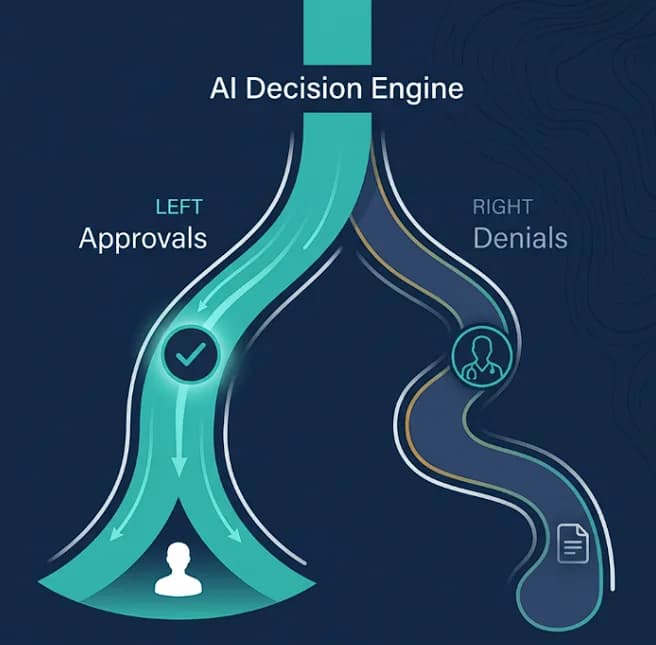
The instinct is to build one model that decides: approve or deny, faster than a human reviewer. That instinct is wrong, and the reason is consequential in place of technical.
When the system approves, the downside is bounded and financial. A few approvals that a stricter reviewer would have questioned cost the payer some money, recoverable, auditable, the kind of risk an insurer is built to absorb. When the system denies, the downside is a patient who does not receive a treatment a clinician judged necessary, who must now either go without or mount an appeal through a process designed to be slow. One of these errors is a line item. The other is a person harmed and a regulator’s attention earned.
So the design principle follows directly, and it is the position many automation vendors will not lead with: AI should be allowed to approve far more readily than it is allowed to deny. The safe, high-value deployment automates the approvals, the clear-cut requests that meet criteria unambiguously, and routes anything approaching a denial to a human. Speeding the yeses is where almost all the patient and clinician benefit lives, and it carries almost none of the harm.
What the model is actually good at, and where it must stop
A prior authorisation model learns to match a request against coverage criteria and clinical guidelines. For the large volume of requests that plainly satisfy those criteria, this is genuine, useful work: the model can recognise a clean approval as reliably as it can recognise a clear pattern, and clearing those instantly removes most of the delay clinicians and patients feel.
The boundary is the ambiguous case, the request that does not cleanly meet criteria but reflects a clinician’s judgment that this patient, with this history, needs this intervention anyway. That judgment is exactly what a criteria-matching model cannot evaluate. It does not know the patient. It knows the rule, and the patient who needs an exception to the rule is the one a model will most confidently deny. The clinical-appropriateness call that justified a prior authorisation process in the first place is the call that cannot be delegated to the thing matching strings against a guideline.
This is why a denial is a clinical decision wearing administrative clothing, and clinical decisions require clinical accountability. A denial that affects care should carry the name of a qualified human who made it and can defend it, and the point stands well beyond whatever regulation requires it, because the accountability for a care-affecting decision is not transferable to a model. The load-bearing control is the human reviewer standing behind every denial. Automate the queue around them, and keep the reviewer in place.
The trade-off, named plainly
Here is the cost. Routing every potential denial to a human means the system does not eliminate human review, it concentrates it. The efficiency gain is real but asymmetric: the easy approvals clear instantly, while the hard cases still need people, and arguably need more skilled people than before, because the easy work that used to pad a reviewer’s day is gone. The reviewer’s queue becomes uniformly difficult.
A vendor selling full automation will quietly promise to remove that cost. They can only do so by letting the model deny, which trades a financial liability for a patient-harm liability and an appeals process that, at scale, regulators notice. The honest framing is that AI compresses the timeline dramatically for most requests and leaves the hardest decisions where they belong. That is the correct shape of automation in this domain, and the framing of it as a failure sits well outside what is actually happening.
Designing the appeal and audit path before you need it
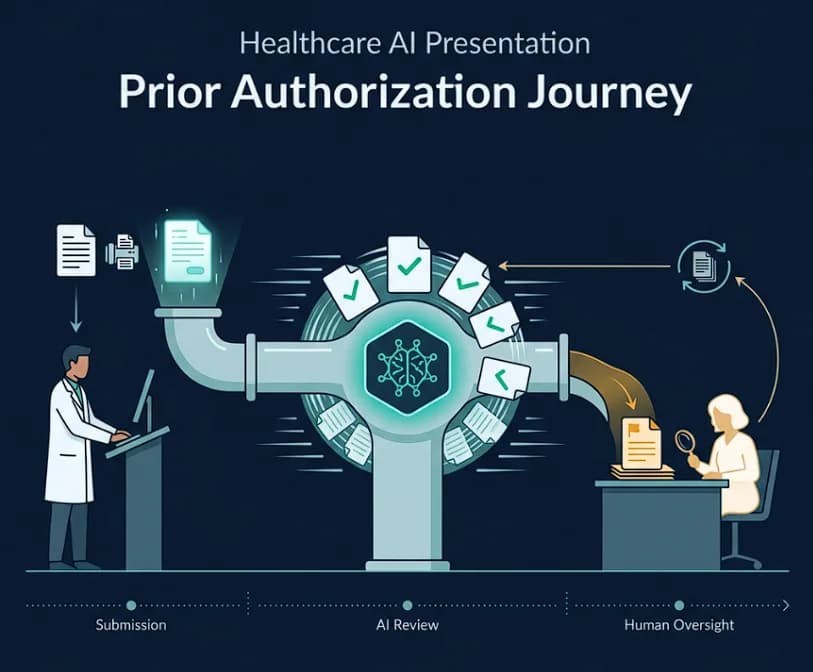
A system that denies, even with a human in the loop, will sometimes deny wrongly, and the measure of the system is what happens next. Every denial needs a reason a clinician can read, a record of the criteria applied, and a path to appeal that is faster than the harm it might cause. Building an audit trail that can reconstruct what the system saw and why it decided is what turns a contested denial from a regulatory incident into an explainable one, and the compliance framing sits well below what it is actually doing. The override and appeal path is the safety mechanism, and it should be engineered with the same care as the approval flow.
Where it almost breaks
A health plan deploys an AI system to clear its prior authorisation backlog, and to maximise the efficiency gain, lets the model issue denials for requests that fall below a confidence threshold for approval. Turnaround times collapse; the backlog clears. Then a pattern surfaces in the appeals data: a particular category of requests, patients whose clinical situation justified an off-guideline intervention, was being denied in volume, and a high share of those denials were overturned on appeal. The model had been confidently denying exactly the cases that most needed a human: the medically necessary exceptions to the rule. Each denial had delayed care for a patient who ultimately got it anyway, slower and after an appeal. The fix was structural. The system was restricted to automating approvals only, every denial was routed to a clinical reviewer, and the oversight was placed precisely where the consequence lived. Turnaround for approvals stayed fast. The wrongful denials stopped.
AI in prior authorisation can give clinicians and patients back most of the time the process steals, on the condition that it is pointed at the right half of the decision. Clearing the clean approvals instantly is enormous, achievable value with little downside. Letting a model issue denials trades a recoverable financial risk for an unrecoverable human one, and it does so on exactly the cases where the model is least equipped to judge and most confident that it can.
The question worth bringing to any prior authorisation system is not how much faster it makes the queue. It is whether it speeds the approvals while keeping a clinician accountable for every denial, and whether the path to appeal a wrong decision is faster than the harm that decision could do.
Related: Healthcare & Life Sciences · Koita Foundation: An AI-powered knowledge hub with citation-backed retrieval across seven repositories
Tell us the number you need to move.
…outcomes that survive scrutiny.