AI for Regulatory Reporting and Reconciliation: Accuracy You Can Defend
Regulatory reporting is where a bank tells its supervisors the truth about itself, on a schedule, in a prescribed form, with penalties for getting it wrong. Capital positions, liquidity ratios, transaction reports, large-exposure returns, all of it flows from source systems through reconciliation and aggregation into submissions that examiners read as statements of fact. The work is enormous, repetitive, and unforgiving, and it consumes armies of people who spend their days matching balances, chasing breaks, and assembling figures under deadline. AI promises to lighten that load, automating the reconciliation and the assembly so the people can focus on the exceptions that need judgment. The promise is real and the efficiency is substantial. The constraint is that a regulatory submission is not just a number the bank reports. It is a number the bank must be able to defend, tracing every figure back through every transformation to the source records that produced it, and any automation that improves the number while obscuring its lineage has made the bank faster and less defensible at the same time.
The distinction most efficiency pitches miss is between producing a report and being able to prove it. A correct submission the bank cannot trace is, in an examination, indistinguishable from a lucky guess, and supervisors do not accept lucky guesses.
The constraint that owns the workflow
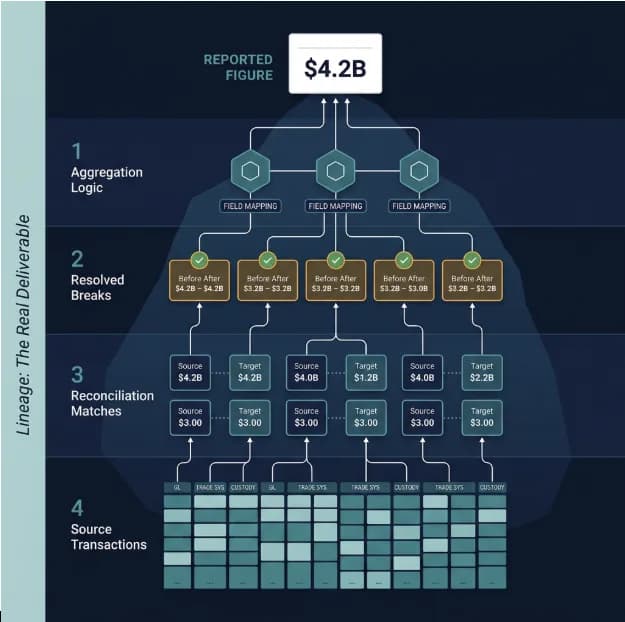
Regulatory reporting sits under obligations that are unusually literal. Reports must be accurate and complete, filed on time and in the prescribed format, and the bank is accountable for errors regardless of whether a person or a system produced them. Beyond the number itself, the bank must be able to demonstrate how each figure was derived, which means data lineage, the traceable path from source record through every reconciliation, adjustment, and aggregation to the reported line, is a first-class regulatory requirement rather than an internal nicety. Reconciliation breaks have to be identified, explained, and resolved, not silently absorbed, because an unexplained break is a hole in the number’s provenance. And the whole apparatus has to hold under audit, because reporting is examined with the assumption that any figure may be selected and traced back to its origin.
The failure modes are specific and severe. A materially wrong submission, which draws penalties and erodes supervisory trust in every other number the bank reports. A break that is silently netted or absorbed rather than investigated, which corrupts the figure’s provenance even when the top-line number happens to be right. And the failure that turns an efficiency gain into an audit finding: a report the bank cannot trace back to source, where automation compressed the derivation into a black box and the lineage that would defend the number no longer exists in a form anyone can follow.
The position: lineage is the deliverable, the number is a byproduct
Here is the stance I would hold against the way reporting automation is usually sold. The pitch is almost always about effort reduction, fewer people matching fewer balances, faster close, lower cost. That framing treats the report as the deliverable and the lineage as overhead. In regulatory reporting the priority is inverted. The defensible lineage is the deliverable, and the number is what falls out of a well-traced process. An automation that produces the right number without preserving the lineage has automated the wrong thing, because the moment an examiner asks how a figure was derived, a number without a traceable path is a liability, not an asset.
The reasoning is about what reporting is for. A bank does not report to inform itself; it reports to let supervisors verify its condition, and verification means tracing. A reconciliation process that a human performed left a trail of matched records, investigated breaks, and documented adjustments, and that trail was the evidence the number was right. If automation replaces the human but not the trail, the bank has kept the number and thrown away the proof. So the engineering objective is not simply to reconcile faster. It is to reconcile in a way that produces richer, more complete lineage than the manual process did, so that automation makes the number both faster to produce and easier to defend. Efficiency that costs lineage is not efficiency in this domain. It is deferred exposure.
Engineering inside the constraint
The architecture treats lineage as an output the system generates as it works, not a reconstruction assembled afterward. Every reconciliation match, every break, every adjustment, and every aggregation step is recorded with its inputs and its rationale, so the path from source record to reported figure is captured continuously as the process operates. A complete, reconstructable data-lineage record is what lets the bank take any reported line, select it, and walk it back through every transformation to the source transactions that built it, which is precisely what an examiner will ask it to do.
Automation earns its place in the matching and the break identification. The system reconciles at scale, matching records across sources far faster and more consistently than manual work, and it surfaces the breaks, the items that do not reconcile, with the context an analyst needs to investigate them. Breaks are never silently netted or absorbed, because a break that disappears without explanation is a gap in provenance the bank cannot defend. Every break is either resolved with a documented rationale or escalated, and the resolution becomes part of the lineage. The system narrows the human’s work to the exceptions that genuinely need judgment, which is where the effort reduction actually comes from, without removing the human from the exceptions that matter.
The figures the automation produces are validated against expected relationships and prior submissions, so an anomalous number is caught before it is filed rather than after an examiner finds it. This is where an explicit evaluation standard earns its place: the reporting pipeline is scored on accuracy, completeness of lineage, and correct break handling, repeatably, every time a data source or a transformation rule changes, so a change to the pipeline is re-validated against the full standard rather than trusted because the top-line number looked plausible. Making that validation repeatable is the work a rubric-based evaluation engine like PRISM is built to carry. Human oversight stays on the exceptions, the material adjustments, and the final sign-off, placed by consequence so a person owns the figures that carry the most regulatory weight and the automation handles the volume that does not need judgment. Automating self-healing reconciliation while preserving the full trail is the kind of end-to-end process work a self-healing process automation layer like FORGE is built to carry, resolving routine breaks by rule while writing every resolution into the lineage the bank will later have to defend.
Where it almost broke
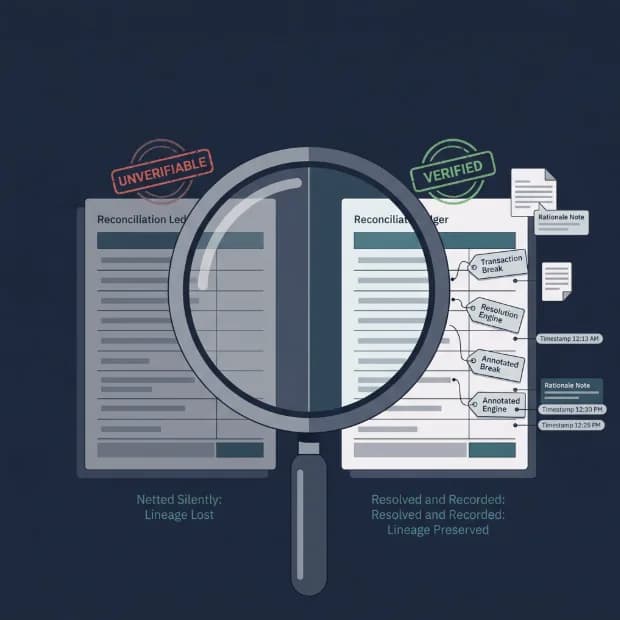
A bank automated a reconciliation process and cut the effort dramatically, closing faster and freeing a team that had spent its days matching balances by hand. The system was efficient and the numbers reconciled. To keep the process clean, it was configured to auto-resolve small breaks below a materiality threshold, netting them out so analysts only saw the larger ones. It worked as designed, and the reports were accurate to the penny at the top line. Then an examination selected a reported figure and asked the bank to trace it to source. The trace operated cleanly until it hit the auto-resolved breaks, where the system had netted differences without recording what they were or why they netted. For those items, the lineage simply stopped. The number was right, and the bank could not prove it, because the automation had absorbed the very breaks whose resolution was the evidence.
The fix was not a better matching engine. It was to record every break and every resolution, however small, into the lineage, so that auto-resolved items carried their rationale rather than vanishing into a net figure. The materiality threshold could still govern which breaks a human reviewed, but it could not govern which breaks were traceable, because in reporting everything has to be traceable regardless of size. A reconciliation that resolves breaks without recording them has automated away the proof, and a number you cannot prove is a number you cannot defend.
AI for regulatory reporting and reconciliation can retire a vast amount of repetitive, deadline-bound work, matching at scale, surfacing the breaks that need attention, and letting skilled people concentrate on the exceptions and the judgment. That efficiency is only worth having when the automation strengthens the lineage rather than dissolving it, so every figure the bank files can be traced, break by break and transformation by transformation, back to the source records that produced it. The number is what the bank submits. The lineage is what the bank defends, and a reporting process that produces the first without the second has made the bank faster on the day and weaker in the examination.
If you are automating a reporting or reconciliation process, the question that matters is not how much effort it removes. It is whether, for any figure you file on any day, you could trace it end to end to source and account for every break along the way. Accuracy you cannot trace is not accuracy a bank can stand behind, and a submission you cannot defend is not an outcome that survives scrutiny.
Related: Banking & Financial Services · Reserve Bank Innovation Hub: Automated grievance workflows with natural-language access and a complete audit record · IndusInd Bank Limited: AI-Powered Knowledge Source-Based Process Training and Query Resolution
Tell us the number you need to move.
…outcomes that survive scrutiny.