AI for Regulatory Submissions in Pharma: Accelerating Filings You Can Defend
A regulatory submission is a promise. Every claim in it is one the company will have to stand behind, in front of an agency whose job is to test whether the promise holds. This is the environment AI enters when it is pointed at the submission process, and it is unlike almost anywhere else these tools get used. The goal is not a faster document. It is a faster document that survives regulatory examination without a single unsupported or unverifiable claim in it. A submission assembled quickly and defended poorly is worse than a slow one, because the delay a slow submission costs is measured in weeks, and the damage a flawed one causes is measured in the agency’s trust, which does not come back on a schedule.
The framing error is treating a submission as a document-production problem. Teams see the enormous manual effort of assembling a regulatory filing, thousands of pages drawing on years of study data, and reach for AI to compress it. The compression is real and worth having. But the value of a submission is not that it exists. It is that every claim in it is traceable to evidence, consistent with every other claim, and defensible under questioning. AI can accelerate the assembly. Whether it preserves the defensibility is a separate question, and it is the question that determines whether the acceleration was worth anything.
Why speed is the easy half of this problem

The submission process is slow for reasons that look like inefficiency and are partly something else. Yes, there is genuine manual labor in assembling, formatting, and cross-referencing a filing, and AI can remove much of it. Drafting sections from structured study data, checking cross-references, ensuring consistency of terminology across thousands of pages: this is real work that a model does faster and more consistently than a team of people, and pointing AI at it is legitimate value with manageable risk.
But some of the slowness is not inefficiency. It is verification. The reason a submission takes as long as it does is partly that every claim in it is checked against its source, every number reconciled to the study it came from, every statement confirmed to be supported. That verification is not overhead to be optimised away. It is the process that makes the submission defensible. A model that accelerates the assembly without preserving the verification has sped up the part that was slow for bad reasons and skipped the part that was slow for good ones. The result looks like a submission and is missing the property that makes a submission worth filing.
So the honest measure of AI in this process is not how much faster the document gets produced. It is whether the accelerated document is as defensible as the slow one was. A filing generated in half the time with claims that cannot be traced to evidence has not accelerated the submission. It has manufactured a liability that presents as progress.
The specific danger of a model that writes confidently
There is a failure mode that makes regulatory submissions a particularly unforgiving place for generative AI, and it has to be named directly. A language model produces fluent, confident text, and it can produce a claim that reads as authoritative and is not supported by the underlying data. In most contexts, a plausible-but-unsupported sentence is a minor error. In a regulatory submission, it is a claim the company will be asked to defend and cannot, because the evidence for it does not exist. The model did not lie. It generated a statement that fit the pattern of the surrounding text, and pattern-fitting is not the same as evidence.
This is why the traceability of every claim to its source is the load-bearing control of the entire process. A model can draft a section, but every assertion in that draft has to be verifiable against the actual study data, and the system has to make that verification possible rather than assumed. The distinction between a fluent output and a defensible one is the whole game here. A submission where the claims read well but cannot each be traced to evidence is exactly the artifact that fails under an agency’s questioning, and it fails worse for having looked complete.
The accountability follows directly. The qualified regulatory professionals who submit the filing own every claim in it, and that ownership cannot transfer to a model that generated the text. The model drafts; the humans verify and attest. Keeping that boundary intact is what separates AI that accelerates a defensible submission from AI that produces an indefensible one faster.
The trade-off, named plainly
Preserving defensibility means the AI does not remove the verification step. It relocates the human effort from assembly to checking. The team spends less time producing the document and, ideally, no less rigour confirming that what the model produced is supported. The efficiency gain is real, but it is a gain in the assembly, not in the verification, and a program that claims to have accelerated both has almost certainly cut the verification that makes the filing defensible.
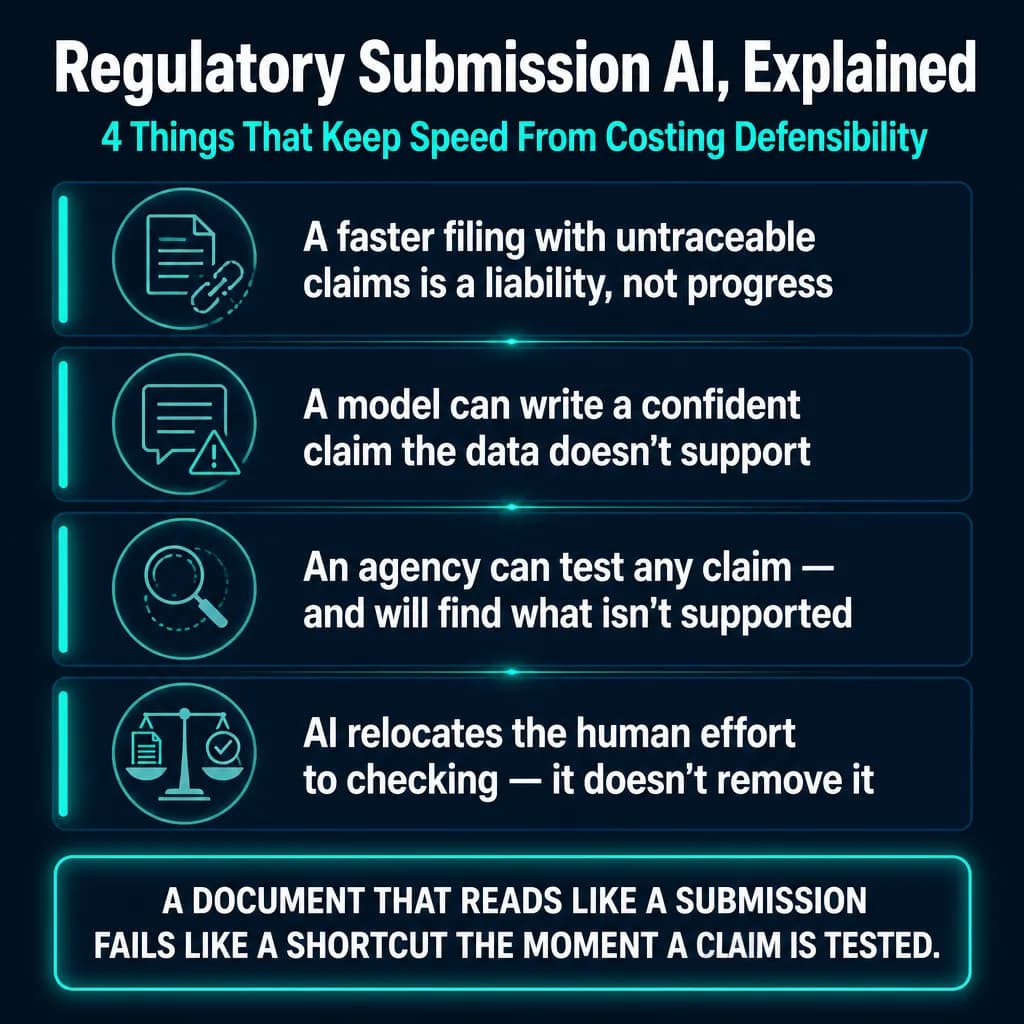
The position worth stating against the full-automation pitch: AI should accelerate the drafting of a regulatory submission and change nothing about the requirement that every claim be verified against evidence before the filing goes out. A vendor promising to automate the submission end to end, verification included, is promising to remove the control that keeps the filing defensible. That is not speed. It is the substitution of a document that reads like a submission for one that can withstand an agency’s examination. The verification is not the slow part to be eliminated. It is the part the whole exercise exists to satisfy. Building the audit trail that traces every claim to its source as a first-class component, so verification is fast rather than skipped, is the engineering that makes acceleration and defensibility compatible.
Where it almost breaks
A pharmaceutical company deploys AI to accelerate its regulatory submissions, and to maximise the gain, lets the model generate substantial sections of narrative from the study data with light human review. The submissions come together dramatically faster. Then an agency query arrives on a specific claim in a filing, asking for the evidence behind a statement in a generated section. The team goes to trace it and finds that the claim, while plausible and consistent with the surrounding text, was not actually supported by the underlying data. The model had produced a well-formed sentence that fit the pattern, and the light review had not caught that it lacked evidence. Nothing had been fabricated deliberately. The verification that would have caught it had been treated as the slow step to compress. The correction was to keep the model drafting but require every claim to be traced to its source before filing, engineer the traceability so verification was fast enough not to erase the time saved, and keep regulatory professionals accountable for every assertion. The submissions stayed faster than before. They regained the property that made them worth submitting.
AI for regulatory submissions can compress the enormous manual effort of assembling a filing, drafting from study data, and maintaining consistency across thousands of pages, and that compression is genuinely valuable. It delivers that value only when it preserves the property a submission exists to have: every claim traceable to evidence, verified before filing, owned by the professionals who attest to it. A model pointed at the assembly and allowed to skip the verification produces a document that reads like a submission and fails like a shortcut the moment an agency tests a claim.
The question to bring to any submission AI is not how much faster it produces the filing. It is whether every claim in the accelerated document can be traced to its evidence as reliably as in the slow one, and whether the people who sign the submission can defend each one. That is the difference between a faster filing and filings you can defend.
Related: Healthcare & Life Sciences · Koita Foundation: An AI-powered knowledge hub with citation-backed retrieval across seven repositories
Tell us the number you need to move.
…outcomes that survive scrutiny.