AI for Treasury and Cash-Flow Forecasting: Forecasts Finance Will Trust
Treasury operates on forecasts, and forecasts are only useful if the people acting on them believe them. A cash-flow projection drives decisions with real money attached: how much liquidity to hold, when to borrow, where to place surplus, how much buffer to keep against a shortfall. Machine learning can sharpen these forecasts, reading patterns across accounts, seasons, and behaviors that spreadsheet models miss. The sharper forecast is worth real money in reduced borrowing costs and better-deployed liquidity. The obstacle is not accuracy in the abstract. It is trust. A treasurer who cannot see why a model produced a number, and who has watched it miss once without warning, will quietly revert to the spreadsheet they understand, and the sophisticated model becomes shelf-ware. AI for treasury and cash-flow forecasting is the discipline of producing forecasts that finance will actually act on, which means engineering for explainability and calibrated confidence alongside accuracy.
The mistake teams make is optimising the forecast error and assuming adoption follows. It does not. A model that is more accurate on average but occasionally, silently, badly wrong is worse for a treasurer than a simpler model whose behavior they can anticipate, because treasury decisions are asymmetric and a surprise miss on the downside can be expensive.
A forecast nobody acts on is not a forecast

Treasury forecasting sits under obligations and realities that shape how a model has to behave. Liquidity risk management requires the firm to understand and defend its liquidity position and the assumptions behind it, so a forecast that drives liquidity decisions has to be explainable to the people who own that risk and, where relevant, to supervisors who examine it. The assumptions in a forecast have to be visible and challengeable, because a liquidity decision resting on a black-box number is one the firm cannot defend when it matters. Forecasts feed real decisions with real cost, so a confident forecast that is wrong carries a direct financial consequence rather than an academic one. And treasury is a domain where the cost of being wrong is not symmetric, because falling short on liquidity is far more damaging than holding a little too much.
The failure modes follow from this. A forecast that is accurate on average but occasionally wrong without any signal it might be, which is the failure that destroys a treasurer’s trust the first time it happens. A model whose reasoning is opaque, so finance cannot challenge or defend the assumptions and will not stake a decision on it. And the calibration failure, where the model expresses the same confidence whether the situation is routine or unusual, so its confidence carries no information about when to trust it.
The position: a forecast finance ignores has no value, however accurate
Here is the stance I would hold against the accuracy-first framing. A treasury forecast delivers zero value if finance does not act on it, and finance acts on forecasts it trusts. Explainability and calibrated confidence are load-bearing features, and adding them after the accuracy is dialed in is already too late. The most accurate model in the world is worthless if the treasurer reverts to their spreadsheet because they cannot see inside it or cannot tell when it is guessing. Trust is the product. Accuracy is one input to it.
The reasoning is about how treasury decisions actually get made. A treasurer is accountable for the liquidity position, and accountability makes people conservative about what they rely on. Given a number they cannot explain, they will discount it, hedge against it, or ignore it, all of which erase the model’s benefit. Given a number they can decompose, whose drivers they can see and challenge, and whose confidence tells them honestly when the model is on familiar ground and when it is extrapolating, they will act on it and act on it appropriately. The engineering effort, then, has to go substantially into making the forecast legible and its uncertainty honest, because those are what convert accuracy into decisions. A model that is a black box will be trusted once, doubted after its first miss, and abandoned after its second.
Showing the drivers behind every projection
Explainability has to be built into the forecast, so every projection comes with its drivers: what the model is expecting and why, which patterns and inputs are pushing the number where it landed. A treasurer looking at a forecast should be able to see that it reflects, say, an expected seasonal inflow plus a large known receivable minus a recurring outflow, and to challenge any of those components against their own knowledge. This decomposition is what lets finance own the forecast rather than merely receive it, and it is what makes the number defensible when a decision built on it is questioned later.
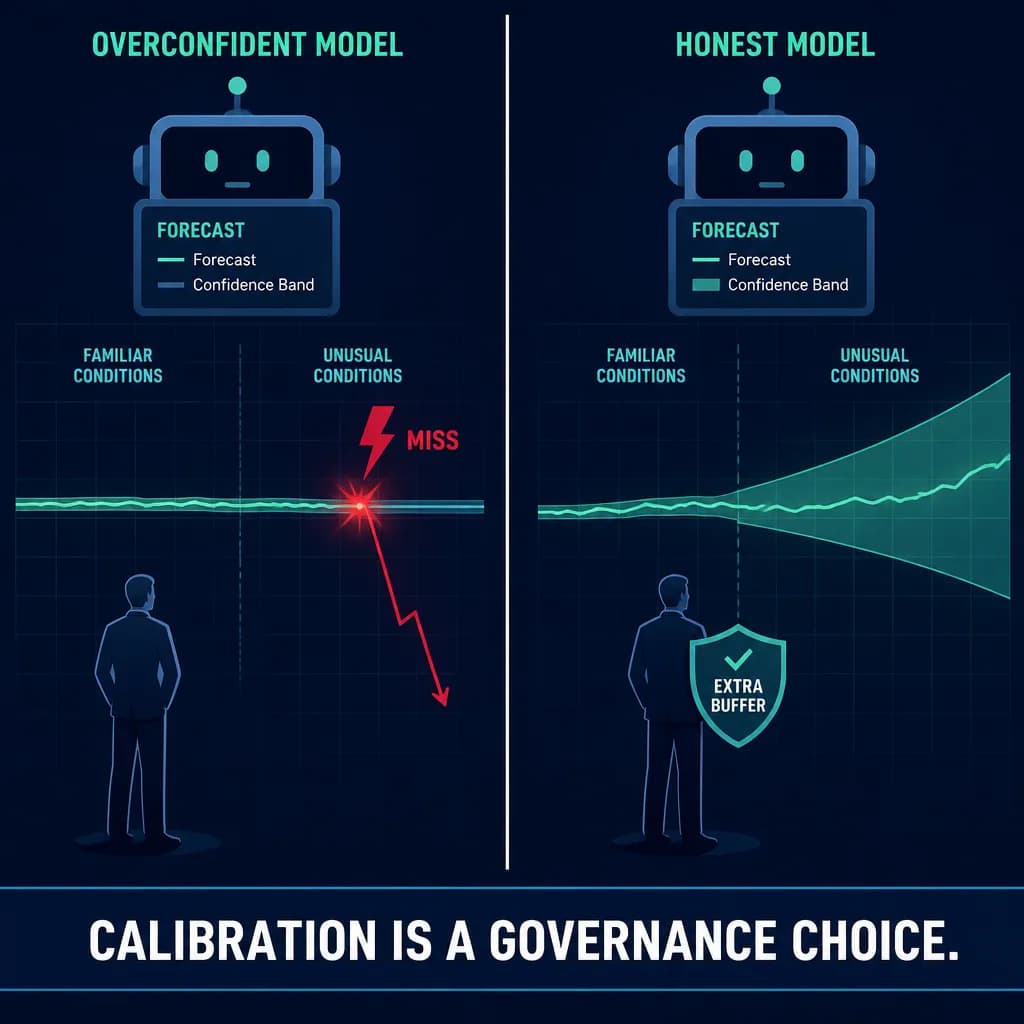
Calibrated confidence is the second load-bearing feature. The forecast has to express uncertainty honestly, widening its range when the situation is unusual or the model is extrapolating beyond what it has seen, and narrowing it when conditions are familiar. A confidence interval that means what it says gives the treasurer exactly the signal they need, telling them when to rely on the point estimate and when to hold extra buffer because the model itself is unsure. Given treasury’s asymmetric costs, this honest uncertainty matters more than a tight average error, because it lets the treasurer manage the downside the model is warning them about.
Every forecast, its drivers, and its actuals are written to a record, so the model’s performance is tracked over time and the firm can show how its forecasts were produced and how they held up. This is where evaluation earns its place: the model is scored not only on average accuracy but on the reliability of its confidence intervals and its behavior in unusual conditions, because a model that is well-calibrated and explainable is more trustworthy than one that is marginally more accurate and opaque. Making that evaluation repeatable across retrains is the work a rubric-based evaluation engine like PRISM is built to carry. And the forecast stays advisory to a human treasurer who owns the decision, with the model informing judgment rather than replacing it, which is the right placement of oversight for a number that drives material financial commitments.
The week the model missed a seasonal outflow
A firm deployed an ML cash-flow model that beat its previous forecasting approach on average error by a comfortable margin, and treasury began to rely on it. The model produced point estimates with a fixed confidence band that looked the same in every condition. For months it performed well, and trust grew. Then an unusual period arrived, an atypical combination of large timing shifts and a behavioral change in a major customer segment, and the model, extrapolating well beyond its experience, produced a confident forecast with its usual narrow band. The forecast was badly wrong, treasury had held its buffer at the level the confident number justified, and the firm faced a liquidity squeeze it had been given no warning to prepare for.
The average accuracy had been excellent. The problem was that the model’s confidence carried no information, expressing the same certainty when it was extrapolating as when it was interpolating, so it gave no signal that this particular forecast deserved less trust. The fix was calibration: rebuilding the model to widen its uncertainty honestly when conditions departed from what it had seen, and surfacing that widening to the treasurer as an explicit signal to hold more buffer. After the change, the model was sometimes less precise, and it was trusted more, because its uncertainty finally meant something. A forecast that is confident in exactly the situations it should be humble is worse than one that admits when it does not know.
AI for treasury and cash-flow forecasting can sharpen the projections that drive a firm’s liquidity decisions, and the sharper forecast translates into lower borrowing costs and better-deployed cash. That benefit only materialises when the forecast is one finance trusts enough to act on, which depends on the treasurer being able to see the model’s reasoning and to read its confidence as an honest signal of when to rely on it. Accuracy on its own does not earn that trust. Explainability and calibrated uncertainty do, and they have to be engineered as first-class features rather than added once the error rate looks good.
A firm weighing an ML forecasting model should ask not only how accurate it is on average but whether a treasurer could explain any given forecast and know from the model itself when to doubt it. A forecast that is precise on ordinary days and silently overconfident on the unusual ones is not an outcome that survives scrutiny.
Related: Banking & Financial Services · Reserve Bank Innovation Hub: Automated grievance workflows with natural-language access and a complete audit record · IndusInd Bank Limited: AI-Powered Knowledge Source-Based Process Training and Query Resolution
Tell us the number you need to move.
…outcomes that survive scrutiny.