AI Governance in Financial Services: A Practical Framework for Banks
Most banks treat AI governance as a gate at the end of the runway. A model is engineered, tuned, and demonstrated, and only then handed to a risk function that has never seen it, with a request to approve it for production. The risk function does the responsible thing: it asks for evidence that does not exist yet, sends the model back, and the calendar burns. Six weeks later the same conversation happens again with a slightly different artifact. This is the experience that has convinced an entire industry that governance is what slows AI down.
It isn’t. The delay comes from governing too late, not from governing too much. AI governance in financial services, done as architecture rather than as a checkpoint, is the thing that lets models reach production faster, because the evidence a regulator needs is generated by the system as it operates, in place of being assembled by hand after the fact.
The constraint that owns the workflow

A model that informs a credit, fraud, pricing, or suitability decision is, in the regulated view, a model under model-risk management. That carries obligations the bank cannot negotiate away: the model’s purpose and assumptions must be documented, its performance independently validated before use, its behavior monitored for drift once live, and a named owner held accountable for it. An examiner is entitled to ask, at any point in the model’s life, what it does, why it was approved, how it is performing now, and who is responsible. A bank that cannot answer in a defensible, evidenced way does not have a model problem. It has a governance problem that happens to involve a model.
The mistake is treating these obligations as a report to be written at the end. The report is downstream of the system. If the system was not built to produce the evidence, the report becomes reconstruction, slow and partial, and exactly the kind of after-the-fact narrative that invites a second look.
Governance as architecture, not as paperwork
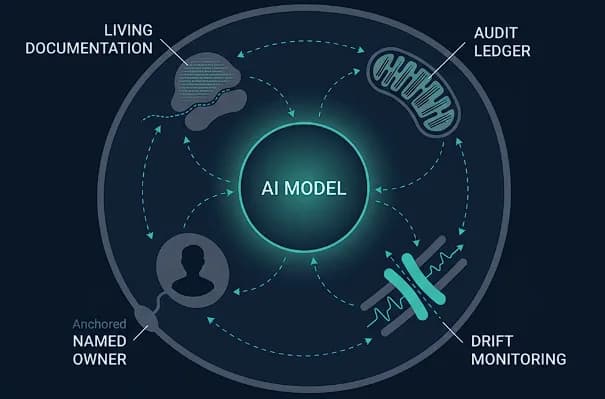
The reframe that makes everything faster is this: every governance obligation is a property the system can be engineered to produce as a byproduct of operating. Documentation, validation evidence, monitoring, and accountability stop being a phase and become outputs of the architecture.
Concretely, that means four things wired in from the start. Each model carries a record of its purpose, training assumptions, and known limits as a living artifact, kept current within the system so it does not drift out of date the moment it is filed. Every decision the model influences is logged with the inputs, the score, and the policy that acted on it, so the audit trail accumulates continuously and is not recovered on demand. Performance and fairness are monitored against defined thresholds with alerting, so drift surfaces as an event and not as a finding in someone else’s review. And a named owner attaches to the model for its whole life, because accountability that is assigned at approval and then orphaned is not accountability.
The position I will defend against the prevailing one: a governance framework should make the compliant path the path of least resistance for the engineering team, so it is chosen naturally in place of being imposed afterward. If doing the governed thing is harder than doing the ungoverned thing, governance has been designed wrong, and no amount of policy will hold under deadline pressure. Build the rails so that the easiest way to ship is also the auditable way, and adoption stops being something you have to enforce.
The piece most frameworks omit: evaluation as a gate
Documentation and monitoring are well-trodden. The part most banks under-build is evaluation, the evidence that the model does what it claims, measured against an explicit, agreed standard in place of a demo. A validation gate is only as strong as the rubric behind it. Scoring a model against a defined set of criteria, including accuracy, stability across customer segments, fairness, and behavior at the edges of its competence, is what converts “the team is confident” into something an independent validator can sign and an examiner can examine. Making that scoring repeatable, versioned, and applied identically to every model change is the work a rubric-based evaluation engine like PRISM is built to carry, so that a retrain is re-validated automatically and never waved through because the headline metric looked fine.
This is also where governance pays back its cost in speed. When evaluation operates as part of the pipeline, a model arrives at the validation gate with its evidence already attached. The gate becomes a review of generated proof in place of a request for proof that does not yet exist. The six-week loop collapses.
Where it almost broke
A bank stood up a governance framework that was, on paper, complete: documentation templates, an approval committee, a monitoring dashboard. It still missed a drift. A model’s input data shifted gradually as an upstream system changed its formatting, and performance decayed slowly enough that no single day looked alarming. The dashboard showed green because the thresholds were set on absolute performance and ignored rate of change.
The fix was structural in place of procedural. Monitoring was re-engineered to watch the trend and the input distribution, going beyond the output metric alone, and to escalate a slow degradation as readily as a sudden one. Governance that only catches cliffs will miss the slopes, and most model failures in production are slopes. A framework is only as good as the failure mode it was designed to see.
A practical framework for AI governance in financial services is not a binder of policies a model must satisfy before it ships. It is an architecture that produces its own evidence, of what the model does, how it was validated, how it is behaving, and who owns it, as a continuous condition of operating. Banks that build it that way find governance does the opposite of what they feared: it shortens the path to production, because the hardest question an examiner can ask is one the system was already answering.
The useful test of any framework is not how much it documents. It is whether, on any given day, you could show what every production model is doing and why it was trusted to do it, and have that answer be an outcome that survives scrutiny.
Related: Banking & Financial Services · Reserve Bank Innovation Hub: Automated grievance workflows with natural-language access and a complete audit record · IndusInd Bank Limited: AI-Powered Knowledge Source-Based Process Training and Query Resolution
Tell us the number you need to move.
…outcomes that survive scrutiny.