AI in Algorithmic Trading: Where Machine Learning Helps and Governance Draws the Line
A trading algorithm places an order in microseconds, and the firm that operates it is accountable for that order as fully as if a trader had entered it by hand. Machine learning promises to make those orders smarter, finding signal in market microstructure that no human could process at speed and optimising execution in ways rule-based logic cannot match. The appeal is obvious to any head of trading watching execution costs and missed opportunities. The hazard is equally real, because a system that can act on the market at machine speed can also manipulate it, destabilise it, or spiral from its operators faster than any human can intervene. AI in algorithmic trading is the discipline of using machine learning where it genuinely helps while drawing a firm governance line around the places where its speed and opacity become a liability the firm cannot afford.
The line matters more than the model. Firms that get this wrong tend to obsess over the sophistication of the signal and treat the controls around it as an afterthought. That ordering is backwards for a system operating in a live, regulated market.
A machine order carries a human signature
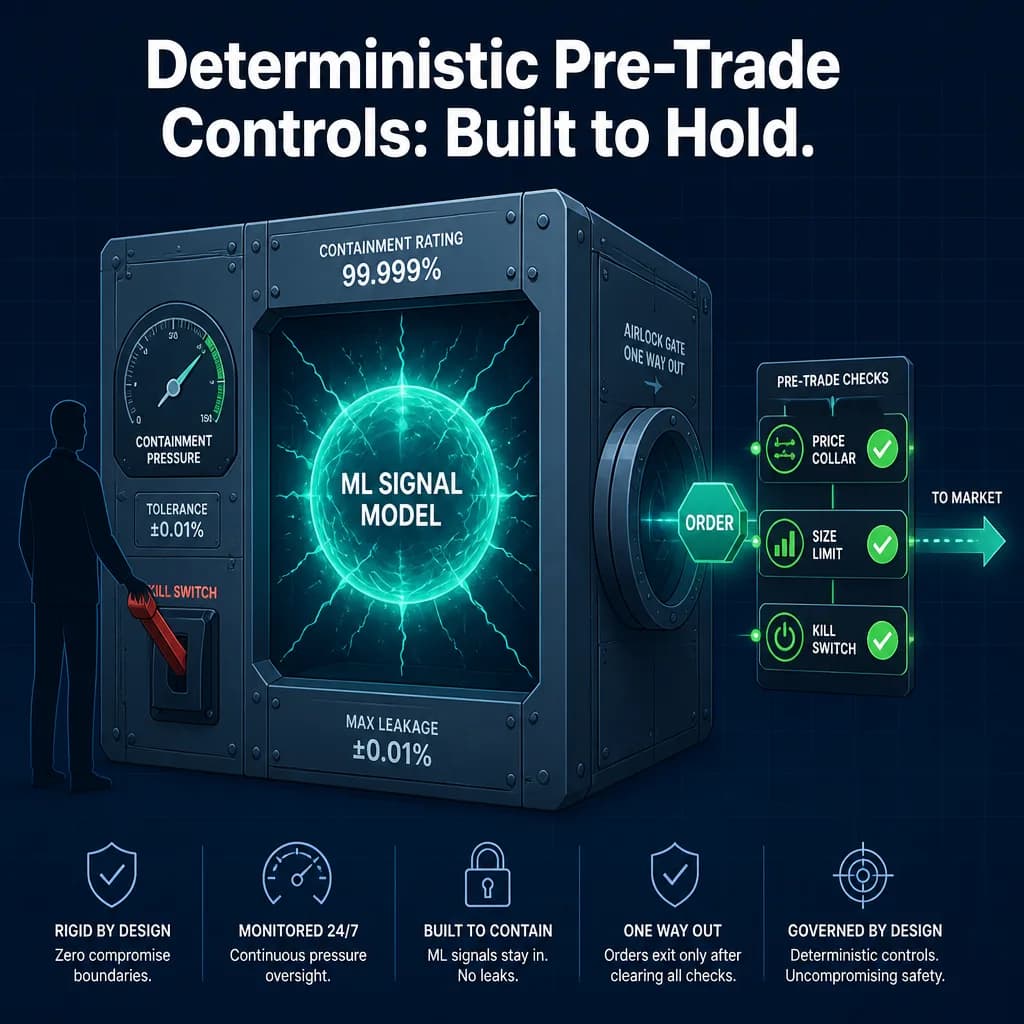
Algorithmic trading sits under obligations that are unusually prescriptive. A firm operating trading algorithms must test them before deployment and after any material change, maintain pre-trade risk controls that stand in front of every order, and have the ability to cancel and halt trading immediately when something goes wrong. Market abuse rules prohibit manipulative behavior regardless of whether a human or an algorithm produced it, so a system that engages in spoofing, layering, or momentum ignition is the firm’s liability even when no one instructed it to. Senior individuals carry personal accountability for the algorithms their firm deploys. And best-execution duties require the firm to demonstrate it acted in the client’s interest, which means the reasoning behind an execution decision has to be reconstructable.
The failure modes regulators pursue are precise and sometimes catastrophic. An algorithm that manipulates the market, whether by design or as an emergent behavior no one anticipated. A uncontrolled algorithm that floods the market with erroneous orders and moves prices before anyone stops it. And the algorithm the firm cannot explain, where an execution or a market impact happened and the firm has no defensible account of why.
Where machine learning earns its place
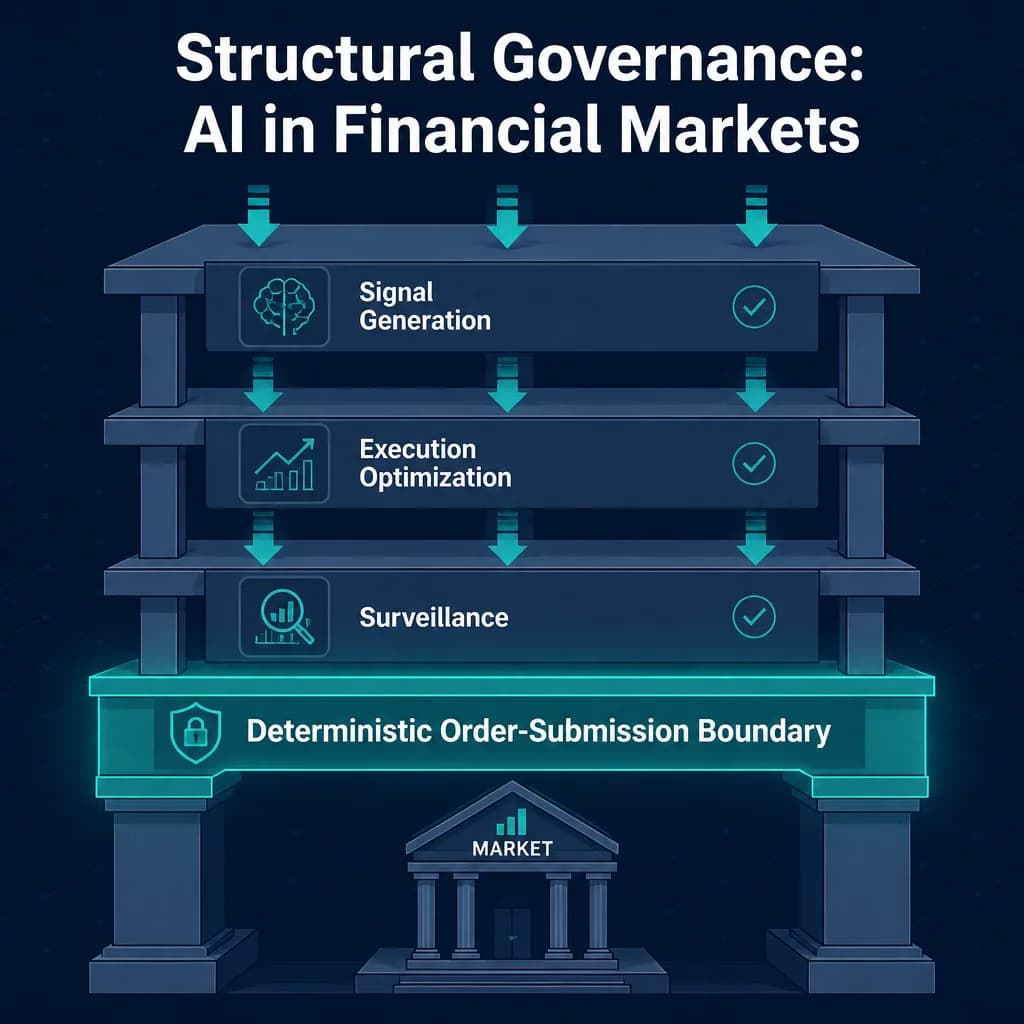
Machine learning contributes most where the problem is genuinely a pattern-recognition problem and the output stays advisory to a controlled execution layer. Signal generation is one such place. A model that reads market microstructure and predicts short-term price movement is doing something rule-based systems do poorly, and its output can inform trading decisions that pass through deterministic controls before reaching the market. Execution optimisation is another. A model that decides how to slice a large order across time and venues to minimise market impact improves a measurable business outcome, client execution cost, without needing unbounded autonomy to do it.
Surveillance is the contribution firms undervalue. The same pattern-recognition capability that generates signal is well suited to detecting manipulative patterns in a firm’s own order flow, catching the spoofing or layering behavior that draws enforcement before it becomes a finding. A firm operating ML on the trading side and ignoring it on the surveillance side has deployed the technology where it creates risk and declined it where it reduces risk.
Where governance draws the line
Here is the position I would hold against the instinct to give the model as much autonomy as its accuracy seems to justify. The governance line belongs at the boundary of order submission, and the controls that sit on that boundary must be deterministic, independently verifiable, and outside the model itself. A machine-learning system can inform what to trade and how to execute. The hard pre-trade checks that decide whether an order is allowed to reach the market, the price collars, size limits, exposure caps, and the kill switch, have to be simple, fast, and auditable, engineered so their behavior is fully predictable under every condition.
The reasoning is about what you can verify. An ML model’s behavior in an unanticipated market state is difficult to prove in advance, because the space of market conditions is unbounded and the model can respond to a novel state in ways testing never surfaced. A deterministic control does exactly what it says under every condition, which is precisely the property you need on the boundary where a mistake reaches the live market at speed. Placing the ML model inside the risk controls rather than the controls inside the model keeps the firm’s ultimate safeguard independent of the component whose behavior is hardest to guarantee. A firm that lets a model bypass or adjust its own pre-trade limits has removed the one control it could actually stand behind.
Instrumenting a decision made in microseconds
Testing has to match the nature of the system. An ML trading model is validated through the model-risk lifecycle before it operates on live flow, with its assumptions documented, its behavior probed under stress and adversarial market scenarios, and a named owner accountable for it. Because the model is non-deterministic and its output space is wide, validation examines the distribution of its behavior and its conduct at the edges. A single happy-path pass proves only that the happy path exists. Making that validation repeatable across every retrain and every material change is the work a rubric-based evaluation engine like PRISM is built to carry, so a model update is re-certified against the full standard before it reaches the market rather than trusted because a backtest improved.
Every order and the reasoning that produced it are written to a reconstructable decision record, so the firm can explain any execution to a regulator and demonstrate best execution and absence of manipulation. Monitoring operates continuously, watching for the emergent manipulative patterns and the behavioral drift that a model can develop after deployment, treating an anomaly as an event rather than a curiosity. And human oversight sits where the consequence is highest, with defined authority and a working kill switch, so a person can halt the system immediately when its behavior leaves the envelope the firm certified.
The strategy that drifted between two reviews
A firm deployed an ML execution model that performed beautifully in normal conditions, reducing market impact on large orders and lowering client costs measurably. The pre-trade controls had been built to accommodate the model’s flexibility, with limits that adjusted based on the model’s own confidence, on the reasoning that a confident model should be allowed to trade more aggressively. During a sudden liquidity dislocation, a market state the model had rarely seen, its confidence stayed high while the market moved against it, and the adaptive limits widened exactly when they should have tightened. The model kept submitting into a falling market, and the controls, tied to the model’s own assessment, did not stop it until a human intervened.
The model was not defective in the ordinary sense. It encountered a state its training underrepresented and behaved with misplaced certainty, and the controls had been compromised by being made dependent on the very system they were meant to constrain. The fix was to make the pre-trade limits deterministic and independent, fixed by risk policy and unadjustable by the model, so that no matter how confident the model became, the hard boundary on what could reach the market stayed fixed and verifiable. A control that trusts the model it is supposed to check is not a control.
AI in algorithmic trading delivers genuine value where machine learning is strong: reading microstructure, optimising execution, and surveilling the firm’s own flow for the manipulative patterns that draw enforcement. That value holds only when the firm draws a hard governance line at the boundary where decisions become live orders, keeping the deterministic controls and the kill switch independent of the model whose behavior is hardest to guarantee. The model can be as sophisticated as the firm can build. The controls around it have to be simple enough to trust under any condition the market produces.
A firm weighing more autonomy for its trading models should ask a plain question about the worst market state it can imagine and what the system does inside it, because that state will eventually arrive. An execution model that is brilliant in normal conditions and unverifiable in a dislocation is not an outcome that survives scrutiny.
Related: Banking & Financial Services · Reserve Bank Innovation Hub: Automated grievance workflows with natural-language access and a complete audit record · IndusInd Bank Limited: AI-Powered Knowledge Source-Based Process Training and Query Resolution
Tell us the number you need to move.
…outcomes that survive scrutiny.