AI in Connected Medical Devices: Engineering Reliability at the Point of Care
An AI model that fails on a server generates an error, a retry, a log entry someone reviews later. The same model, embedded in a device at a patient’s bedside, does not have that luxury. There is no analyst watching, no chance to reprocess, no gap between the model’s output and its effect on care. The output happens where the patient is, in the moment care is delivered, and whatever the model produces becomes part of what happens to that patient right then. This is the property that makes AI in connected medical devices a different engineering problem from AI almost anywhere else. The model operates at the point of care, and the point of care is unforgiving of the failure modes that are merely inconvenient elsewhere.
The framing error is to treat a device model like any other deployment, judged mainly on how accurately it performs. Accuracy matters, but it is not the distinguishing constraint. A model in a connected device operates in a physical setting, close to or inside the delivery of care, often without a human positioned to catch a bad output before it has an effect. The engineering question is not only whether the model is accurate. It is how the model fails, what happens when it does, and whether the device is built so that a model failure does not become a patient harm. Reliability at the point of care is a property of the whole device, not the accuracy of the model inside it.
Why the point of care changes the failure math
In a typical AI deployment, there is slack between the model and the consequence. The output goes to a human who reviews it, or into a process that has checkpoints, or into a system where an error can be caught and corrected before it matters. That slack is a safety margin, and most AI systems rely on it more than their designers acknowledge. The connected device removes it.
When a model is embedded in a device delivering or informing care in real time, several protections that other deployments assume are simply absent. There may be no human reviewing the output before it acts. There may be no opportunity to reprocess a questionable result. The environment is physical and variable, subject to conditions a server never faces: connectivity that drops, sensors that degrade, power that fluctuates, physical wear. Each of these is a way the device can fail that has nothing to do with the model’s accuracy and everything to do with whether the device keeps a patient safe when something goes wrong. A model that is accurate under ideal conditions and untested under degraded ones is a model whose real-world reliability is unknown, precisely in the setting where reliability matters most.
So the failure math inverts. In a server deployment, you optimise for how often the model is right. In a device deployment, you have to engineer for what happens when it is wrong or unavailable, because there is no reviewer to absorb the error and no retry to fix it. The rare failure that a server deployment tolerates because a human catches it becomes, at the point of care, a failure that reaches the patient directly.
Engineering for graceful failure, not just accuracy
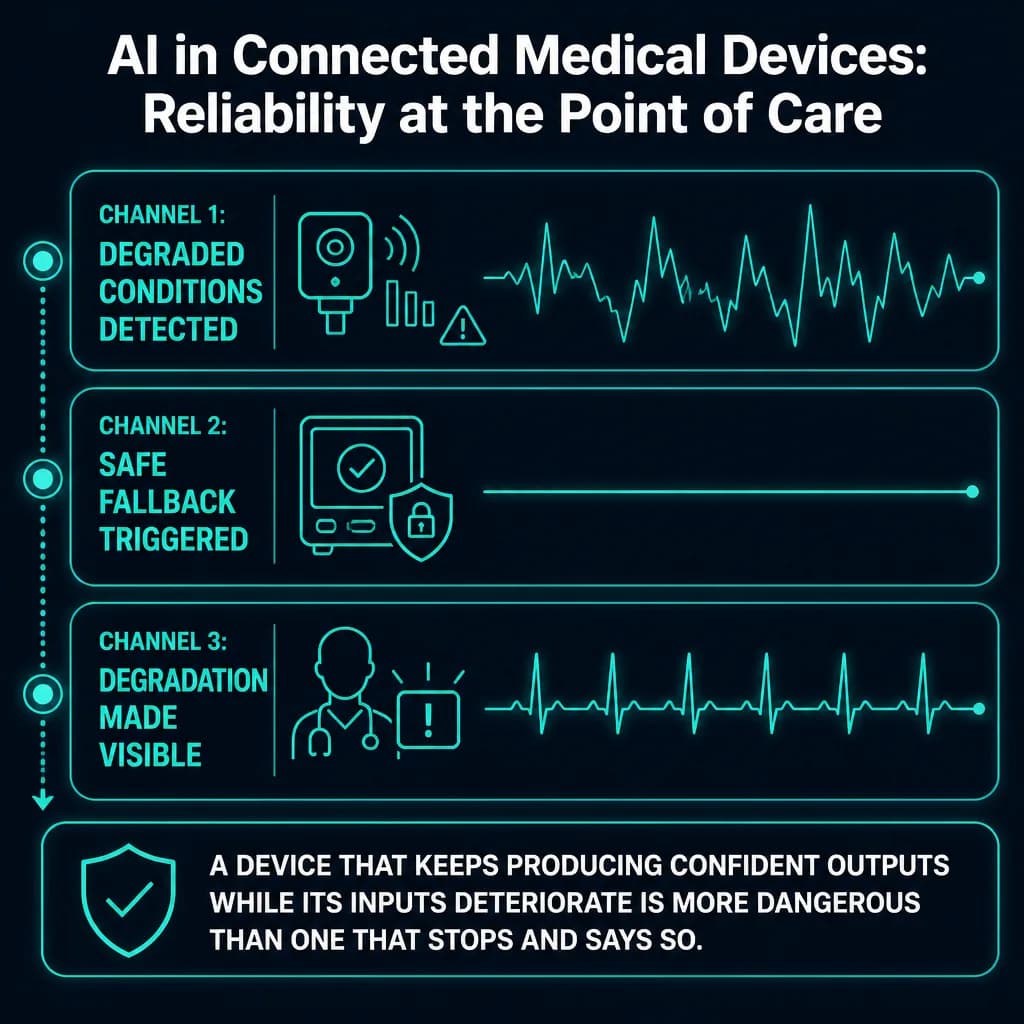
The devices that are safe to deploy are built on a principle that has little to do with model performance: they fail safely. When the model produces a low-confidence output, when a sensor degrades, when connectivity drops, when conditions move outside what the model was validated for, the device has to have a defined safe behaviour rather than continuing to act on a model it can no longer trust.
This means the device needs to know the boundaries of the model’s competence and detect when it is operating outside them, the same way the model’s confidence has to be calibrated to its competence rather than uniformly certain. It means a defined fallback: what the device does when the AI cannot be relied on, whether that is alerting a clinician, reverting to a non-AI mode, or holding at a known safe state. And it means the device degrades in a way that is visible, so a clinician knows the AI is compromised rather than trusting an output the device itself can no longer stand behind. Silent degradation is the specific danger. A device that keeps producing confident outputs while its inputs deteriorate is more dangerous than one that stops and says so.
The human oversight, where it exists, has to be engineered into the device’s operation rather than assumed to be present. If the safety of the device depends on a clinician catching a bad output, then the device has to surface its outputs in a way that makes catching them possible, and has to be honest about when it cannot be caught, connecting to the broader discipline of placing oversight where the clinical consequence actually lives.
The trade-off, named plainly
Engineering for graceful failure costs capability and adds constraint. A device built to fail safe is more conservative than one built to maximise the model’s performance. It refuses to act when confidence is low, reverts to simpler behaviour when conditions degrade, and gives up some of the model’s theoretical capability in exchange for predictable behaviour when things go wrong. That is a real cost, and a vendor selling maximum capability will be reluctant to name it.
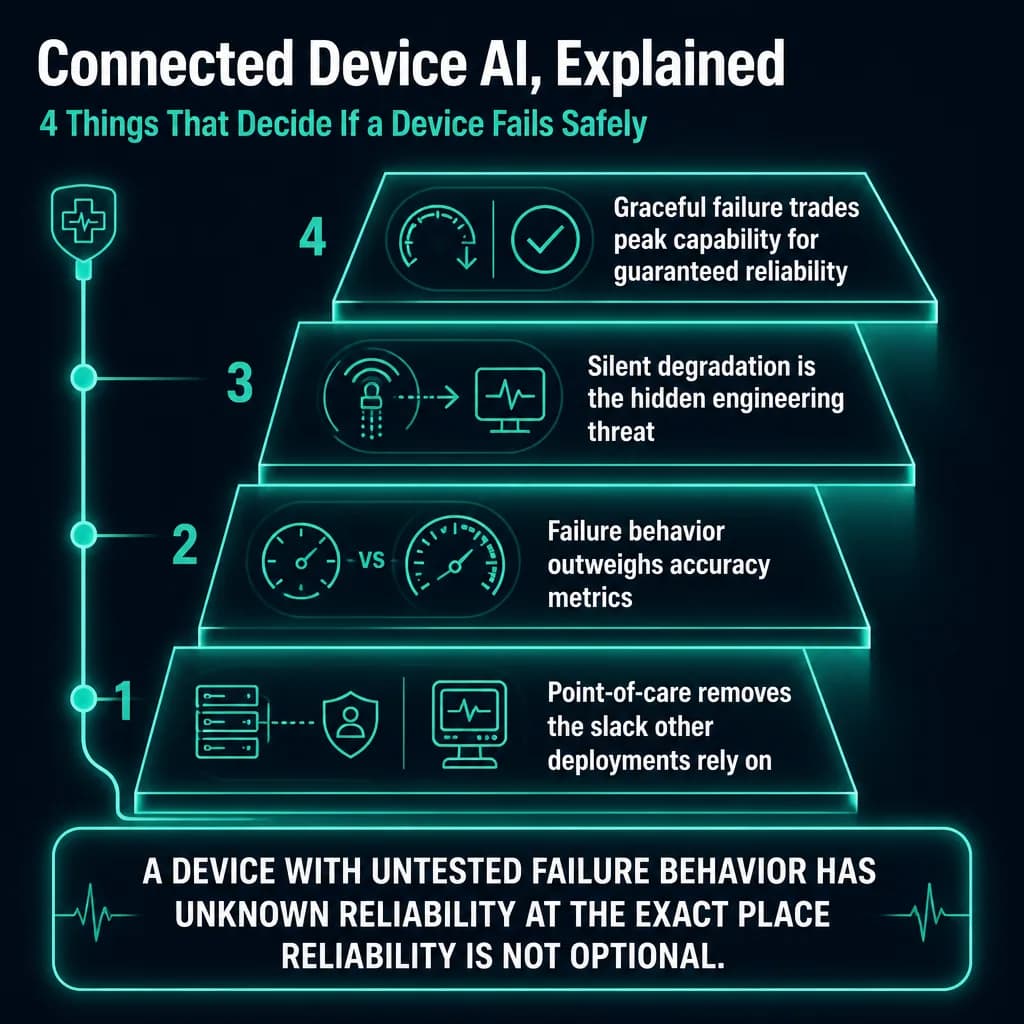
The position worth stating plainly: a connected medical device should be engineered so that a model failure produces a safe, visible state, not a confident wrong output, even at the cost of the model’s peak performance. The point of care is the wrong place to optimise for capability at the expense of failure behaviour, because the failure has nowhere to go except the patient. A device that is brilliant when everything works and unpredictable when something breaks is not a reliable device. It is a capable one, and at the point of care, reliability under failure is the property that matters more. Validating that behaviour means testing the device under the degraded conditions it will actually meet, treating evaluation as an ongoing discipline across real operating conditions rather than a one-time check under ideal ones.
Where it almost breaks
A connected device with an embedded AI model is deployed to support care at the bedside, and it performs well under the conditions it was tested in. Then it meets the real environment. A sensor begins to degrade, connectivity becomes intermittent, and the model continues producing confident outputs based on inputs that were no longer reliable. There was no reviewer positioned to catch the outputs, because the device had been trusted to operate on its own, and the device gave no sign that it was operating on degraded inputs. Nothing announced that the AI could no longer be relied on. The outputs looked exactly as authoritative as they had when everything worked. The correction was to engineer the device to detect when it was operating outside its validated conditions, define a safe fallback for when the model could not be trusted, make any degradation visible to the clinician rather than silent, and validate the device under the degraded conditions it would actually encounter. The device gave up some capability at the edges. It stopped producing confident outputs it had no basis for, at the exact place a wrong output reaches the patient.
AI in connected medical devices can bring real capability to the point of care, informing and supporting decisions where they are made rather than after the fact. That capability is safe to deploy only when the device is engineered for how it fails, not just how it performs: aware of the boundaries of its competence, equipped with a defined safe fallback, and honest about when it is degraded. A device sold on the accuracy of its model, with its failure behaviour untested under the conditions it will actually meet, is a capable device with an unknown reliability at the exact place reliability is not optional.
The question to bring to any connected medical device is not how accurate its model is under ideal conditions. It is what the device does when the sensor degrades, the connection drops, or the model moves outside what it was validated for, and whether it fails into a safe, visible state or keeps producing confident outputs no one is positioned to catch. That is the difference between a capable device and reliability that survives scrutiny at the point of care.
Related: Healthcare & Life Sciences · Koita Foundation: An AI-powered knowledge hub with citation-backed retrieval across seven repositories
Tell us the number you need to move.
…outcomes that survive scrutiny.