AI in Drug Discovery: Where It Compresses Timelines and Where Validation Stays Hard
A computational team hands biologists a ranked shortlist of candidate molecules, narrowed by a model from a chemical space too vast for any human to search. It is a real result, and it changes the work that follows. It does not change the part of drug discovery that takes the longest and decides everything: whether any of those molecules actually does what the model predicted, in a cell, in an animal, in a body. AI compresses the search. It does not compress the proof. Understanding exactly where that line falls separates a tool that genuinely accelerates a pipeline from a narrative that oversells one, and the difference matters because the cost of confusing them is measured in years and in candidates carried too far.
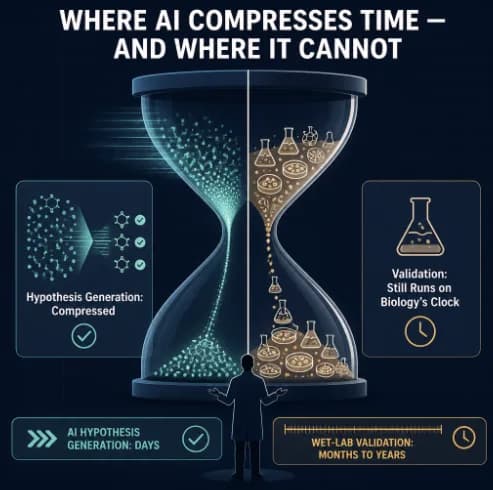
The framing error is treating a model that ranks candidates faster as a model that has sped up discovery. What it has sped up is hypothesis generation, the proposing of molecules worth testing. The testing itself, where most of the time, cost, and attrition live, operates on the same physical clock it always has. Conflating the two is how timeline claims drift from optimistic to false, and it is a specific temptation in drug discovery because the front of the process is where AI is most visible and the back is where the timeline is actually set.
Why the stage that’s easy to accelerate isn’t the one that sets the timeline

Drug discovery is a funnel whose stages differ enormously in duration and failure rate. The early computational work, searching chemical space, predicting which structures might bind a target, prioritising what to synthesise, is genuine work that AI does well. It can explore combinations no team could enumerate by hand and surface candidates a human search might never reach.
That stage was never the bottleneck. The timeline is dominated by what comes after: synthesising the compound, testing it in the lab, watching it fail for reasons no model predicted, and starting again. A model that makes the front of the funnel dramatically faster has compressed a stage that was not what made discovery slow. The molecules still have to be made and tested, and that is governed by chemistry and biology, not by inference speed.
So the honest measure of AI’s contribution is not how much faster it proposes candidates. It is whether the candidates it proposes are better, more likely to survive validation, because a faster way to generate hypotheses that fail at the same rate has not accelerated discovery. It has produced failures sooner. The value is in the hit rate, not the throughput, and a program measuring itself by candidates generated is measuring the stage that was never the constraint.
Why the prediction is not the proof
A model in drug discovery predicts a property, binding affinity, toxicity, how a molecule will behave, from patterns in the data it was trained on. That prediction is a probabilistic statement about a structure, learned from prior chemistry. It is genuinely useful for narrowing where to look. It cannot be evidence that the molecule works.
The reason is foundational rather than a limitation that better models will remove. Biological systems are more complex than any training set captures. A molecule that binds its target in a model can fail in a cell for reasons the model never saw: off-target effects, metabolism, toxicity that emerges only in a living system, the gap between a clean computational target and the noise of real biology. The model’s confidence reflects the regularities in its training data, and the body does not consult that distribution. This is why wet-lab validation is not a formality the model is gradually making obsolete. It is the step where prediction meets reality, and reality has the final say.
This reframes what validation is in drug discovery. It is not a hurdle to optimise away. It is the design input that determines whether anything the model proposed is real, and the discipline that catches the confident, plausible, wrong prediction before it consumes years of development. Overstating what a model has demonstrated, by treating a prediction as a finding, is the specific failure this field cannot afford, because the cost of a false positive is not a wasted afternoon. It is a candidate carried deep into a pipeline before biology reveals it was never going to work. The confident-but-unproven output is dangerous here in the same way it is throughout applied AI, with a longer and more expensive feedback loop.
The trade-off, named plainly
A model tuned to propose many candidates casts a wide net and surfaces more possibilities, at the cost of a lower hit rate, sending more molecules into expensive validation that will fail there. A model tuned for precision proposes fewer, higher-confidence candidates and risks missing the unconventional structure a broader search would have caught. No setting escapes this. More candidates means more validation cost; fewer means more missed opportunities. The right balance depends on where the expensive bottleneck sits in a given program, and pretending the model removes the trade-off is the tell of a tool sold on its front end.
The position worth stating plainly: AI’s real contribution to drug discovery is improving the quality of what enters validation, not removing the need for it, and a program that measures its AI by candidates generated is measuring the wrong thing. The number that matters is what fraction of computationally-proposed candidates survive the wet lab, and whether that fraction is better than it was without the model. A program that reports a faster front-of-funnel as a compressed timeline has confused generating hypotheses faster with discovering drugs faster, and the confusion surfaces later, when the candidates reach the lab and fail at the old rate.
Designing the pipeline so prediction and validation reinforce each other
The teams that get durable value treat the model and the lab as a loop rather than a handoff. The model proposes; the lab tests; the results, including the failures, feed back to sharpen the next round of predictions. This is where evaluation built as an ongoing discipline rather than a one-time benchmark earns its place: a model’s value is measured against experimental ground truth, not against a held-out test set that shares the biases of its training data. A model that scores well on retrospective benchmarks and poorly against the wet lab has learned the data, not the biology, and the only way to know which it has learned is to hold it accountable to experimental reality rather than to itself.
Where it almost breaks
A discovery team deploys a model that dramatically expands the number of candidate molecules it can evaluate and reports the acceleration as a compression of the discovery timeline. Leadership plans around it. Then the candidates reach the lab, and the hit rate among the AI-proposed molecules is no better than the prior approach: the model had been confidently surfacing structures that scored well on its learned objective and failed against real biology, including a cluster it ranked highly that shared a feature its training data had over-represented. Nothing had been generated faster in any sense that mattered, the funnel’s true bottleneck was untouched, and now more molecules were failing in expensive validation. The correction was to stop measuring the model by candidates produced and start measuring it by validation survival, feed wet-lab failures back to retrain it, and benchmark it against experimental reality rather than its own held-out data. The model became genuinely useful once it was held accountable to the lab instead of to itself.
AI in drug discovery can search a chemical space no team could explore by hand and propose candidates worth testing that a human search would have missed. That is a real contribution, and on the right programs it meaningfully improves the odds of what enters the lab. But it accelerates discovery only to the degree it raises the hit rate, and it never removes the validation that turns a promising prediction into a real one. A tool sold on the speed of its search, rather than the quality of what survives the lab, is selling the easy half of a hard problem.
The question to bring to any drug-discovery AI is not how many candidates it can generate or how fast. It is whether the candidates it proposes survive validation at a better rate than before, and whether the program is measuring the model against the wet lab, where biology, not the model, has the last word. That is the difference between compressing a timeline and appearing to.
Related: Healthcare & Life Sciences · Koita Foundation: An AI-powered knowledge hub with citation-backed retrieval across seven repositories
Tell us the number you need to move.
…outcomes that survive scrutiny.