AI in Mental Health Support: Where It Helps and Where the Guardrails Must Hold
There is a category of user for whom a mental health support tool’s failure is not an inconvenience but a crisis, and that user does not announce themselves. They arrive in the same conversational stream as everyone else, and the tool has to recognise them from what they say, because no one else will. This is what makes AI in mental health support a fundamentally different engineering problem from other conversational AI. Most tools can afford to be wrong occasionally, because the cost of a wrong answer is bounded. A mental health support tool that misses a user in crisis, or responds to one badly, can contribute to a harm that is not recoverable. The value of these tools is real for the large population they can genuinely help. The engineering is defined by the small population for whom getting it wrong is catastrophic.
The framing error is treating mental health support as a conversational quality problem, where a more empathetic, more capable model is straightforwardly better. Conversational quality matters, and a tool that provides accessible support to people who would otherwise have none is doing genuine good. But the measure of a mental health support tool is not how well it converses with the users it can help. It is how reliably it recognises the users it cannot help, the ones in crisis, at genuine risk, beyond what a support tool should handle, and gets them to appropriate human help. That recognition is the entire safety story, and it is a different problem from being a good conversational support, one that a tool optimised for engagement and empathy can fail precisely because it is trying so hard to be helpful.
Why the guardrail is the product

A mental health support tool operates across a spectrum of users. Many are dealing with everyday stress, low mood, the ordinary difficulties for which accessible, always-available support has real value, and for whom a tool that listens and offers grounded support is a genuine good, especially where human support is scarce or hard to reach. This is the population the tool is for, and helping them is legitimate.
At the other end of the spectrum are users in crisis: at risk of self-harm, in acute distress, dealing with something that requires human intervention a support tool cannot and must not attempt to provide. For these users, the tool’s job is not to help directly. It is to recognise the situation and escalate to appropriate human help, reliably, regardless of how the conversation had been going. The guardrail that catches this user and routes them to a crisis line or human support is not a feature at the edge of the product. It is the product’s most important function, because it is the function that prevents the catastrophic failure the whole design has to be built against.
The difficulty is that the same qualities that make the tool good for the first population can make it dangerous for the second. A tool optimised to be empathetic, engaging, and helpful, to keep the conversation going and make the user feel supported, is optimised to do exactly the wrong thing with a user in crisis, where the right action is to stop trying to handle it and escalate. An engagement-maximising design keeps the crisis user in a conversation with a tool when it should be moving them to a human. The guardrail that overrides the conversational flow is what prevents the tool’s helpfulness from becoming the mechanism of its most serious failure.
Why the guardrails cannot be left to the model’s judgment
The recognition of a user in crisis, and the escalation that follows, cannot rest on the conversational model’s general judgment, for the same reason that critical clinical transitions cannot. A probabilistic model asked to notice crisis and respond appropriately will do so unreliably, well most of the time and wrong in the cases that matter most, and in this domain the cost of the wrong cases is not one the design can absorb.
So the guardrails have to be deterministic and hard, catching defined signals of risk and escalating on rules that override whatever the conversational model would otherwise generate, the same way deterministic escalation rules own the dangerous transitions in triage. The model handles the supportive conversation for the users it can help. The rules own the recognition of and response to crisis, because those are the situations where a probabilistic best-effort is not good enough and a reliable, defined response is required. Building the safety this way, as hard guardrails rather than as a hoped-for behaviour of a capable model, is what makes the difference between a tool that usually handles crisis well and one that reliably does.
The tool also has to be honest about what it is. A user has to understand they are talking to an AI support tool, not a human therapist, and the tool has to be clear about its own limits, because a user who believes the tool is more than it is may rely on it in a situation where they should be seeking human help. This honesty is itself a safety mechanism, keeping the user’s reliance calibrated to what the tool can actually and safely provide.
The trade-off, named plainly
Building hard guardrails that escalate generously means the tool sometimes escalates a user who was not in genuine crisis, interrupting a supportive conversation to route someone toward human help they may not have needed. That is a real cost, and it makes the tool feel less smooth and less self-sufficient. It is also the correct cost, because the alternative error, failing to escalate a user who was in crisis, is catastrophic and irreversible in a way that an unnecessary escalation is not.
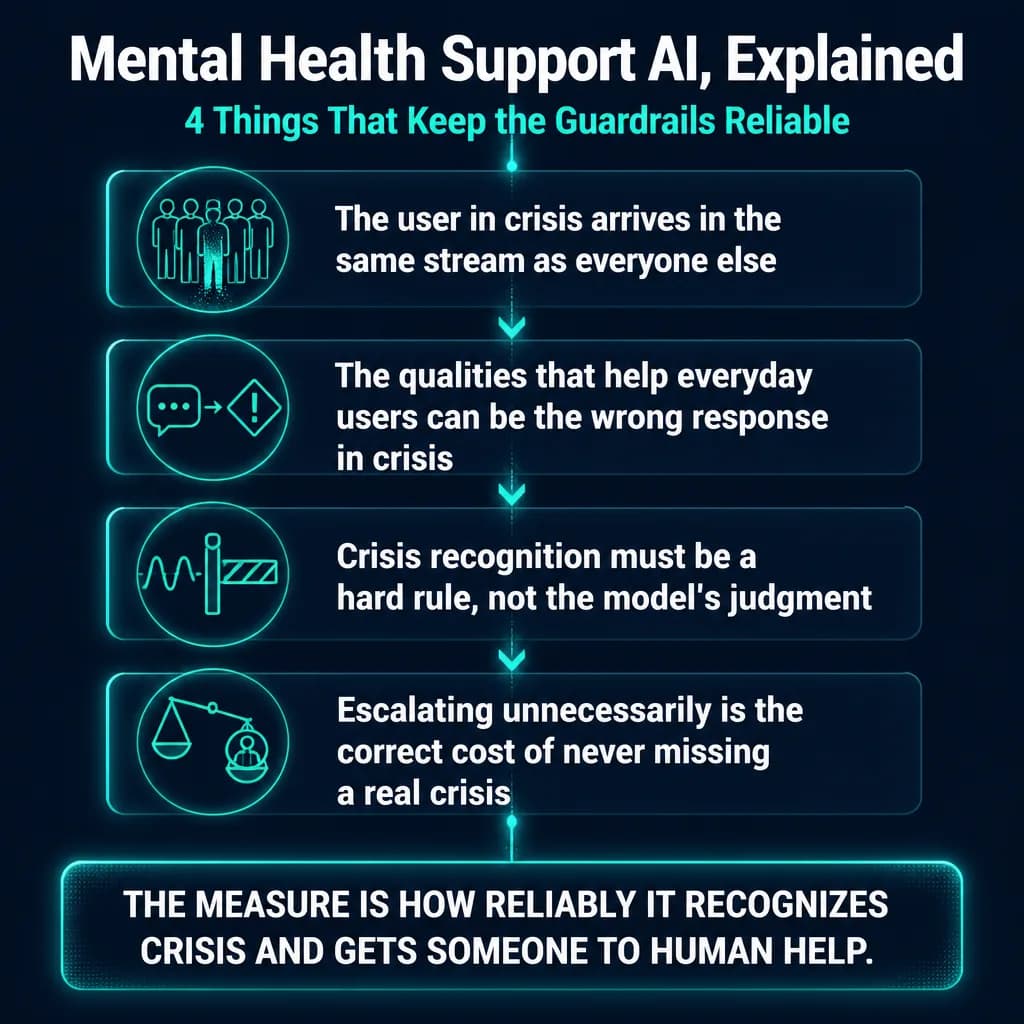
The position worth stating plainly: a mental health support tool should be engineered to escalate on the side of caution, accepting unnecessary escalations as the price of not missing a user in genuine crisis, and its guardrails should be hard rules rather than the judgment of a model optimised to be helpful. A tool measured on engagement or conversational quality is optimised for the users it can help and against the reliability it needs for the users it cannot. The guardrail is not a limit on the product. In this domain, the guardrail is the part of the product that matters most.
Where it almost breaks
A mental health support tool is deployed and optimised to be empathetic, engaging, and genuinely helpful, and it provides real support to a large population dealing with everyday stress. Its conversational quality is praised. Then a user in genuine crisis engages with it, and the tool, optimised to be supportive and to keep the conversation going, kept trying to help directly rather than recognising the severity and escalating to human crisis support. The very helpfulness that served the everyday users was the wrong response for this one, and there was no hard guardrail to override the conversational flow and route the user to appropriate help. The model’s general judgment had been trusted to handle a situation that required a reliable, defined response. The correction was to build hard, deterministic guardrails that recognise crisis signals and escalate to human support regardless of the conversation, tune the escalation to err toward caution, make the tool honest about being an AI with limits, and treat crisis escalation reliability as the primary safety measure rather than conversational quality. The tool kept helping the population it could help. It stopped trying to handle the users it never should have.
AI in mental health support can provide real, accessible support to a large population who benefit from a tool that listens and helps, particularly where human support is scarce, and that good is worth pursuing. It delivers safely only when it is engineered around the users it cannot help, with hard guardrails that reliably recognise crisis and escalate to human support, tuned to err toward caution, and honest about the tool’s own limits. A tool optimised for conversational quality and engagement has optimised for the population it can help and against the reliability it needs for the population where failure is irreversible.
The question to bring to any mental health support tool is not how empathetic or helpful it is with the users it can serve. It is how reliably it recognises the user in crisis and gets them to human help, whether that recognition rests on hard guardrails rather than the model’s judgment, and whether it escalates generously enough that it never mistakes a crisis for a conversation to continue.
This is a sensitive area, and if you are working through something difficult yourself, please reach out to a qualified professional or a crisis line where you are; I can help you find appropriate resources if that would be useful.
Related: Healthcare & Life Sciences · Koita Foundation: An AI-powered knowledge hub with citation-backed retrieval across seven repositories
Tell us the number you need to move.
…outcomes that survive scrutiny.