AI in Oncology: From Tumour Detection to Treatment Planning, With Oversight
Oncology spans a range of AI applications that look continuous and are not. At one end, a model helps detect a tumour on an image. At the other, AI informs a treatment plan for a specific cancer patient. These get discussed as a single trajectory, detection leading naturally to planning as the technology matures, and that framing obscures a sharp increase in risk along the way. Detecting a tumour and planning its treatment are different problems with different stakes, and the difference is not degree but kind. Detection narrows where a human looks. Treatment planning shapes a decision about a person’s care, in a domain where the decisions are consequential, the patients are heterogeneous, and the accountability cannot rest anywhere but with the oncologist. The value of AI in oncology is real across the range. The oversight that keeps it safe has to intensify as it moves toward the decision.
The framing error is treating the progression from detection to planning as a smooth expansion of the same capability. A model that detects tumours well seems like it should, with more data and better training, help plan treatment, as though planning were just detection with more steps. But planning is not an extension of detection. It is a different kind of task, involving judgment about a specific patient’s disease, biology, preferences, and circumstances, weighed against evidence and experience in ways that a pattern-recognition model does not do and cannot be accountable for. Moving along the oncology range is not moving up a capability ladder. It is moving from a task where AI narrows a search toward a task where AI touches a decision, and the oversight has to change accordingly.
Why detection and planning are different risk problems

Detection is, at its core, a perception task. The model examines an image and flags what might be a tumour, and the cost of its errors is bounded by the human review that follows. A false positive costs a pathologist or radiologist time confirming the finding is benign. A false negative is caught, in a well-designed workflow, by the human who examines the study regardless. The model accelerates and sharpens the search, and the oncologist or radiologist remains the one who confirms and decides, which keeps detection a high-value, manageable-risk application. The model is a second set of eyes, not the final word.
Treatment planning is a judgment task, and the risk profile is entirely different. A treatment decision in oncology weighs the specific characteristics of a specific patient’s cancer, their overall health, their circumstances and preferences, the evidence for different approaches, and the oncologist’s experience, into a decision with major consequences and often no single right answer. A model can inform this by surfacing relevant evidence, organising information, and identifying considerations, which is real value. It cannot make the judgment, because the judgment requires integrating factors the model does not have access to and carrying an accountability the model cannot hold. And the model’s limitations bite hardest exactly here: it reasons from patterns in its training data, which means it is weakest on the atypical patient, the unusual presentation, the case that does not match the population it learned from, and those are precisely the cases where treatment judgment is hardest and most consequential.
The confidence that is not calibrated to competence makes this sharper. A model informing a treatment decision will present its output about an atypical case with the same assurance as a typical one, and an oncologist who over-relies on it may be led toward a plan the model had the least basis to inform. Keeping the oncologist as the decision-maker is what keeps the model’s confident output on a hard case from becoming the plan.
Why oversight has to intensify toward the decision
The principle that follows is that oversight is not uniform across oncology AI. It scales with how close the application sits to the treatment decision. Detection needs the oversight of a human confirming findings, which is real but bounded. Treatment planning needs the oncologist fully in control of the decision, with AI firmly in a supporting role, because the stakes and the accountability are at their highest.
This is the oversight placed where the consequence lives, applied across a range rather than at a single point. As an oncology AI application moves from narrowing a search toward informing a decision, the human’s role has to move from confirming the model’s perception to owning the judgment the model can only support. A system that blurs this, that lets AI drift from informing a treatment decision toward effectively making it, has extended automation into the part of oncology where a wrong output carries the gravest consequence and the model is least equipped to be accountable. The oncologist’s ownership of the treatment decision is not a caveat on the technology. It is the control that the entire application has to be built around as it approaches the decision.
The trade-off, named plainly
Keeping the oncologist fully in control of treatment planning means AI in oncology does not automate the high-value decision, only supports it. A system that pushed further, generating treatment recommendations the oncologist reviews and approves, would appear more capable and more efficient, at the cost of shifting the oncologist from decision-maker to approver on exactly the decisions where genuine ownership matters most. The version that keeps AI supporting rather than deciding is less automated and preserves the accountability the decision requires. The tension is real, and resolving it toward more automation is how oncology AI would cross from supporting care into shaping it without accountability.
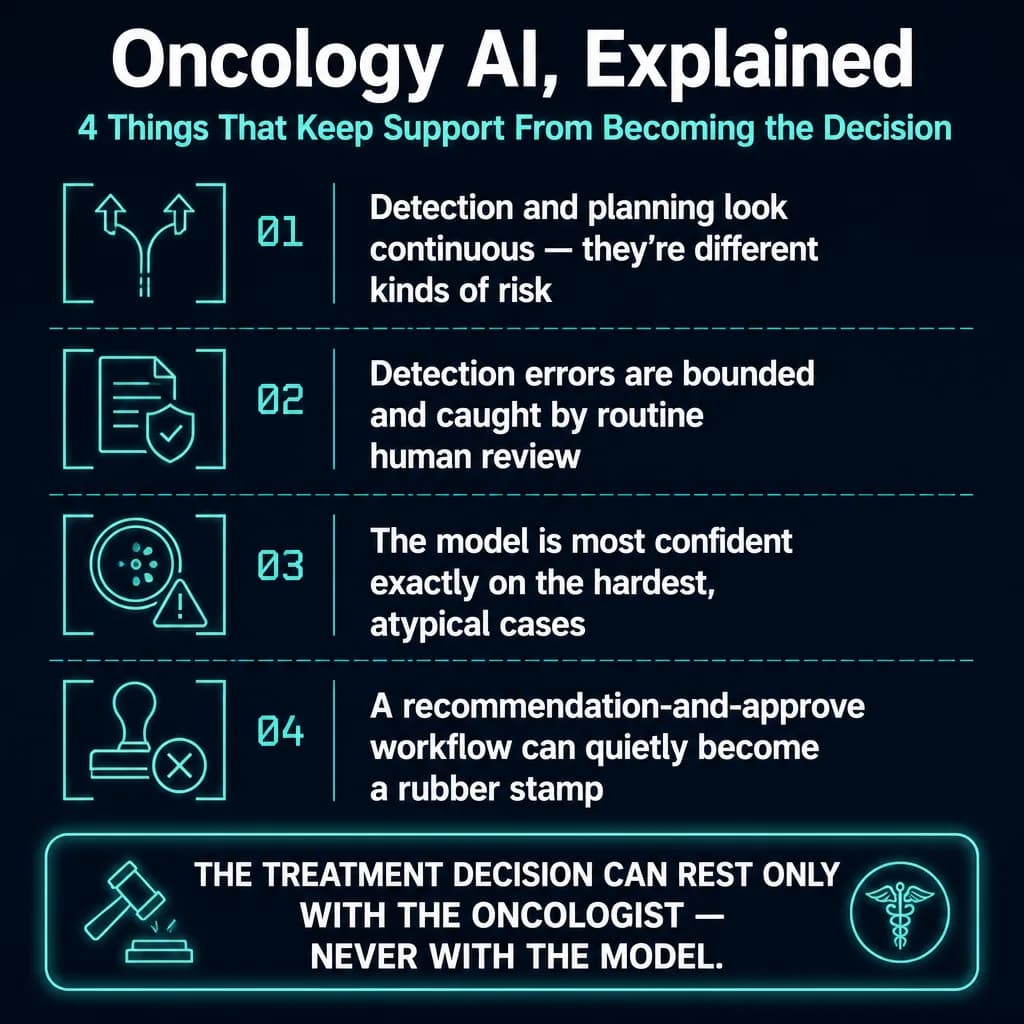
The position worth stating plainly: AI in oncology should support the treatment decision and never move toward making it, however capable the technology becomes, because the treatment decision is where the stakes are highest, the patients are most heterogeneous, and the accountability can rest only with the oncologist. A system that generates treatment plans for approval, however impressive, has positioned AI to shape a life-altering decision on cases where the model is least reliable and most confident, with the oncologist reduced to approving rather than deciding. The value of AI in oncology is in sharpening detection and informing planning. Extending it to the decision itself trades the accountability the decision demands for an automation it should never have.
Where it almost breaks
An oncology program deploys AI across its workflow, and the detection applications work well, earning the team’s trust. Encouraged, the program extends the AI toward treatment planning, letting it generate recommended plans for oncologists to review and approve, treating this as the natural next step. For typical cases the recommendations were reasonable, and the review became routine. Then an atypical patient arrived, whose cancer and circumstances did not match the population the model had learned from, and the model generated a confident recommendation it had little basis for. The oncologist, accustomed to the recommendations being sound and to a review that had become a rubber stamp, nearly deferred to a plan that a fully engaged clinical judgment would have questioned. The model was most confident exactly where it was least reliable, and the workflow had quietly shifted the oncologist from decider to approver. The correction was to keep AI supporting rather than generating treatment decisions, restore the oncologist as the active decision-maker with the model surfacing evidence and considerations rather than plans, and intensify oversight as the application approached the decision. Detection stayed valuable. The treatment decision returned fully to the oncologist.
AI in oncology can sharpen tumour detection and genuinely inform treatment planning, surfacing evidence and organising the considerations an oncologist weighs, and that value spans the range of oncology work. It delivers safely only when the oversight intensifies as the application approaches the treatment decision, keeping the oncologist as a confirming reviewer in detection and as the full owner of judgment in planning, especially on the atypical cases where the model is least reliable and most confident. A system that drifts from informing treatment toward making it has extended automation into the part of oncology where the stakes are gravest and the accountability can rest only with the clinician.
The question to bring to any oncology AI is not how much of the pathway it can handle. It is whether the oversight scales with proximity to the treatment decision, whether the oncologist genuinely owns the judgment rather than approving the model’s, and whether the system supports the decision on the hard cases rather than shaping it. That is the difference between AI that advances oncology care and oncology AI whose outcomes survive scrutiny under oversight.
Related: Healthcare & Life Sciences · Koita Foundation: An AI-powered knowledge hub with citation-backed retrieval across seven repositories
Tell us the number you need to move.
…outcomes that survive scrutiny.