AI in Pharma Manufacturing and Quality: GxP-Aligned Models in Production
A model flags a batch as anomalous, and the quality team faces a question the model cannot answer: can they trust the flag enough to act on it, and can they prove to an inspector why they did. In pharmaceutical manufacturing, a decision that affects product quality is never just a decision. It is a decision that has to be defensible, documented, and reconstructable years later when a regulator asks how it was made. This is the environment AI enters when it moves onto the manufacturing floor, and it is unlike almost anywhere else these systems get deployed. The model is not operating in a space where being usually right is good enough. It is operating inside a validated quality system, and the quality system does not bend to accommodate a model it cannot explain.
The framing error is to treat a manufacturing AI model as a performance problem. Teams focus on whether the model predicts deviations accurately, catches quality issues early, optimises a process parameter. Those things matter. They are also the easy part. The hard part is that the model has to live inside a GxP framework built on validation, control, and the ability to demonstrate that every element of the process does what it was proven to do. A model that improves a process but cannot be validated, controlled, and explained within that framework is not an asset. It is a control the quality system cannot account for.
Why the validated environment changes the problem

Regulated manufacturing operates on a principle that predates AI by decades. Showing that a process produces good output is the easy half. You also demonstrate that it is under control, that it behaves predictably, and that you understand why it produces what it produces. Validation is the evidence that a process does what it is specified to do, consistently, in a way that can be inspected. This is the ground rule, and AI does not get an exemption from it.
That principle collides with a property of many machine learning models. A validated process is expected to be stable and understood. A model that continues to learn from new data is, by design, changing. A process whose behaviour shifts as it ingests new inputs is a process that was validated in one state and is now operating in another. For a quality system, that is not an improvement. That is a validated element that has silently gone out of its validated state. The tension between a model that adapts and a framework that demands demonstrated stability is the central engineering challenge of pharmaceutical AI, and pretending it away is how deployments fail their first inspection.
So the design has to resolve it deliberately. A model operating in a GxP context is treated as a controlled element: validated in a defined state, locked in that state for production use, and re-validated through a governed change process when it is updated. The adaptability that makes machine learning attractive elsewhere becomes something to manage rather than something to let operate. This is a real constraint, and it is the correct one. A model that quietly retrains itself in a validated environment has broken the control the environment exists to maintain.
What the model can own, and what stays with the quality system
A manufacturing model is genuinely useful at pattern recognition across process data that humans monitor imperfectly. It can detect a drift toward an out-of-specification condition before it crosses the line, flag an anomalous batch pattern earlier than a periodic review would, and surface correlations in process parameters that a human analyst would take far longer to find. This is valuable work, and it carries manageable risk because the model informs the decision while the quality determination stays with the quality system.
The boundary is the quality decision itself: the disposition of a batch, the judgment that a deviation does or does not affect product quality, the release of material into the supply chain. Those are decisions with patient safety at the end of them, and they belong to qualified quality personnel operating under the quality system. A model can flag, predict, and surface. It cannot own the disposition, because the accountability for a decision that affects a product patients will take is not transferable to a model, the same way clinical accountability stays with the clinician. The quality professional who signs the disposition remains the load-bearing control. The model informs that judgment. It does not replace it.
This matters because of how these models fail. A model trained on historical process data learns the plant’s history, including its historical assumptions about what normal looks like. If that history contained a bias, the model inherits it, and it applies the inherited bias consistently across every batch it evaluates. A human reviewer might catch that a flagged pattern reflects a change in the process rather than a genuine anomaly. A model applying a learned definition of normal will not, unless the quality system is watching the model as carefully as the model is watching the process.
Fitting the model into the validated environment
Getting a model into GxP production is an exercise in fitting it to controls that already exist rather than building new ones around it. The model needs a defined intended use, documented and bounded, exactly as intended use anchors any governed clinical deployment. It needs validation evidence generated on the actual process, equipment and conditions it will operate against. A general benchmark proves nothing about this line. It needs a change control process, so an update is a governed event with re-validation rather than a silent improvement. And it needs the audit trail engineered as a first-class component, because the ability to reconstruct what the model saw, what it output, and what a human did with it is not optional in an environment built on documented evidence.
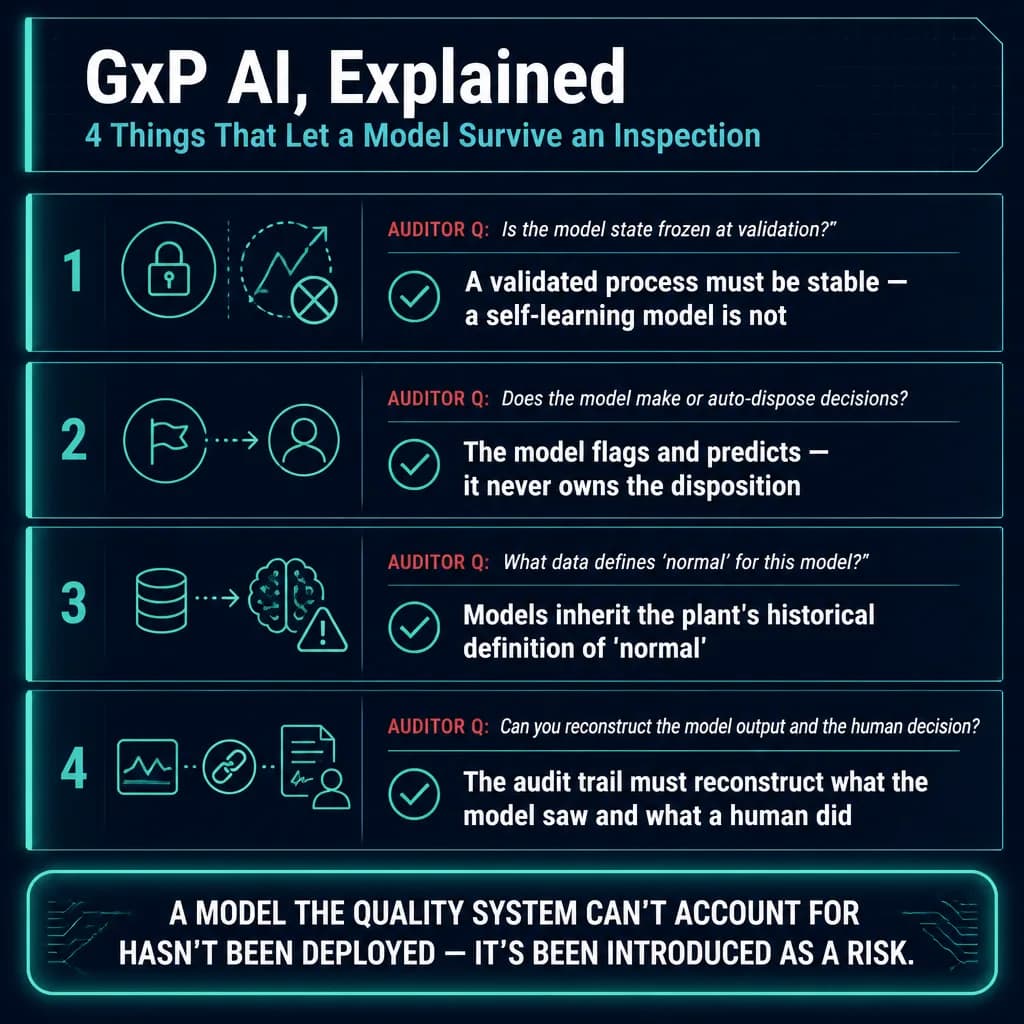
The trade-off is straightforward and worth stating. Operating a model as a controlled, validated element means giving up the continuous self-improvement that makes machine learning attractive in unregulated settings. The model improves on a governed schedule, through a change process, with re-validation. That is slower than letting it learn continuously. It is also the only version that survives an inspection, and in this environment survival is the requirement.
The flagged batch nobody could justify releasing
A manufacturing site deploys a model to detect quality anomalies and, to keep it sharp, allows it to continue learning from incoming production data. Its detection improves over months. Then an inspection asks a direct question: in what validated state is this model operating, and how do you demonstrate control over a system whose behaviour has changed since validation. The site could not answer cleanly. The model had drifted from its validated state through continuous learning, and the quality system had no record of the states it had passed through. Nothing about the product had failed. The control around the model had. The correction was to lock the model in a validated state, route all updates through change control with re-validation, keep quality personnel accountable for every disposition the model informed, and put the model’s own behaviour under monitoring as a controlled element of the process. The model kept catching anomalies. It did so as a validated part of the quality system rather than a capable component the system could not account for.
AI in pharmaceutical manufacturing can see drift toward an out-of-specification condition before a human would, catch an anomalous batch earlier, and surface process relationships that improve quality and yield. That value is real. It is only realisable if the model is operationalised as a controlled element inside the quality system, validated in a known state, governed through change control, and kept subordinate to the qualified people who own the quality decisions. A model that improves a process but cannot be accounted for by the framework built to protect the patient at the end of it has not been deployed. It has been introduced as a risk the quality system cannot yet see.
The question to bring to any manufacturing AI is not how well it predicts. It is whether you can state the validated state it operates in, demonstrate control over how it changes, and prove that a qualified human owns every quality decision it informs. That is the difference between a model that helps and outcomes that survive scrutiny.
Related: Healthcare & Life Sciences · Koita Foundation: An AI-powered knowledge hub with citation-backed retrieval across seven repositories
Tell us the number you need to move.
…outcomes that survive scrutiny.