AI in Remote Patient Monitoring: Turning Sensor Data Into Action
Remote patient monitoring produces an enormous stream of data: continuous readings from devices tracking vital signs, activity, and physiological signals from patients at home. The promise is that this stream lets clinicians catch problems earlier, outside the clinic, before a patient deteriorates. The reality that determines whether the promise is realised has little to do with the sensors and everything to do with what happens to their output. A continuous stream of data that no one can act on is not monitoring. It is noise, and worse than noise, because it creates an appearance of oversight that is not real and a volume of alerts that exhausts the clinicians it was supposed to help. The value of remote monitoring is not in the data collected. It is in the small fraction of that data that should trigger action reaching a clinician who can act on it, and everything about whether that happens is a design problem, not a sensor problem.
The framing error is treating remote monitoring as a data collection capability, where more data and more monitored patients is more value. Collecting the data is the easy part, and it is not where the value or the risk lives. The value lives in turning the stream into action, which means distinguishing the readings that matter from the vast majority that do not, and getting the ones that matter to a clinician in a form they can act on. A monitoring program that collects data well and acts on it poorly has built the appearance of continuous oversight on top of a stream that mostly generates noise, and the noise does specific harm: it fatigues clinicians, buries the signal that matters, and creates a false confidence that patients are being watched.
Why the data stream is the problem, not the solution
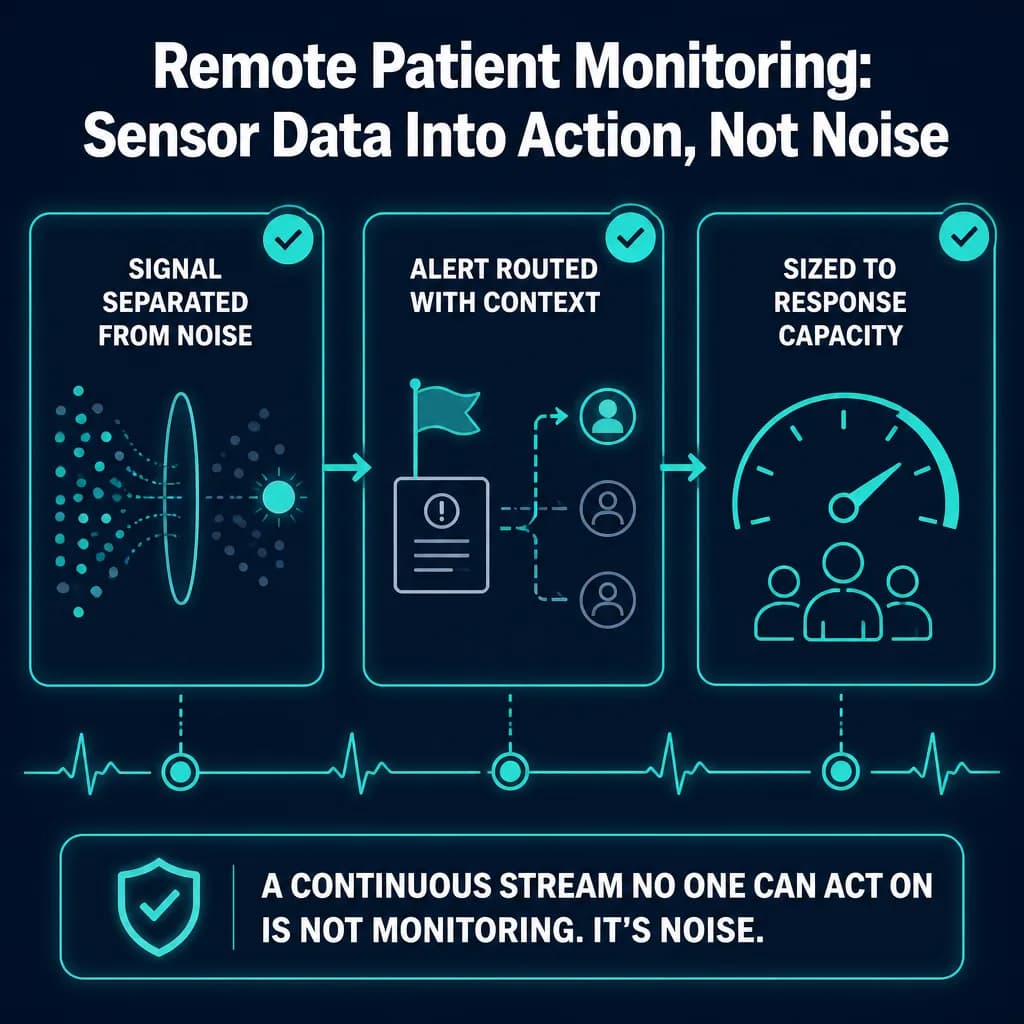
A remote monitoring program generates far more data than can be reviewed, which means the fundamental task is separation: identifying the small fraction of readings that indicate a patient needs attention and getting the rest out of the way. This is harder than it sounds, because the data is continuous, individually variable, and full of readings that are abnormal for benign reasons. A patient’s reading can be outside the normal range because they exercised, because the sensor shifted, because their individual baseline differs from the population, or because they are genuinely deteriorating, and telling these apart is the entire challenge.
Get the separation wrong toward sensitivity, and the program generates a flood of alerts, most of them false, which produces exactly the alert fatigue that turns a monitoring signal into background noise. Clinicians receiving a stream of alerts that are mostly benign learn to discount them, and the alert that matters gets discounted with the rest. The monitoring is technically happening and functionally failing, because the signal that should trigger action is buried in noise the clinicians have learned to ignore. Get the separation wrong toward specificity, and the program misses real deteriorations it should have caught, which defeats the purpose of monitoring in the first place.
This is why the data stream is the problem rather than the solution. Collecting it is trivial. Turning it into a reliable signal that a clinician can trust, one that fires when it should and stays quiet when it should not, is the actual work, and it is work that a program focused on collection and coverage tends to skip. The measure of a remote monitoring program is not how many patients it monitors or how much data it collects. It is whether the readings that warrant action reliably become action, and whether the readings that do not stay quiet.
Why action requires a response system, not just an alert
Separating signal from noise is necessary and not sufficient, because a signal that fires into a system that cannot act on it is still not monitoring. The alert has to reach a clinician who has the responsibility and the capacity to act, in a form that lets them act, which is the same principle as engineering the response to a prediction rather than just the prediction. A remote monitoring program that generates good alerts and sends them into a diffuse system where no one owns the response has built a signal that dissipates.
This means the alert has to route to a specific owner, carry enough context for the clinician to assess without starting from scratch, and fire at a rate the responding clinicians can actually handle. A program monitoring more patients than its response capacity can support will generate alerts that go unactioned regardless of how good the separation is, which means the coverage the program is proud of is coverage in name only. The response capacity is the binding constraint, and the number of patients monitored should be set by it rather than by how many devices can be deployed. Accountability sits with the clinical team, which means the program has to be built so that the alerts reaching them are ones they can trust and act on, not a volume that exceeds their ability to respond.
The trade-off, named plainly
Tuning the separation between signal and noise forces a choice with no free option, and it has to be resolved against the program’s actual response capacity. Tune toward sensitivity and the program catches more real deteriorations at the cost of more false alerts that fatigue the team. Tune toward specificity and the alerts are more trustworthy and fewer at the cost of missing some real events. And the number of patients monitored trades against the quality of response each can receive: more patients monitored on a fixed response capacity means each alert competes for less clinical attention. There is no configuration that monitors the most patients, catches every deterioration, and never generates a false alert.
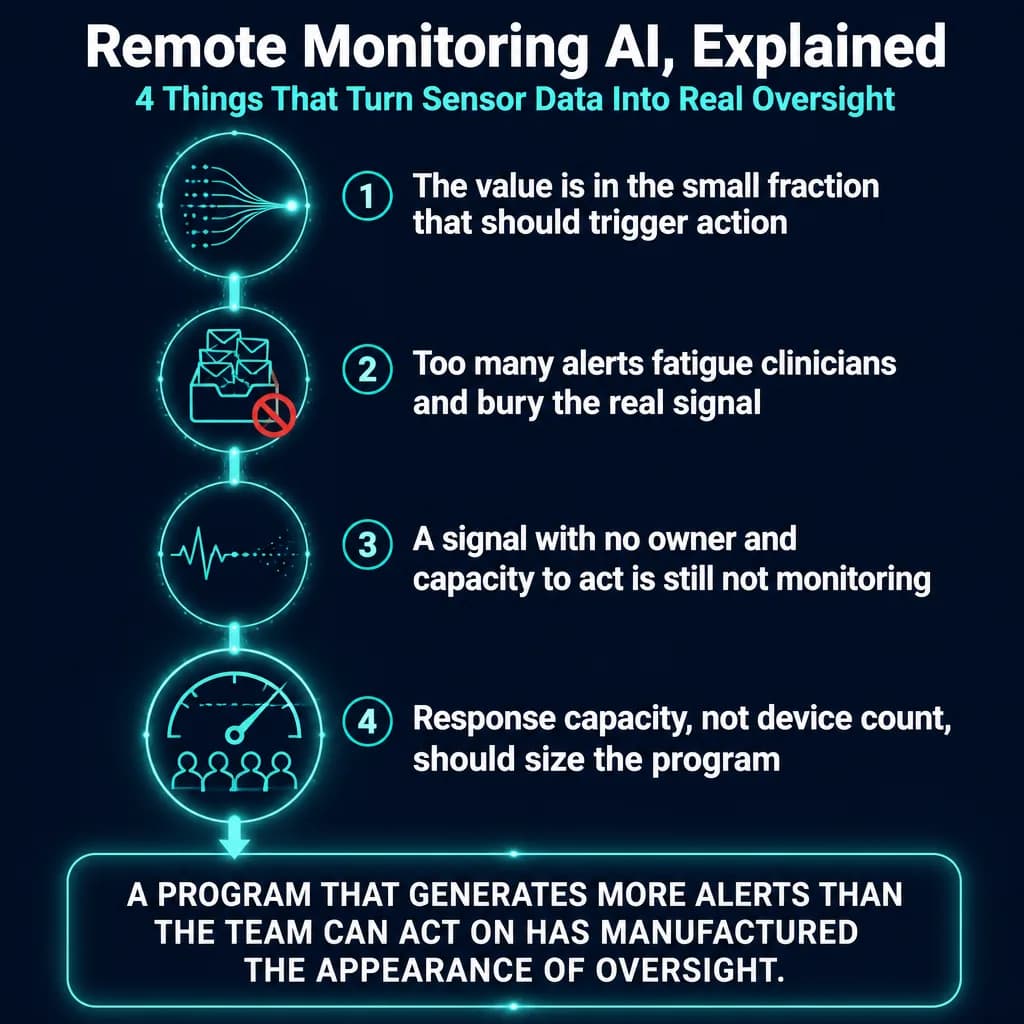
The position worth stating plainly: a remote monitoring program should be sized and tuned to the clinical team’s capacity to act on its alerts, not to the number of patients it could technically monitor or the amount of data it could collect, because monitoring that exceeds the capacity to respond generates noise, not oversight. A program measured on patients monitored or data collected is optimised for coverage that looks like oversight and functions as noise. The value is in action, and action is bounded by response capacity, which makes response capacity the constraint that should size the program. A monitoring program that generates more alerts than the team can act on has not extended oversight. It has manufactured the appearance of it.
Where it almost breaks
A health system deploys remote patient monitoring and, to maximise its value, enrolls a large number of patients and tunes the alerting to be sensitive so nothing is missed. The coverage numbers are impressive. Then the clinical team responsible for the alerts is overwhelmed: the volume of alerts, most of them benign readings from patients whose individual baselines or activities explained the abnormality, exceeds what the team can review, and they begin discounting alerts to keep up. A genuine deterioration fires, gets discounted with the noise, and is missed, inside a window the monitoring had technically captured. The program had been monitoring more patients than its response capacity could support, tuned to generate more alerts than the team could act on, and the excess had turned oversight into noise. The correction was to size the program to the team’s response capacity, tune the separation to fire reliably rather than exhaustively, suppress alerts explained by individual baselines or known benign causes, route each alert to an owner with context to act, and monitor the alert-response rate as the signal of whether the program still functioned. The system monitored fewer patients more effectively, and the alerts that fired were trusted and acted on.
AI in remote patient monitoring can extend a clinician’s awareness beyond the clinic and catch deterioration earlier, which is real value for patients managed at home. It delivers that only when the program is built to turn the data stream into reliable action: separating the readings that matter from the many that do not, getting the ones that matter to a clinician who can act in a form they can act on, and sizing the whole program to the team’s capacity to respond. A program optimised for coverage and data collection builds the appearance of oversight on a stream that mostly generates noise, fatiguing the clinicians it was meant to help and burying the signal it was meant to surface.
The question to bring to any remote monitoring program is not how many patients it monitors or how much data it collects. It is whether the readings that warrant action reliably become action, whether the alerts reaching clinicians are trustworthy enough to be acted on rather than discounted, and whether the program is sized to the team’s actual capacity to respond. That is the difference between collecting sensor data and turning it into action rather than noise.
Related: Healthcare & Life Sciences · Koita Foundation: An AI-powered knowledge hub with citation-backed retrieval across seven repositories
Tell us the number you need to move.
…outcomes that survive scrutiny.