AI in Surgical Planning and Intraoperative Support: Precision With Human Control
The operating room is the least forgiving environment AI can enter, and the reason is time. Almost everywhere else in healthcare, a wrong output has a window before it becomes a harm: a note gets reviewed, an alert gets assessed, a recommendation gets weighed. In surgery, that window can be seconds, and there is no reprocessing a step that has already happened to a patient on the table. This is what separates surgical AI from every other clinical application. The support has to be genuinely useful to a surgeon operating in real time, and it has to be built so that the surgeon’s control over every consequential action is absolute, because the consequences are immediate and physical and cannot be undone.
The framing error is to imagine surgical AI on a trajectory toward autonomy, with each generation handling more of the procedure until the surgeon supervises rather than operates. That framing misreads where the value is and where the risk lives. The value of AI in surgery is in sharpening the surgeon’s own precision and judgment, not in taking actions from them. And the risk is that a system positioned to act, even in small ways, in an environment where actions are irreversible and instantaneous, introduces a failure mode that no downstream review can catch. Surgical AI earns its place by making the surgeon more precise while leaving every consequential decision unambiguously theirs.
Why planning and intraoperative support are different risk problems

Surgical AI spans two settings with very different risk profiles, and collapsing them is how the stakes get misjudged. Planning happens before the procedure, with time to review. Intraoperative support happens during it, with none.
In planning, AI can analyse imaging and patient data to help a surgeon anticipate anatomy, model approaches, and prepare for what a specific case will demand. The surgeon has time to examine the model’s output, question it, and reconcile it against their own reading. A wrong output in planning is catchable, because the whole point of planning is deliberation. This is high-value, manageable-risk work, and it improves the procedure by improving the preparation for it.
Intraoperative support is a different problem entirely. Here the AI is providing information or guidance while the surgeon operates, in real time, with the patient on the table. There is no window to deliberate over an output before it informs an action. A model that surfaces information intraoperatively is useful only if it is reliable at the speed of surgery, and dangerous if the surgeon comes to depend on it in a way that substitutes for their own perception. The anchoring risk that bends a radiologist’s read toward the model becomes acute here, because there is no time to form an independent impression and then reconcile. The information arrives, and the surgeon acts, and if the information subtly shaped the action, there was no interval in which to catch it.
Why human control is not a caveat but the architecture
In most clinical AI, human oversight is a control layered onto the system: a clinician reviews, confirms, decides. In surgery, human control is not a layer. It is the architecture, and the system has to be built so that the surgeon’s authority over every consequential action is structural rather than procedural.
This means a clear line between what the AI does and what the surgeon does, with no ambiguity about who is acting. The AI can inform, surface, highlight, and measure. The surgeon perceives, judges, and acts. Any system that blurs this, that positions the AI to take even a small action the surgeon has not directly commanded, has introduced autonomy into an environment where a wrong action cannot be recalled. The accountability for what happens to the patient on the table is not transferable to a model, and in surgery that principle has to be enforced in the design, not just stated in the governance document.
There is a specific reason to hold this line hard in surgery rather than treating it as a philosophical default. The model’s competence has boundaries, and it does not know where they are. It will present information about an unusual anatomy or an atypical case with the same confidence it presents information about a routine one, and its confidence is not calibrated to its reliability. The surgeon is the one who can recognise that this case is unusual, that the model may be outside what it handles well, that the thing on the screen does not match the thing under their hands. Keeping the surgeon in unambiguous control is what keeps a confident wrong output from becoming an irreversible wrong action, precisely in the cases where the model is least reliable and most confident.
The trade-off, named plainly
Building for absolute human control means the system gives up capability it could technically offer. A design where the AI never acts, only informs, is less “advanced” than one where the AI handles some actions directly, and a vendor pushing toward autonomy will frame the informing-only design as a limitation. In surgery, it is not a limitation. It is the correct boundary, and crossing it trades a marginal efficiency for an irreversible failure mode.
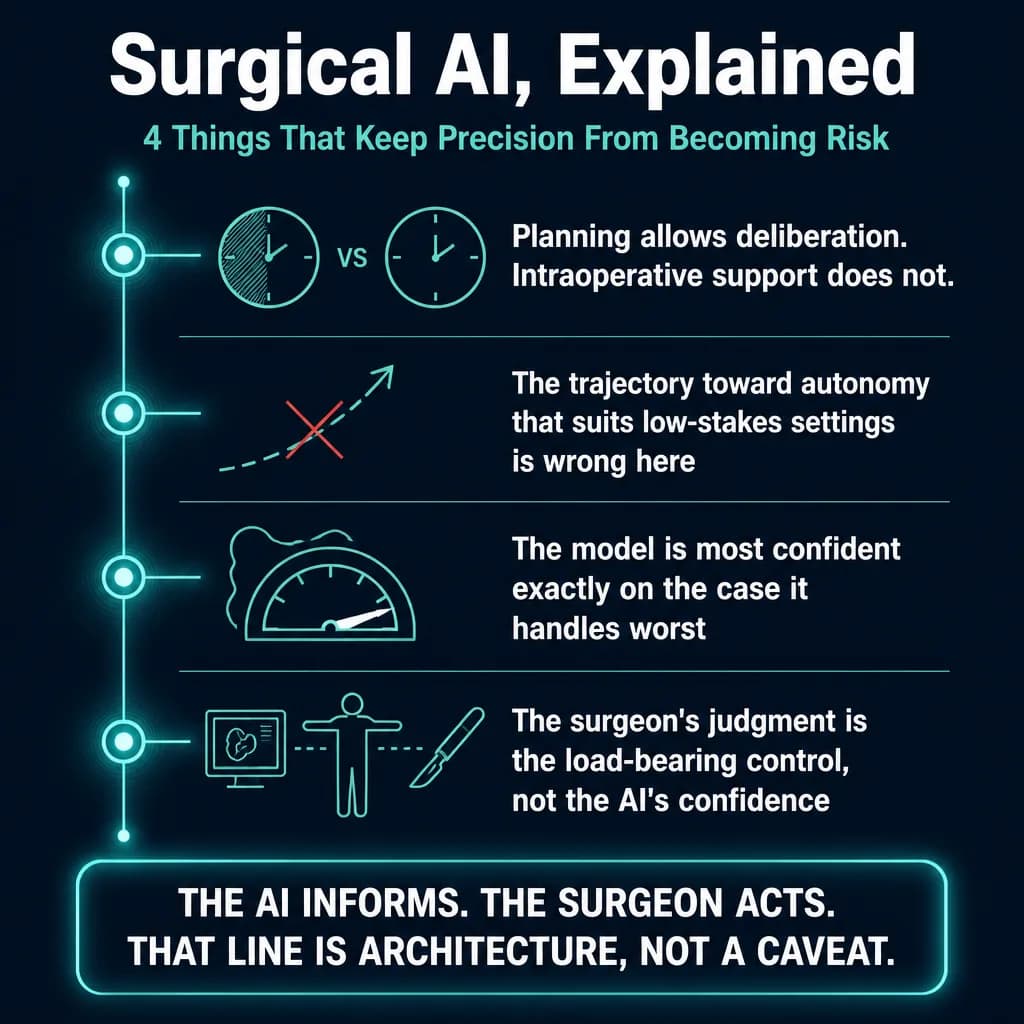
The position worth stating plainly: surgical AI should be engineered to make the surgeon more precise and never to act in their place, even where the technology could take an action, because the operating room is the one environment where a wrong action has no window for correction. The trajectory toward autonomy that makes sense in low-stakes, reversible settings is exactly wrong here. The value is precision under human control, and the moment the system takes an action the surgeon did not command, it has introduced a risk that no amount of accuracy justifies, because accuracy is not the same as infallibility and the operating room does not tolerate the difference.
Where it almost breaks
A surgical support system is deployed to provide intraoperative guidance, and it performs well across routine cases, earning the surgical team’s trust. Then an atypical case arrives, with anatomy unlike what the model had reliably seen. The system presented its intraoperative information with its usual confidence, and because the team had come to rely on it, the guidance carried weight it had not earned for this case. There was no interval to deliberate, because the support was real-time, and the model gave no signal that it was outside its reliable range. The surgeon’s own perception, that the case was unusual and the guidance did not match what they were seeing, was the only thing standing between a confident wrong output and an action on the patient. The correction was to keep the surgeon’s control structural and unambiguous, to engineer the system to signal when a case fell outside its validated range rather than presenting everything with uniform confidence, and to validate the system specifically on atypical cases rather than assuming routine-case performance would hold. The system stayed useful for the cases it handled well. It stopped presenting confident guidance the surgeon might have deferred to on the cases it did not.
AI in surgical planning and intraoperative support can make a surgeon more prepared and more precise, analysing a case in advance and surfacing useful information during it. That value is real, and it is fully compatible with the surgeon retaining absolute control. It delivers safely only when human control is built into the architecture rather than added as oversight, when the system signals the boundaries of its own competence rather than presenting every case with equal confidence, and when the AI is engineered to inform the surgeon’s action rather than to take one. A system positioned to act in the one environment where actions cannot be undone has traded a marginal capability for a risk no accuracy figure can justify.
The question to bring to any surgical AI is not how much of the procedure it can handle. It is whether the surgeon’s control over every consequential action is structural and unambiguous, whether the system tells the surgeon when it is outside what it handles reliably, and whether it was validated on the atypical cases where a confident wrong output does the most harm. That is the difference between AI that assists surgery and precision that survives scrutiny under human control.
Related: Healthcare & Life Sciences · Koita Foundation: An AI-powered knowledge hub with citation-backed retrieval across seven repositories
Tell us the number you need to move.
…outcomes that survive scrutiny.