AI in the EHR: Reducing Click Burden Without Compromising the Record
The click burden in the electronic health record is one of the most cited sources of clinician frustration, and for good reason: clinicians spend a large fraction of their day navigating, entering, and reconciling data through interfaces that seem designed to maximise friction. AI promises to cut through it, drafting entries, surfacing information, reducing the manual work of the record. The promise is legitimate, and it sits on top of a distinction that determines whether it helps or quietly harms. The click burden exists partly because of bad interface design and partly because the record is a deliberate, structured, accountable artifact whose integrity depends on the care taken to build it. Reducing the friction that is just bad design is pure gain. Reducing the friction that was actually the record being built carefully is a loss disguised as efficiency.
The framing error is treating every click as waste to be eliminated. Click reduction becomes the metric, and fewer clicks feels like unambiguous progress. But not every click is friction. Some of the friction in the EHR is the clinician actively constructing the record: reviewing, reconciling, deciding what to enter, catching an inconsistency in the process. Automating those clicks does not just save time. It removes the clinician’s active engagement with the record at the exact points where that engagement was maintaining the record’s integrity. The goal is not the fewest clicks. It is the removal of friction that carries no value while preserving the engagement that keeps the record accurate and accountable.
Why some friction is the record being built
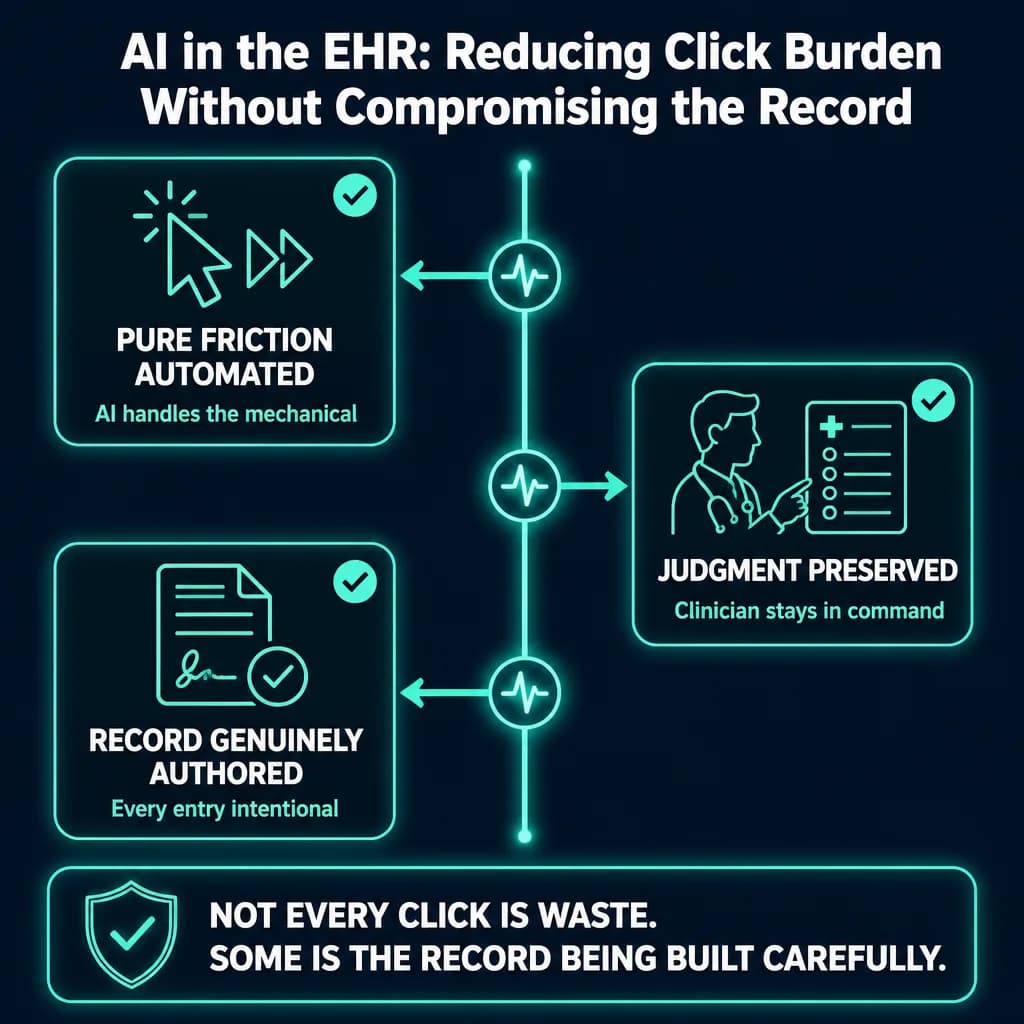
The EHR is not just a data entry burden. It is the authoritative account of a patient’s care, and it is authoritative because clinicians build it with attention: entering what they observed, reconciling it against what is already there, and taking responsibility for what the record now says. That attention shows up as clicks and effort, and it is tempting to see all of it as overhead. Some of it is. Some of it is the mechanism by which the record stays trustworthy.
Consider what happens at the points of friction that involve judgment. A clinician reconciling a medication list is doing tedious work, and they are also checking that the list is right, catching a discrepancy, making a clinical judgment about what belongs. A clinician entering an assessment is clicking through an interface, and they are also committing to a clinical statement they are accountable for. Automate the reconciliation, and the discrepancy the clinician would have caught goes uncaught. Pre-populate the assessment, and the clinician’s active authorship becomes passive acceptance of what the model generated. The clicks disappeared, and so did the clinical engagement that the clicks were carrying, which is the same failure as automating a nurse’s task and removing the observation that happened during it.
So the useful distinction is between clicks that are pure interface friction, navigation, redundant entry, mechanical steps that carry no judgment, and clicks that are the clinician engaging with the record’s content. The first category is waste, and removing it is real value with no downside. The second category is the record being built, and automating it trades integrity for speed.
Why the record’s integrity is the constraint
The record has to remain something the clinician actively owns, because everyone downstream relies on it as the authoritative account, and its integrity depends on the clinician’s engagement being real rather than nominal. AI that drafts and pre-populates can erode this in a specific way: it shifts the clinician from author to reviewer, and review is a weaker form of engagement than authorship. A clinician composing an entry thinks it through. A clinician reviewing a generated entry may accept it with far less scrutiny, especially under time pressure, and the record now contains something the clinician nominally owns but did not really construct.
This is the sign-off becoming a rubber stamp problem in a different setting, and it matters because the record’s accountability assumes the clinician’s ownership is genuine. When an entry is questioned later, the clinician is accountable for it, and that accountability is only meaningful if they actually engaged with what they signed. AI in the EHR has to be designed to keep the clinician’s engagement real for anything that carries clinical or accountability weight, which means making the review active rather than passive, surfacing what the clinician needs to actually decide rather than presenting a finished entry to wave through. The clinician remains accountable for the record, so the tool has to support authorship rather than replace it.
The trade-off, named plainly
Preserving the clinician’s engagement with the record means AI in the EHR reduces fewer clicks than it technically could. A tool that pre-populates everything, automates reconciliation, and presents finished entries for one-click acceptance would cut click burden dramatically, at the cost of turning the clinician from author into approver and weakening the record’s integrity. A tool that automates only the friction carrying no judgment saves less time and keeps the record something the clinician genuinely builds. The tension is real, and pushing hard toward maximum click reduction is exactly what erodes the engagement the record depends on.
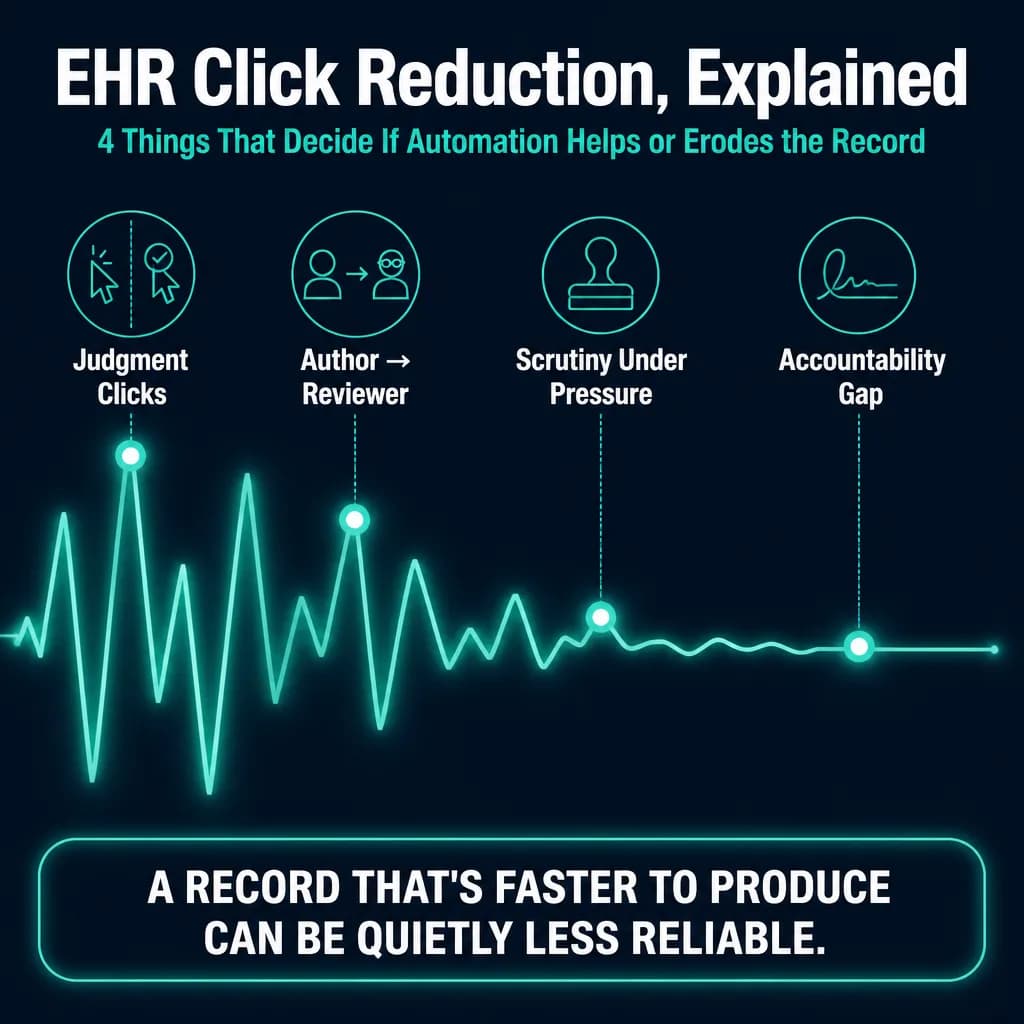
The position worth stating plainly: AI in the EHR should eliminate the friction that carries no clinical judgment and preserve the clinician’s active engagement with everything that does, even though automating more would show a better click-reduction number. A tool measured purely on clicks eliminated is optimised to remove engagement it should have kept, and the loss shows up not as a metric but as a record that is faster to produce and less trustworthy. The clinician who can wave through a fully generated note has saved clicks and stopped authoring the record, and the record is worse for it in ways no efficiency metric captures.
Where it almost breaks
A health system deploys AI in its EHR to attack click burden, and to maximise the relief, it automates medication reconciliation and pre-populates clinical entries for clinicians to accept. Click counts drop sharply, and clinicians appreciate the lighter load. Then a case surfaces where an automated medication reconciliation carried forward a discrepancy that the clinician, in the old manual process, would likely have caught, because catching discrepancies was part of what the manual reconciliation actually did. The clinician had accepted the automated result without the scrutiny the manual process forced. The clicks that had been eliminated were not pure friction. They were the reconciliation being done with attention. The correction was to distinguish the friction that carried judgment from the friction that did not: automate the navigation and redundant entry fully, keep reconciliation and clinical entry as active clinician tasks with AI assisting rather than replacing, and design the interaction so the clinician engaged with what mattered rather than waving it through. Clinicians kept meaningful relief from genuine friction. The record regained the integrity that passive acceptance had eroded.
AI in the EHR can remove a real and demoralising burden by eliminating the mechanical friction that carries no clinical value, and that relief is worth pursuing in a setting where interface burden drives burnout. It delivers safely only when it distinguishes the friction that is pure overhead from the friction that was the clinician building the record, automating the first fully and preserving genuine engagement with the second. A tool optimised purely to cut clicks will eventually automate the engagement that kept the record trustworthy, and the loss will surface as a record that is faster to produce and quietly less reliable.
The question to bring to any EHR AI is not how many clicks it eliminates. It is whether it removes the friction that carried no judgment while keeping the clinician genuinely engaged with the entries and reconciliations that carry clinical weight, whether review remains active rather than a rubber stamp, and whether the record stays something the clinician actually authors. That is the difference between reducing click burden and reducing it without compromising the record.
Related: Healthcare & Life Sciences · Koita Foundation: An AI-powered knowledge hub with citation-backed retrieval across seven repositories
Tell us the number you need to move.
…outcomes that survive scrutiny.