AI Nursing Assistants and Workflow Support: Easing Load Without Adding Risk
Nurses spend a large share of their shift on work that is not nursing: documentation, coordination, chasing information, administrative tasks that accumulate around the actual care. The load is real, it contributes directly to burnout, and it is a legitimate target for AI. But a nurse’s workflow is not a neutral space to automate. It is a clinical environment where the nurse is often the person who notices the thing no one else caught, the subtle change, the patient who does not look right, the detail that turns out to matter. AI that eases the administrative load without disturbing that vigilance is genuine help. AI that eases the load by inserting itself into the nurse’s clinical attention, or by degrading the information the nurse relies on, has traded a burden for a risk, and in nursing the risk is measured in patients.
The framing error is treating nursing support as pure efficiency, where any task the AI takes off the nurse’s plate is a win. Some tasks are, and removing them is real value. But the nurse’s work is not cleanly divided into clinical and administrative, and the administrative tasks are often where clinical observation happens incidentally. A nurse reviewing a chart, coordinating a handoff, or documenting an assessment is frequently also noticing something. Automating the task without understanding what the nurse was observing while doing it can remove the observation along with the task, which is not efficiency. It is the quiet subtraction of a safety function that was never labelled as one.
Why the nurse’s attention is a clinical instrument
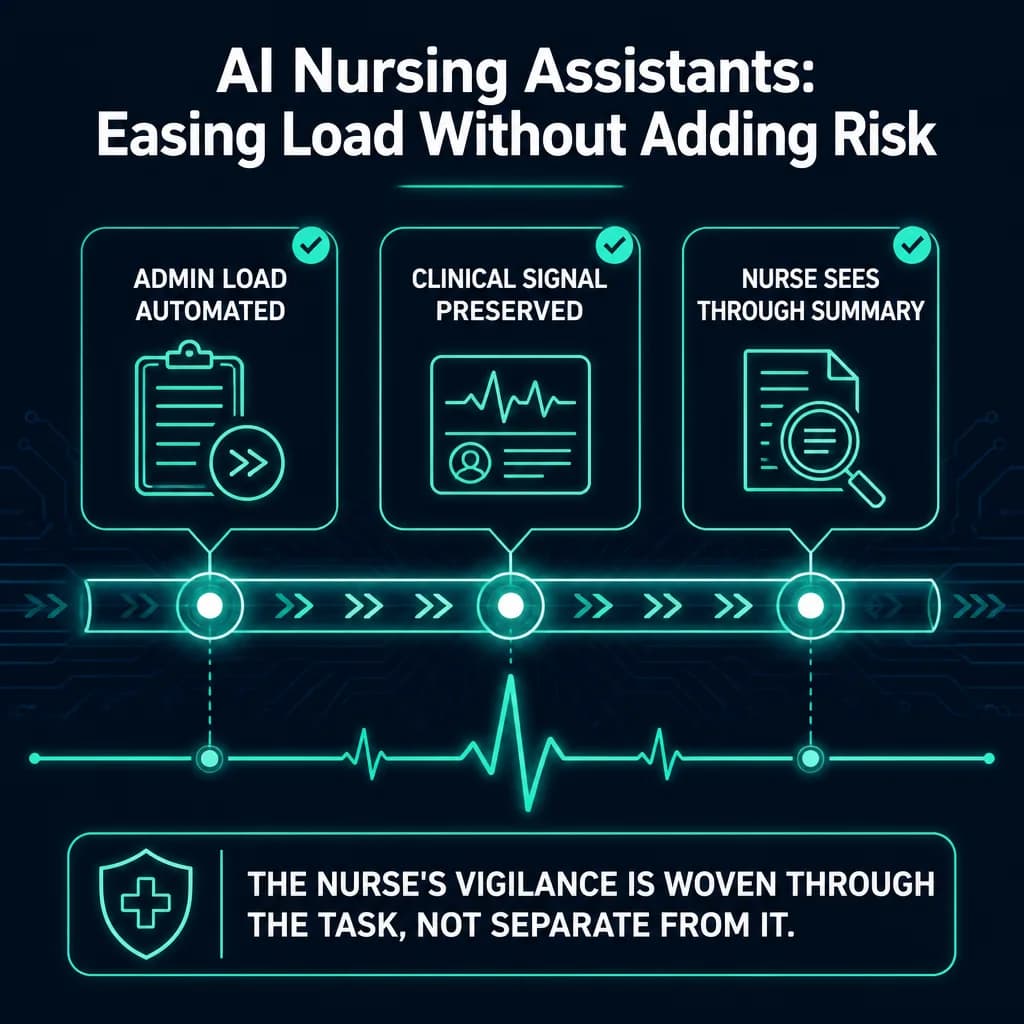
The nurse is often the continuous human presence in patient care, the one with sustained contact who builds the pattern-sense for how a patient is doing and notices when it changes. That noticing is not a separate activity the nurse performs on top of their tasks. It is woven through the tasks. The nurse observing a patient while taking vitals, sensing something off during a routine interaction, catching an inconsistency while reviewing information: the clinical vigilance and the workflow are intertwined, and the vigilance is a large part of what makes nursing a safety-critical role rather than a task list.
This matters for AI support because it changes what a task actually is. An administrative task that looks like pure overhead may be the occasion for an observation the nurse would not otherwise make. Automate the review of information, and the nurse no longer reviews it, which means the nurse no longer notices what they would have noticed in the reviewing. The task got faster. The incidental observation disappeared. Whether that is a good trade depends entirely on what the nurse was catching while doing the task, and a support tool designed without that understanding will optimise away observations no one realised were happening.
So the design principle follows: AI nursing support should reduce the load that is genuinely just load, and preserve the nurse’s engagement with the information and observations that carry clinical signal. Drawing that line requires understanding the actual work, not just the task labels, which means the design has to reflect the operational reality of nursing rather than an idealised flowchart of it.
Where the support is safe and where it strains
The safe, high-value support is in the tasks that are genuinely administrative and carry no incidental clinical observation. Coordinating logistics, drafting routine documentation for the nurse to review, surfacing information the nurse needs faster, reducing the mechanical overhead of the shift: these ease real load with a bounded downside, because nothing clinical was riding on the nurse doing them manually.
The strain appears where the support touches information the nurse acts on clinically. A tool that summarises a patient’s status for a nurse is helpful until the summary omits or softens the detail that would have prompted concern, at which point it has filtered the nurse’s clinical picture through a model that does not share the nurse’s accountability. The fluent summary that reads well and quietly drops the detail that mattered is the specific danger, because the nurse, trusting a helpful tool, may act on the summary rather than the source. The support has to keep the nurse connected to the underlying information for anything clinical, presenting the summary as a starting point the nurse can see through rather than a substitute for the record.
Accountability stays with the nurse throughout, which means the tool has to support the nurse’s judgment rather than replace it, and the nurse has to remain able to see past the tool to what it was built on. A nursing support tool that becomes the nurse’s only view of the patient has inserted a model into the clinical accountability chain, and the model does not carry the accountability the nurse does.
The trade-off, named plainly
Designing support that preserves clinical vigilance means the AI eases less load than it technically could. A tool that summarises everything, filters aggressively, and handles more of the nurse’s information work would save more time, at the cost of distancing the nurse from the observations that make them a safety instrument. The version that keeps the nurse engaged with clinical information saves less time and preserves more signal. There is a real tension, and resolving it toward maximum time-saving is how a support tool quietly degrades the vigilance it was supposed to protect.
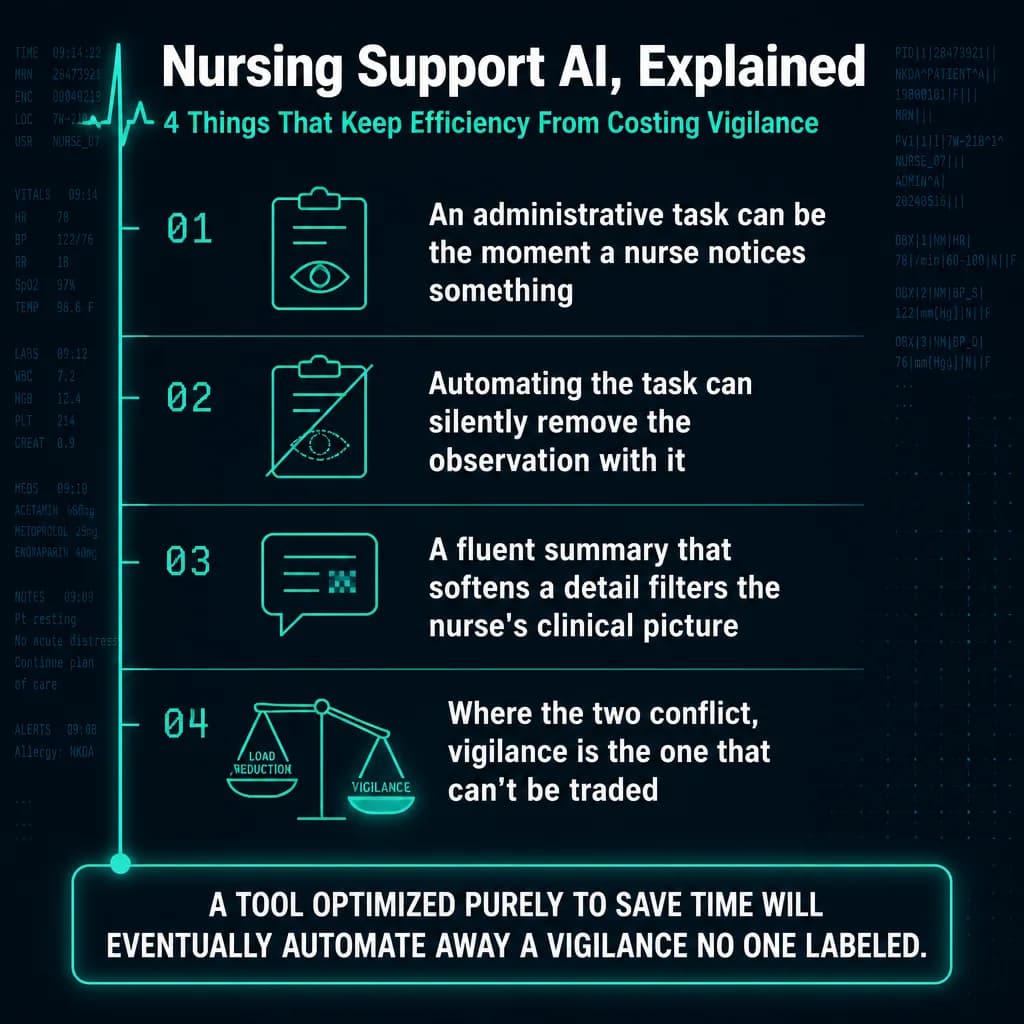
The position worth stating plainly: AI nursing support should be designed to preserve the nurse’s clinical vigilance even where that means automating less, because the nurse’s incidental observation is a safety function that does not appear on any task list and is easy to remove without noticing. A tool optimised purely for load reduction will eventually automate away an observation that mattered, and the loss will be invisible until a patient is affected. Easing burden and preserving vigilance are both real goals, and where they conflict, in a safety-critical role, vigilance is the one that cannot be traded.
Where it almost breaks
A hospital deploys an AI nursing support tool to reduce documentation and information-handling load, and to maximise the relief, it summarises patient status and handles much of the information review nurses had done manually. Nurses get real time back, and the tool is welcomed. Then a case surfaces where a nurse, relying on the tool’s summary rather than the full record it had condensed, missed a detail the summary had softened, a subtle change that the nurse reviewing the source would likely have caught. The task the tool had automated was the exact task during which the nurse used to make that observation. Nothing had malfunctioned. The tool had removed the observation along with the overhead, and no one had realised the observation was happening. The correction was to redesign the support around the actual work: automate the genuinely administrative load, keep the nurse connected to the source information for anything clinical, present summaries as visible-through starting points rather than substitutes, and preserve the nurse’s engagement with the observations that carried signal. The nurses kept meaningful time savings. The vigilance the tool had quietly eroded came back.
AI nursing assistants and workflow support can give nurses back real time by removing the administrative load that accumulates around care, and that relief is worth pursuing in a role where burnout is a genuine threat to patient safety. It delivers that safely only when it is designed around the actual work, easing the load that is just load while preserving the nurse’s engagement with the information and observations that make them a clinical safety instrument. A tool optimised purely to save time will eventually automate away a vigilance no one labelled, and the loss will surface as a patient affected rather than a metric missed.
The question to bring to any nursing support tool is not how much time it saves. It is whether it eases the load that carries no clinical signal while keeping the nurse connected to the observations that do, whether the nurse can still see past the tool to the record it summarised, and whether the design was built from the real work rather than the task labels. That is the difference between easing load and easing load without adding risk.
Related: Healthcare & Life Sciences · Koita Foundation: An AI-powered knowledge hub with citation-backed retrieval across seven repositories
Tell us the number you need to move.
…outcomes that survive scrutiny.