AI Symptom Checkers and Triage Chatbots: Safe Routing Under Clinical Rules
A patient with chest tightness at eleven at night has three options: wait until morning, drive to an emergency department, or type their symptoms into whatever your organisation put on its website. The third option exists because the first two are imperfect, one delays care that might be urgent, the other floods the ED with cases that are not. A triage chatbot sits in that gap, promising to send each patient to the right level of care. Whether it keeps them safe depends entirely on a design decision made long before the patient starts typing: is the system routing, or is it diagnosing?
Those are not the same job, and conflating them is the central failure mode of patient-facing symptom tools. A diagnosis names what is wrong. Triage decides how urgently, and where, a human should look, without needing to know what is wrong at all. The safe system does the second and refuses the first. The dangerous one drifts, under the pressure of seeming helpful, toward telling patients what their symptoms mean.
Why “what’s wrong with me” is the wrong question for the bot to answer

The reason is not caution for its own sake. It is the consequence of what these tools are and who uses them.
A symptom checker reasons from what a patient types, and patients are not reliable describers of their own symptoms. They use the wrong words, omit the detail that matters, downplay what frightens them, and emphasise what is merely uncomfortable. A clinician compensates for this constantly, reading tone, asking the follow-up, noticing what the patient is not saying. A chatbot has only the text. Building a diagnosis on self-reported, lay-described input is constructing a clinical conclusion on the least reliable foundation in medicine.
Triage is more forgiving, and that is the point. A routing decision does not need to be right about the diagnosis. It needs to be right about the urgency, and when uncertain, it can safely round up. “I cannot tell you what this is, but this combination of symptoms needs a clinician today” is a defensible output from limited information. “This is probably anxiety” is a claim that sits well outside what the system can support. The system should be engineered to make routing decisions it can stand behind and to refuse diagnostic ones it cannot.
The asymmetry that governs every escalation rule
Triage errors are not symmetric, and the entire safety design follows from that fact.
Over-triage sends a patient to a higher level of care than they turned out to need. The cost is a wasted visit, an over-loaded ED, an anxious patient, real money. Under-triage sends a patient to a lower level, or home, when they needed urgent care. The cost is a missed time-critical condition and a patient harmed, sometimes permanently. These are not two sides of one error. One is inefficiency; the other is the headline.
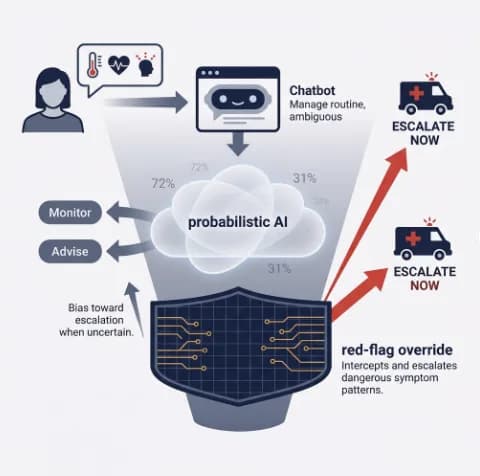
So the escalation logic must be deliberately, openly biased toward caution: when the system is uncertain, it routes up. This is a trade-off, and it is worth stating without softening. A safely-built triage bot will over-refer, sending some patients to clinicians who did not strictly need one. That is the cost of the design, and it is the correct cost to pay. A bot tuned to minimise unnecessary referrals is a bot tuned, whether its builders admit it or not, to occasionally send home someone who should have been seen. The oversight has to sit where the consequence lives, and in triage the consequence lives in the under-triage tail.
The load-bearing controls, then, are the escalation rules, and the model’s diagnostic cleverness sits well below them. Hard-coded red flags route a patient to emergency care immediately regardless of what the conversational model concludes. Chest pain with the wrong companions, signs of stroke, breathing difficulty, the symptoms of sepsis, these should never be subject to a probabilistic model’s judgment. They are deterministic rules that fire on pattern, override the chat flow, and escalate. The model handles the ambiguous middle; the rules own the dangerous edges.
Designing the boundaries the patient never sees
A safe triage system makes three commitments visible in its behaviour even though the patient never reads them.
It states what it is and is not, a routing aid, and diagnosis and substitution for a clinician’s judgment sit well outside what it claims to do. It always offers the escape hatch: a clear, immediate path to a human or to emergency services that does not require completing the conversation. And it fails safe, defaulting to escalation when input is ambiguous, contradictory, or outside what it can interpret, and holding guessing off the table.
Validation, here, is specifically the discipline of measuring under-triage. The metric that matters is not how often the bot agrees with a clinician on average. It is how often it sends home a patient who needed care, and on which presentations. Treating that as an ongoing evaluation in place of a launch-day check is non-negotiable, because the failures cluster in exactly the rare, atypical presentations that a model trained on common cases handles worst. A symptom tool that performs beautifully on routine complaints and fails on the unusual cardiac presentation has optimised for the cases that were never the danger.
Where it almost breaks
A health system deploys a triage chatbot to reduce ED volume, and to make it feel helpful, lets the conversational model weigh symptoms freely and suggest likely explanations. For routine complaints it works well, and ED visits for minor issues drop. Then a patient describing atypical symptoms, discomfort the patient framed as indigestion, with companions the patient did not think to mention prominently, is reassured by the bot and advised to monitor at home. The presentation was an atypical cardiac event, and the model’s fluent reassurance had carried more weight with the patient than a hedge would have. No deterministic rule had been allowed to override the conversational flow. The fix was structural. A layer of hard-coded red-flag rules was introduced to escalate certain symptom combinations to emergency routing regardless of the model’s conclusion, a default-to-escalation behaviour on ambiguous input was added, and continuous monitoring of the under-triage rate was established as the system’s primary safety metric. The bot kept deflecting routine volume. It stopped reassuring the patients it should have escalated.
An AI symptom checker can take real load off a stretched system, answering the routine question, reassuring the worried-but-well, and pointing people to the right level of care without a clinician spending time on it. That value is real and it is achievable without pretending the tool diagnoses anything. The discipline is keeping it firmly in the routing job, biasing every uncertain call toward a human, and putting deterministic rules in charge of the symptoms that cannot be allowed to slip through.
The question to bring to any patient-facing triage tool is not how accurately it identifies conditions. It is what it does when it is unsure, whether it rounds up to a clinician or guesses to seem helpful, and whether anyone is measuring the one number that matters: how often it sent home a patient it should have escalated.
Related: Healthcare & Life Sciences · Koita Foundation: An AI-powered knowledge hub with citation-backed retrieval across seven repositories
Tell us the number you need to move.
…outcomes that survive scrutiny.