AI Trade Surveillance: Detecting Market Abuse Without Drowning in Alerts
A firm’s trade surveillance function exists to catch market abuse, insider dealing, manipulation, spoofing, the trading conduct that regulators hold firms responsible for detecting in their own activity. The volume of trading a firm has to monitor is enormous, and traditional surveillance systems, built on rules and thresholds, respond to that volume by generating alerts in overwhelming numbers, the vast majority of which are false positives. Surveillance analysts spend their days clearing alerts that turn out to be nothing, and the genuine abuse, if it is caught at all, is caught only if an analyst reaches it before the queue buries it. AI promises better surveillance, detecting the patterns of abuse with more precision than crude rules. The value is real, and it depends entirely on precision, because a surveillance system that floods analysts with false positives does not improve detection, it just relocates the noise, and the genuine abuse stays buried in a bigger pile. AI trade surveillance is the discipline of detecting market abuse with enough precision that analysts can actually investigate the alerts, catching the abuse that matters without drowning in the alerts that do not.
The core problem is the same one that afflicts every high-volume surveillance function: an alert is only valuable if a human investigates it, and a system that generates more alerts than can be investigated does not increase detection, it increases the noise that hides the real signal.
The constraint that owns the workflow
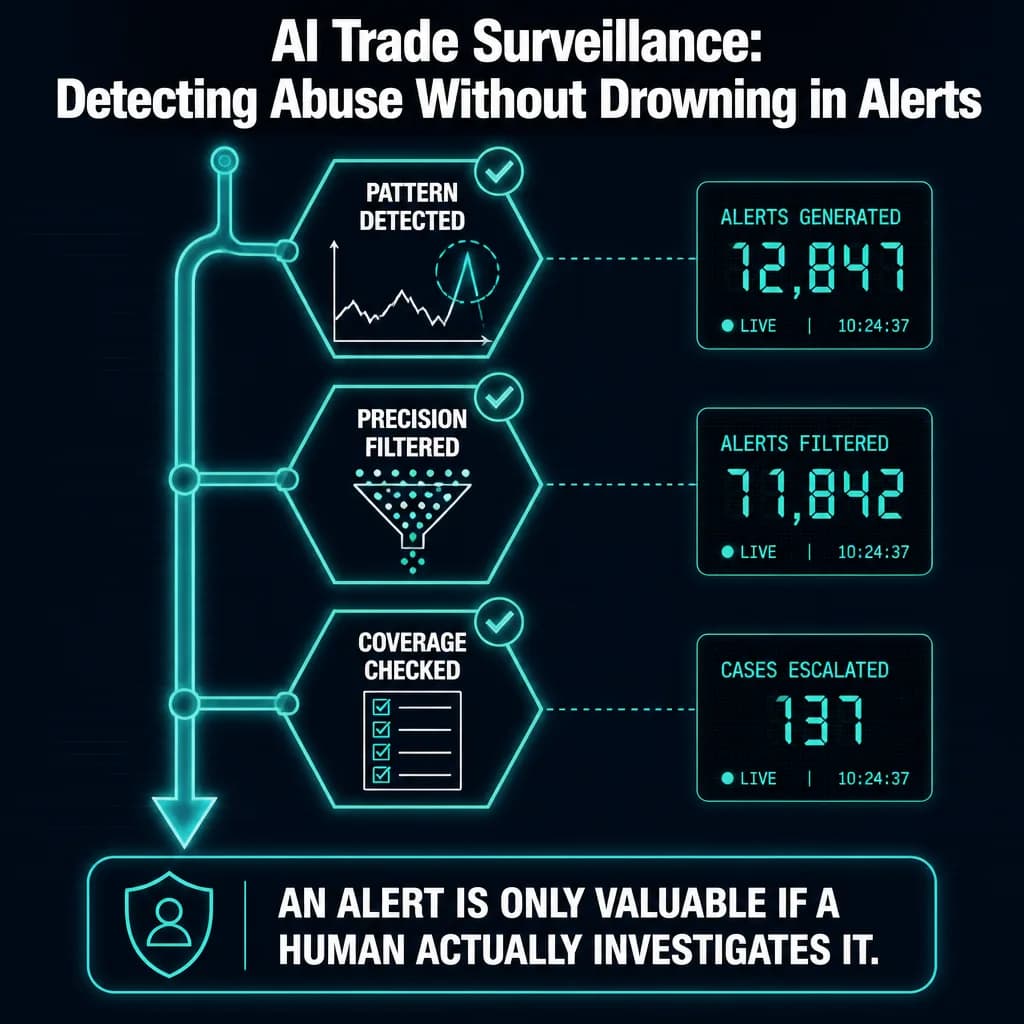
Trade surveillance sits under obligations that require it and shape it. Firms are obligated to monitor for and detect market abuse in their trading activity, so the surveillance has to provide genuine coverage of the abuse types the firm is responsible for catching. Detected potential abuse has to be investigated and, where confirmed, escalated and reported, so the surveillance feeds a process that requires human investigation. The firm has to be able to demonstrate its surveillance is effective, so the process has to be reconstructable and defensible. And surveillance that generates unmanageable false positives fails in practice, because analysts buried in noise cannot investigate the genuine signals, so precision is not just efficiency, it is what makes detection actually happen.
The failure modes are the familiar surveillance failures. Under-detection, where genuine market abuse is missed, which is a compliance failure the firm is responsible for. The false-positive flood, where the system generates so many alerts that analysts cannot process them and the genuine abuse is buried in the noise, which is a practical failure that also means abuse goes uncaught. And the coverage-gap failure, where the system detects some abuse types well and others poorly, leaving blind spots in exactly the coverage the firm must provide.
The position: precision determines how much abuse actually gets caught
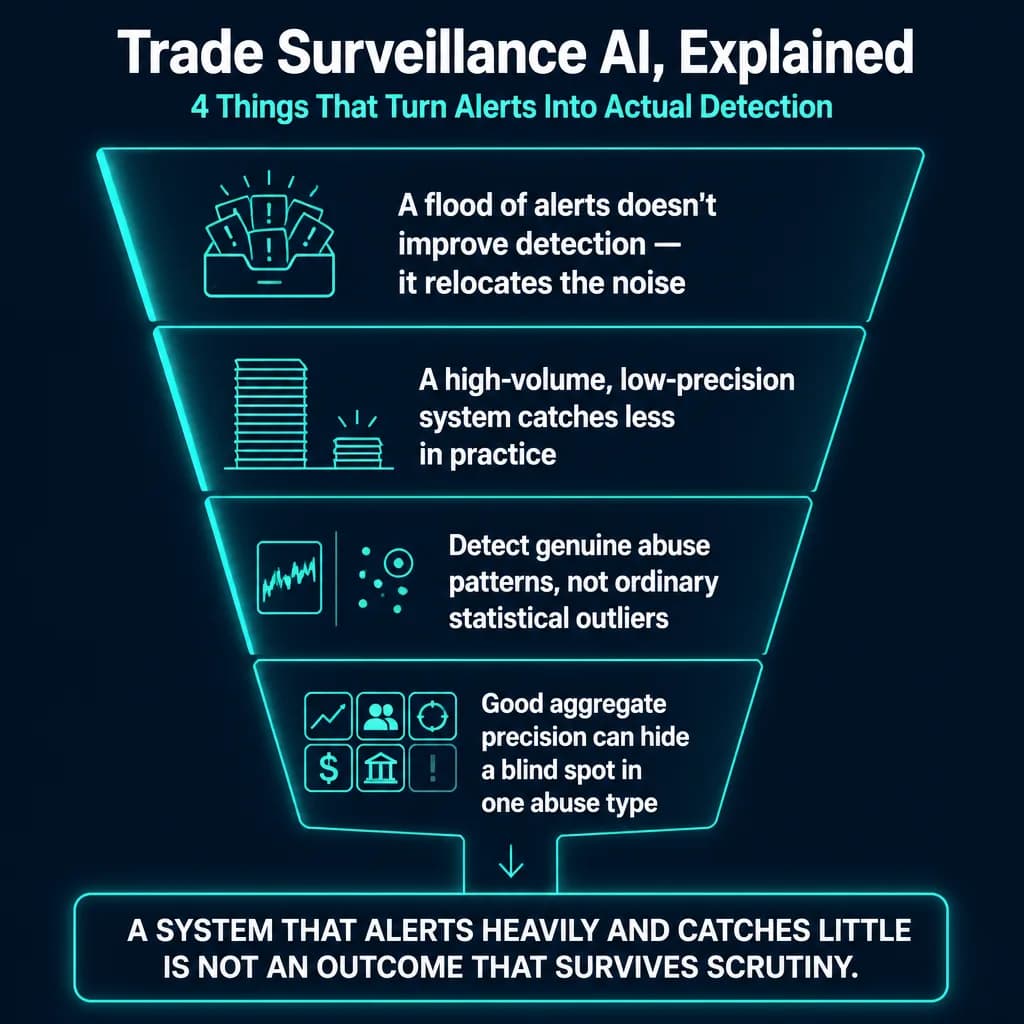
Here is the stance I would hold. The precision of a trade-surveillance system determines how much market abuse actually gets investigated and caught, because an alert only leads to detection if an analyst investigates it, and a low-precision system that floods the queue buries the genuine alerts among false positives the analysts cannot clear. A system judged by how many alerts it generates is optimising the wrong thing, because raw alert volume is not detection, and a high-volume, low-precision system achieves worse practical detection than a system that alerts less but alerts better. Precision is the property that turns surveillance coverage into actual detection.
The reasoning is about what happens to an alert after it is raised. Detection of market abuse requires a human to investigate an alert, confirm whether it represents genuine abuse, and escalate it, and analysts can only investigate a finite number of alerts. A system that raises far more alerts than can be investigated does not surface more abuse, it fills the queue with false positives while the genuine alerts wait unexamined, so the abuse the system technically detected never gets investigated because it is buried. Precision, the fraction of alerts that represent genuine concern, therefore determines how much of the abuse the system flags actually gets caught, and a low-precision system defeats its own purpose by making the queue unmanageable. So the engineering has to optimise for precision and for surfacing genuine abuse, not for alert volume, because the goal is caught abuse, not raised alerts. A surveillance system that generates alerts faster than they can be cleared has made detection harder, not easier.
Engineering inside the constraint
The system is engineered for precision in detecting genuine market abuse. It analyses trading activity for the patterns of specific abuse types, insider dealing, spoofing, layering, manipulation, aiming to surface the activity that genuinely warrants investigation rather than everything that superficially trips a threshold, because the crude threshold approaches that generate most false positives are exactly what buries the real signal. The detection is built to identify the actual patterns of abuse rather than simple statistical outliers that are usually innocent, which is where AI can improve on rules, distinguishing genuine concern from the ordinary trading that rule-based systems flag indiscriminately.
Detected concerns are routed to human investigation with the context that makes investigation efficient, the reasoning behind the alert and the relevant trading activity, so an analyst can assess an alert quickly rather than reconstructing it from scratch. Every alert, its investigation, and its disposition are written to a reconstructable record, so the firm can demonstrate its surveillance is effective and its concerns are properly handled.
The critical discipline is ensuring precision does not come at the cost of coverage gaps, because a system that achieves good aggregate precision by detecting the easy abuse types well and missing the hard ones leaves blind spots in exactly the coverage the firm is obligated to provide. The system is evaluated against an explicit standard covering precision and coverage across each specific abuse type it must detect, operated repeatably as the system changes, which is the work a rubric-based evaluation engine like PRISM is built to carry, so a change is checked for whether it preserved detection across all the abuse types rather than just improving the aggregate alert numbers. Human investigation and judgment own the assessment of flagged activity, because deciding whether trading represents genuine abuse is a judgment the firm’s surveillance function has to make, and the reporting that follows carries regulatory weight.
Where it almost broke
A firm replaced its rule-based trade surveillance with an AI system to improve detection, and the new system did detect a broader range of abuse patterns. To be thorough, it had been tuned toward sensitivity, and it generated a high volume of alerts, which the firm initially read as comprehensive coverage. The surveillance analysts could not process the volume, and the great majority of alerts were false positives, so the genuine concerns sat in a queue the analysts could not clear, and the practical detection was no better than before despite the more sophisticated system. The firm had a more capable detector producing more alerts than anyone could investigate, and the real abuse was still buried, now in a larger pile.
The system detected well and surfaced little, because its low precision meant the genuine alerts drowned in false positives. The fix was to tune for precision, refining the detection to surface genuinely concerning activity rather than everything that looked statistically unusual, so the alerts analysts saw were worth investigating, and checking coverage across each abuse type so precision did not create blind spots in the harder-to-detect patterns. The alert volume dropped, the investigable signal rose, and detection improved in practice. A surveillance system that floods analysts with false positives has not improved detection, it has moved the noise and left the abuse buried.
AI trade surveillance lets a firm monitor a volume of trading that human review could never cover, detecting the market abuse regulators hold firms responsible for catching. It works only when it is precise enough that analysts can actually investigate the alerts, because a system that floods the queue with false positives does not improve detection, it relocates the noise and leaves the genuine abuse buried among alerts no one can clear. Precision is what turns surveillance coverage into caught abuse, and coverage across every abuse type is what ensures precision does not hide a blind spot.
A firm operating trade surveillance should ask not how many alerts its system generates but how many of them are worth investigating, and whether its precision holds across every abuse type it must detect. A surveillance system that alerts heavily and catches little is not an outcome that survives scrutiny.
Related: Banking & Financial Services · Reserve Bank Innovation Hub: Automated grievance workflows with natural-language access and a complete audit record · IndusInd Bank Limited: AI-Powered Knowledge Source-Based Process Training and Query Resolution
Tell us the number you need to move.
…outcomes that survive scrutiny.