AI Underwriting That Survives a Model-Risk Committee
An underwriting model that improves loss ratios and cannot explain its decisions will not make it into production at a serious lender, and the reason has nothing to do with its accuracy. Underwriting decides who receives credit and on what terms, which makes it one of the most heavily governed decisions a financial institution makes. Before that model goes live, it has to pass a model-risk committee whose job is to probe exactly the things a performance metric does not capture: can this decision be explained, is it fair, can it be governed, what happens when it drifts. Many capable models die in that room.
This is the real bar for AI underwriting, and it is set by the committee rather than the data science. A model that predicts default beautifully and cannot answer the committee’s questions is not deployable, because the institution cannot defend decisions it cannot explain to a regulator, a declined applicant, or its own risk function. Building underwriting AI that survives the committee means engineering for the committee’s questions from the start, not optimising for accuracy and hoping explainability can be added later.
What the committee actually probes
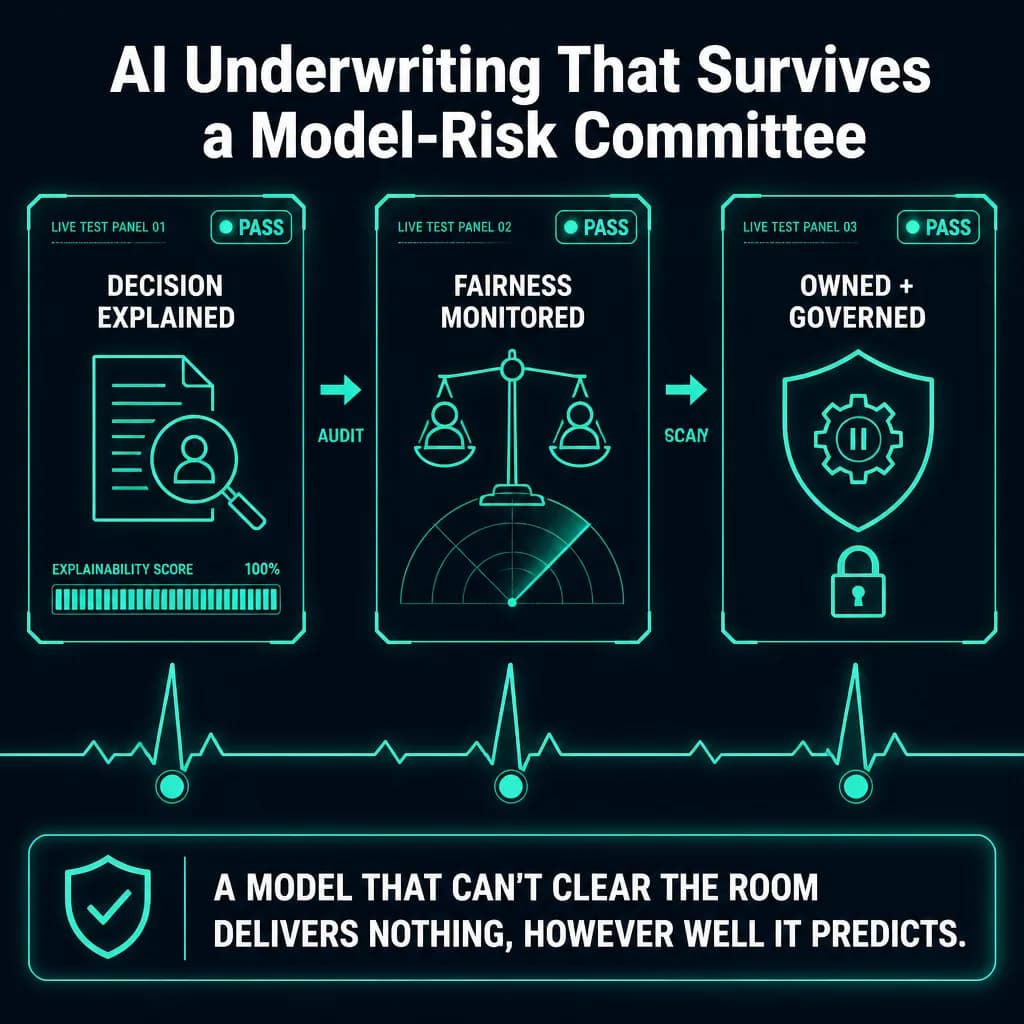
A model-risk committee reads an underwriting model as a source of risk to be governed. It asks how a specific decision was reached and whether that reasoning can be reconstructed for any past applicant. It asks whether the model treats protected groups fairly and how that fairness is measured and monitored. It asks who owns the model, who validates changes to it, and how fast it can be stopped if it misbehaves. It asks how drift is detected and what happens when the model’s world shifts.
None of these questions is about raw predictive accuracy, and a model built only to maximise accuracy has answers to none of them. The committee is testing whether the institution can operate and account for the model safely, which is a property of the whole system around the model, not of the model alone.
Engineering underwriting for the committee
Surviving the committee means building its requirements into the architecture. Each decision has to carry its reasoning, so any past underwriting outcome can be reconstructed and explained to an applicant or a regulator. Fairness has to be measured across groups and monitored continuously, because a model fair at launch can drift into disparate treatment. The model needs a named owner, a governed change process, and a defined way to be paused. And it needs monitoring that surfaces drift before it becomes a problem the committee discovers later.
The adverse-action requirement makes explainability non-negotiable. When credit is declined, the applicant is often entitled to the specific reasons, which means the model has to produce them for every decision, not approximate them after the fact. A model that cannot state why it declined a specific applicant fails a legal requirement before it reaches the committee’s harder questions.
The trade-off, and where it almost breaks
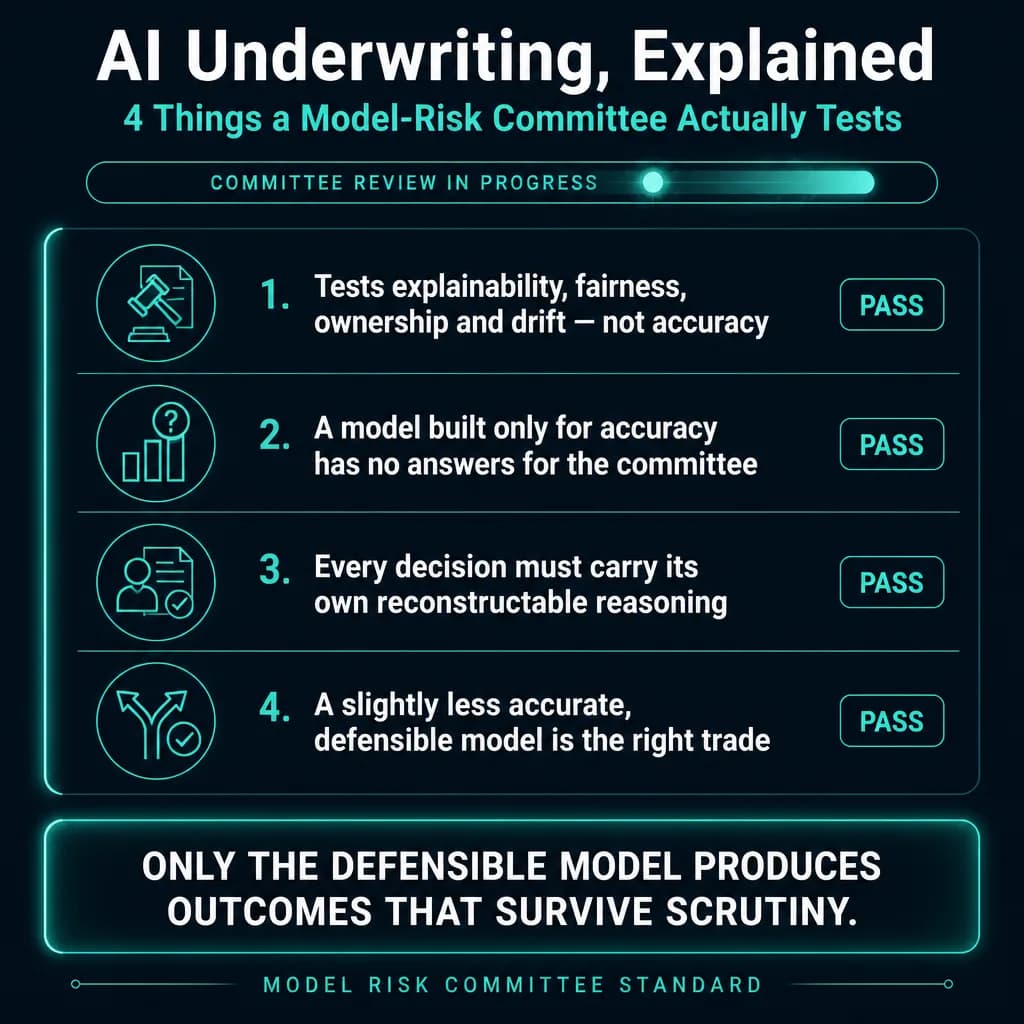
Engineering for the committee constrains the model. The most accurate model available may be the least explainable, and building for explainability and fairness can mean accepting a model that scores slightly lower on pure prediction. That is a real trade, and it is almost always correct in underwriting, because a marginally better loss ratio is worth nothing if the model cannot be deployed, and an unexplainable decline is a legal and conduct exposure regardless of how accurate the model is.
The near-miss to design against is a program that optimises the model for months, clears every accuracy benchmark, and then stalls at the committee because no one can reconstruct an individual decision or demonstrate fairness. The work was real and aimed at the wrong target. The correction is to design backward from the committee’s questions, so explainability, fairness measurement, ownership, and drift monitoring are in the architecture before the model is tuned, not bolted on when the committee sends it back.
AI underwriting that survives a model-risk committee is engineered for the committee’s questions from the first design decision, because explainability, fairness, and governability are what the room tests and what a raw performance metric never captures. The value is an underwriting model that reaches production and stays there, defensible to the applicant and the regulator alike. An operator building for BFSI designs underwriting backward from the committee, because a model that cannot clear the room delivers nothing however well it predicts, and only the defensible model produces outcomes that survive scrutiny.
Related: About Us
Tell us the number you need to move.
…outcomes that survive scrutiny.