AI Voice Agents in Healthcare Call Centres: Access, Compliance, and Escalation
A patient calls a healthcare line and reaches an AI voice agent. Nothing about that patient is filtered or prepared. They may be calling about a bill, or they may be describing symptoms that need urgent attention, and they will present both in the same conversational stream, sometimes in the same call. The voice agent has to handle whoever calls, however they present, and the range is enormous: worried patients, confused ones, people in distress, people whose administrative question turns clinical halfway through. This is what makes voice agents in healthcare call centres a harder problem than they appear. The agent is the front door to a health system, and a front door has to be built for everyone who might walk through it, including the ones it is not equipped to help.
The framing error is treating a voice agent as a customer service deflection tool measured by how many calls it resolves without a human. Resolution rate is the metric that gets optimised, and it points the system in a dangerous direction. Because the calls a voice agent should not resolve on its own, the ones that need a human, are exactly the calls that a resolution-maximising agent is incentivised to handle anyway. The measure of a healthcare voice agent is not how many calls it resolves. It is how reliably it handles the calls it can and escalates the calls it must, and those two goals pull against each other whenever resolution rate is the number on the dashboard.
Why the front door has to be built for the wrong caller

A voice agent handling routine calls well is the easy case, and it is genuine value. Appointment scheduling, billing questions, directions, general information a health system has already approved: these have stable answers, and an agent that handles them frees human staff and gives patients a faster path. The downside is bounded, because a wrong answer about office hours is an inconvenience.
The problem is the caller the agent was not built for, and in a healthcare context that caller will arrive. Someone calls about a routine matter and, mid-conversation, mentions a symptom that changes everything. Someone in genuine distress calls the general line because it is the number they had. Someone describes a situation that has crossed from administrative into clinical without signalling the transition. The voice agent, optimised to resolve calls, has to recognise that this call is no longer one it should be handling and hand it to a human. That recognition is the entire safety story, and it is precisely what a resolution-maximising design erodes, because every escalation counts against the resolution rate the agent is being judged on.
This is the same structural danger as a patient-facing chatbot that answers a question that has quietly become clinical, and it is sharper in voice, because a spoken conversation moves fast, the caller cannot see the boundary, and the agent’s fluent handling of the earlier part of the call builds a trust that carries into the part it should not handle. The agent that smoothly booked the appointment sounds equally competent reassuring the caller about the symptom they mentioned on the way out, and the caller has no way to know the second was outside the agent’s competence.
Escalation as the load-bearing control
The safety of a healthcare voice agent rests on when and how it escalates, which means escalation has to be engineered as the primary function, not the fallback. A safe agent recognises the categories of call it should not handle and routes them to a human quickly, and it does this reliably even at the cost of resolving fewer calls.
Certain triggers cannot be left to the conversational model’s judgment. A caller describing symptoms that suggest urgency, a caller in evident distress, a call that has moved into clinical territory: these should escalate on defined rules, overriding whatever the conversational flow would otherwise do, the same way a deterministic red-flag rule overrides a probabilistic model in triage. The agent handles the ambiguous administrative middle. The rules own the transitions into clinical or crisis territory, because those are the transitions where a resolution-optimised model is most tempted to keep going and where keeping going does the most harm.
Compliance operates underneath all of this. A voice agent handling patient calls is handling protected health information in a real-time channel, which means identity verification, what the agent is permitted to disclose, and how the conversation is recorded and retained all have to be engineered within the PHI boundaries drawn before the system is built. And accountability stays clear: the health system owns every interaction the agent had, which means the audit trail has to reconstruct what a caller said and what the agent did, because when an escalation fails or a disclosure is questioned, the organisation has to be able to see exactly what happened.
The trade-off, named plainly
Building an agent that escalates reliably means accepting a lower resolution rate than the technology could achieve. An agent tuned to resolve more calls handles more of the ambiguous ones itself, including some it should have escalated. An agent tuned to escalate safely hands off more calls, including some it might have resolved. There is no setting that maximises both, and the resolution rate that looks best on a dashboard is achieved by handling calls that should have gone to a human.
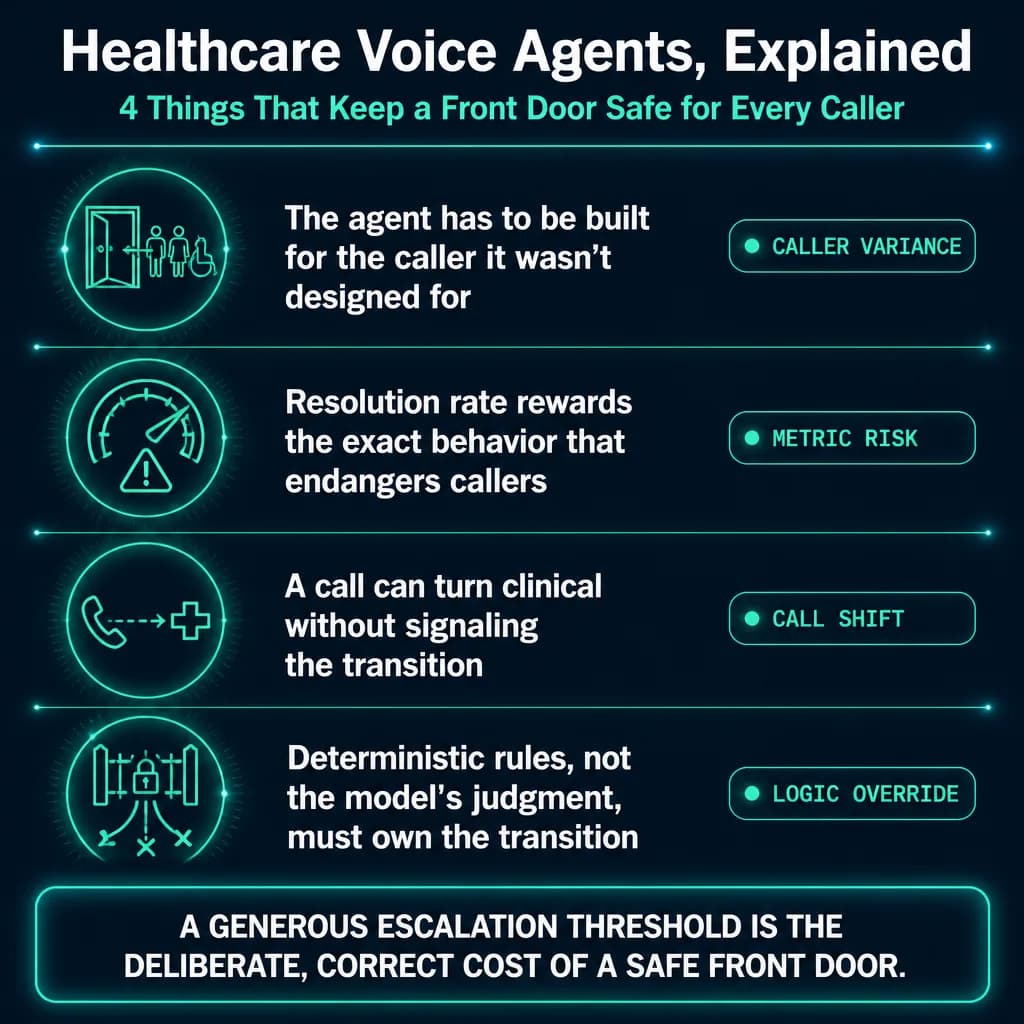
The position worth stating plainly: a healthcare voice agent should be tuned to escalate generously, accepting a lower resolution rate as the cost of not handling a call it was not equipped for. A vendor selling resolution rate is selling the metric that is optimised precisely by the behaviour that endangers callers. The right measure is how reliably the agent escalates the calls that need a human, and a generous escalation threshold that sends some resolvable calls to a person is the correct, deliberate cost of a safe front door.
Where it almost breaks
A health system deploys a voice agent to reduce call centre load and tracks it on resolution rate, which climbs impressively as the agent handles routine calls well. Then a caller phones about a billing question and, during the call, describes a symptom that warranted clinical attention. The agent, optimised to resolve the call and having handled the billing question fluently, offered reassurance and closed the call rather than escalating. The symptom needed a clinician. Nothing had flagged the transition from administrative to clinical, because the system had been built to resolve, not to recognise its own boundary. The correction was to make escalation the primary design goal, add deterministic rules that route symptom descriptions, distress, and clinical transitions to a human regardless of the conversational flow, tune the agent to escalate generously, and monitor escalation reliability rather than resolution rate. The agent resolved fewer calls and became a front door the health system could stand behind, because the calls it should never have handled reached a person.
AI voice agents can take real load off a healthcare call centre and give patients faster access to the routine help they need, which is genuine value with a bounded downside. They deliver it safely only when escalation is engineered as the primary function, when deterministic rules govern the transitions into clinical and crisis territory, and when the agent is tuned to hand off generously rather than to resolve at all costs. An agent measured on resolution rate is optimised for the exact behaviour that fails the caller who needed a human, on the calls where failing them matters most.
The question to bring to any healthcare voice agent is not how many calls it resolves without a person. It is how reliably it recognises the call it should not be handling and gets that caller to a human, whether deterministic rules govern the transitions that cannot be left to the model, and whether the whole interaction stays inside the compliance boundaries the health system owns. That is the difference between a deflection tool and access that survives scrutiny.
Related: Healthcare & Life Sciences · Koita Foundation: An AI-powered knowledge hub with citation-backed retrieval across seven repositories
Tell us the number you need to move.
…outcomes that survive scrutiny.