AI Workflow Automation Compared: Governing What You Automate
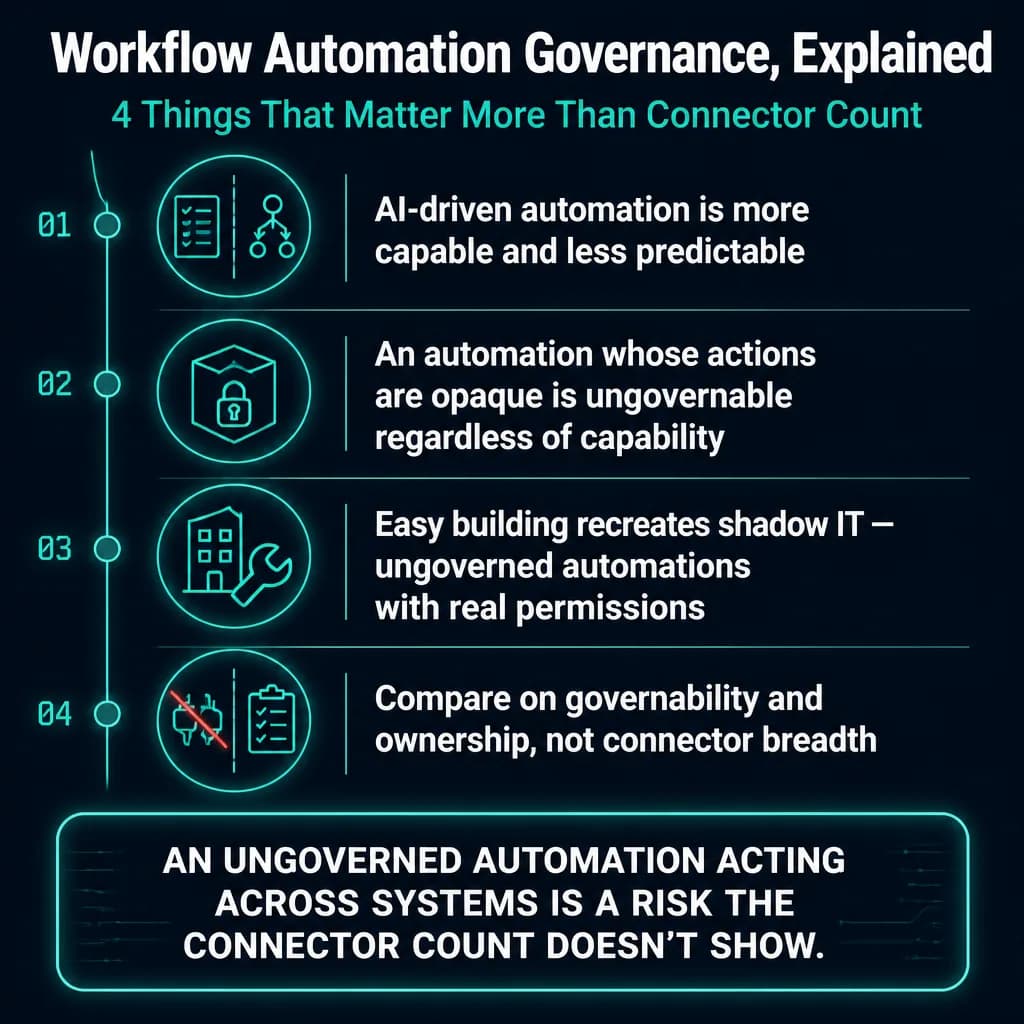
AI workflow automation sells itself on a clean promise: connect your systems, describe what should happen, and let the automation carry work across tools without human involvement. The efficiency case is obvious, and the tools are adopted quickly because building an automation no longer requires engineering. What arrives with the efficiency, and arrives less visibly, is that the organisation now has automations taking real actions across real systems, often holding real data and real permissions, built by people outside IT and governed by no one. Comparing AI workflow automation tools is less about which connects to more systems and more about which lets you govern what you have automated, because an ungoverned automation acting across systems is a risk the connector count does not show.
An AI workflow automation tool connects applications and automates multi-step processes across them, moving data, triggering actions, and carrying work between systems, increasingly with AI deciding steps rather than following fixed rules. The capability that genuinely changed is the addition of AI-driven decision-making to automation, so the automation reasons about what to do rather than executing a predetermined path. That is a real advance in what can be automated, and it is also what makes governance harder, because an automation that decides is an automation whose behaviour is less predictable and whose actions carry more consequence.
Why AI-driven automation raises the governance bar
Rule-based automation does exactly what it was configured to do, and its behaviour is predictable because the rules are fixed. AI-driven automation decides steps based on reasoning, which makes it more capable and less predictable, and that shift changes the governance requirement.
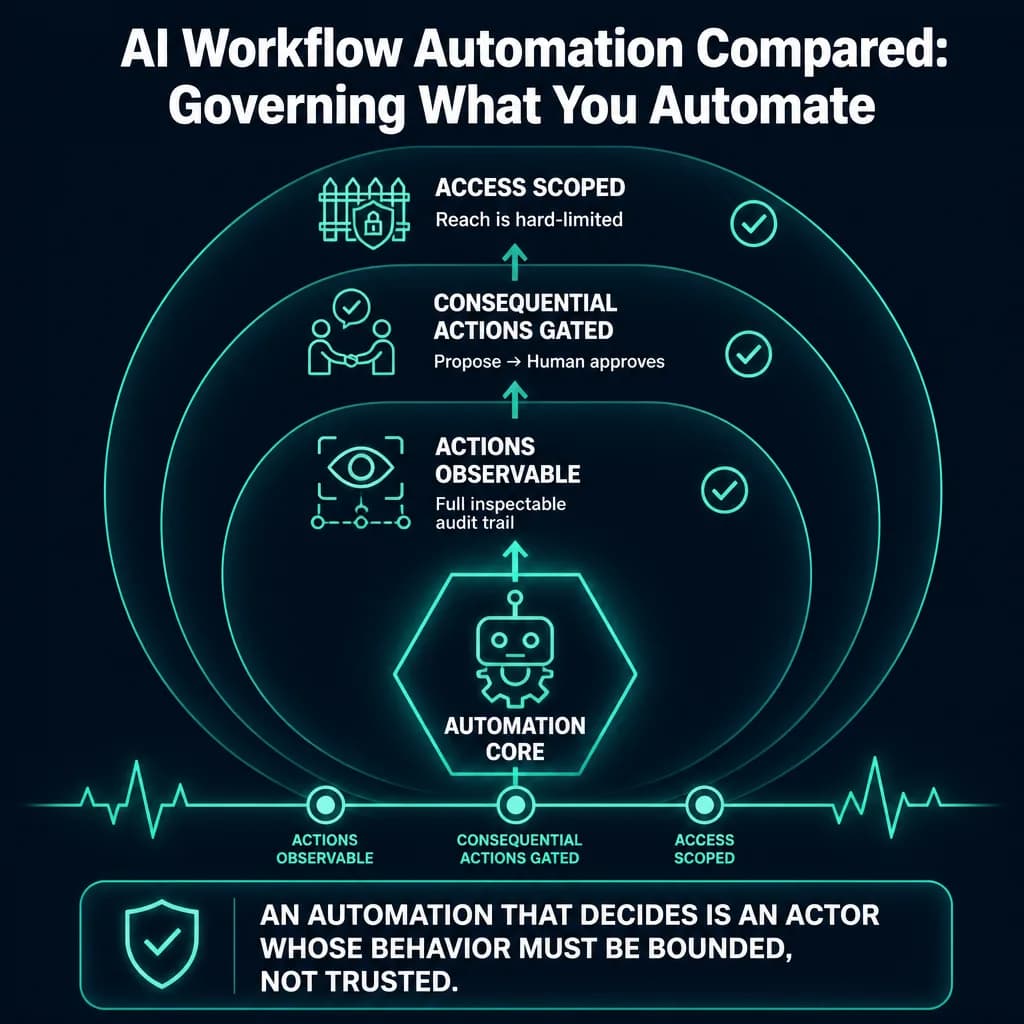
An automation that reasons can handle cases a fixed rule could not, and it can also make a decision the designer did not anticipate, take an action based on a misjudged situation, or behave differently as inputs vary in ways that are hard to test exhaustively. When that automation takes real actions across real systems, moving money, changing records, sending communications, modifying data, the consequence of an unanticipated decision is real, and the automation acting on its own judgment across authenticated systems is an actor whose behaviour has to be bounded rather than trusted. The capability that makes AI automation valuable is exactly what makes governing it necessary, and a comparison that weighs capability without weighing governability picks the more powerful and less controllable tool.
What governing an automation actually requires
The properties that make AI workflow automation governable are the axes a comparison should weigh, because they determine whether the automation is a controlled capability or an ungoverned risk.
Observability is the first. An automation acting across systems needs a complete, inspectable record of what it did, in what order, and why, so a failure can be reconstructed and an unexpected action understood, and an automation whose actions are opaque is ungovernable regardless of how capable it is. Action control is the second, bounding what the automation can do and placing consequential or irreversible actions behind human confirmation, so the automation proposes and a person commits on anything that moves money, changes a system of record, or communicates externally, because an automation with unrestricted authority to act on its own decisions is an incident waiting to happen. Access scoping is the third, granting the automation exactly the permissions its process requires and no more, so a misjudged decision is contained by the limits of its access rather than free to reach across everything a broad credential allows. This is the same bounded-automation discipline behind FORGE, where automation ships with observability, scoped permissions, human gates on consequential actions, and recovery designed in rather than added after a failure, and teams working through governing AI-driven process automation should weigh observability, action control, and access scoping ahead of connector breadth.
The ownership problem automation tools recreate
AI workflow automation also revives the shadow-IT problem, because building an automation no longer requires engineering, so automations appear across the organisation built by people outside IT.
These automations take real actions and hold real permissions, and they accumulate without visibility, and one becomes load-bearing when a business process comes to depend on it, and it has no owner, no monitoring, and no place in any register, so when it fails or misbehaves nobody is accountable and nobody knows how it worked. The comparison should weigh whether a tool supports governed deployment, visibility into what has been automated, ownership, and administrative control, rather than only how easily anyone can build an automation, because the ease of building is what creates the ungoverned sprawl. The trade-off is direct. Automation removes the effort of carrying work across systems and creates automations taking real actions that have to be governed and owned, and an organisation that adopts the automation without the governance ends up with a fast way to deploy ungoverned actors across its systems.
Where it fits
Strong fit for bounded, well-defined processes where the automation’s actions are scoped, its consequential steps gated, and its behaviour observable, structured data movement, routine multi-step processes, and workflows where the decisions are contained and the actions are reversible or confirmed.
Weaker fit for high-consequence processes where an unanticipated decision carries real cost, for automations granted broad authority to act on their own judgment without gates, and for any deployment without observability, ownership, and access scoping in place. Those need the governance built first, because an AI automation acting across authenticated systems inherits whatever control surrounds it, and with none it is an ungoverned actor.
AI workflow automation is a real efficiency gain, and comparing the tools means weighing whether you can govern what you automate far more than how many systems each connects. The organisations getting value from it weighed observability, action control, and ownership ahead of connector count and treated the automation as the actor it is. If an automation tool comparison is underway in your organisation, the more revealing exercise than counting integrations is asking, for any automation you would build, whether you could reconstruct what it did after a failure and whether a person sits between it and any consequential action, because those answers separate a governed capability from an ungoverned risk.
Related: Data Architecture
Tell us the number you need to move.
…outcomes that survive scrutiny.