AML Transaction Monitoring With AI: Fewer Alerts, Never a Missed Filing
A legacy AML transaction monitoring system generates alerts the way a smoke detector triggers on toast, constantly, and mostly for nothing. The overwhelming majority of alerts a rules-based system produces are false positives, and an army of investigators spends its days clearing them. The obvious move is to point a model at the alert queue and suppress the noise. The obvious move is also where banks get into the most trouble, because in AML the alert you choose not to investigate is the one an examiner will ask about first.
The constraint here is unforgiving and specific. When a bank identifies suspicious activity, it owes a regulatory filing within a defined deadline, and it may not tip off the subject that they are under scrutiny. The entire program is examined. So the temptation to cut volume operates directly into an obligation that treats a missed filing as one of the most serious failures a bank can commit.
The constraint that owns the workflow
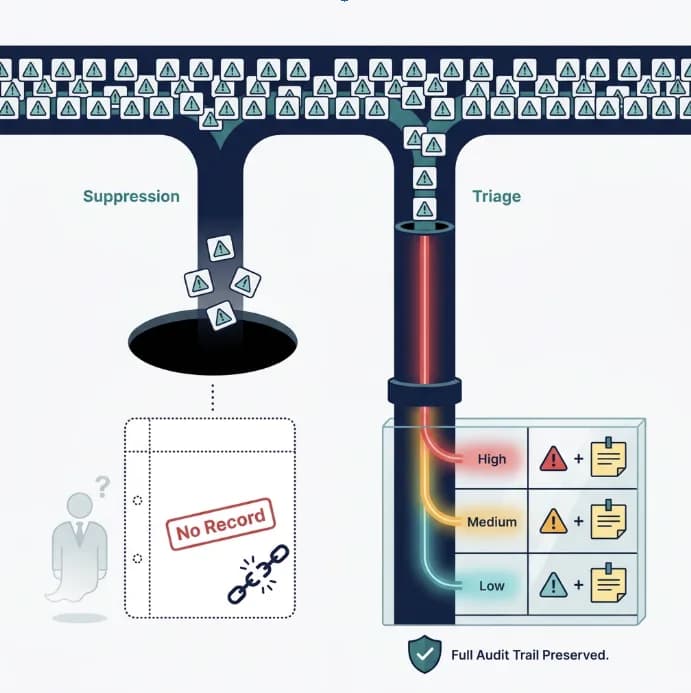
Three obligations sit on top of every monitoring decision and none of them bend. Suspicious activity must be reported within a hard deadline, which means the clock starts the moment something is detected, well before an investigator gets around to it. The program must be defensible end to end, and an examiner is entitled to understand not just what you filed, but how you decided what to look at and what you decided to set aside. And the bank must avoid both directions of error: a true suspicious pattern that goes unreported, and a wave of defensive filings on activity that was never suspicious, which buries the genuine signal and tells the regulator your program cannot tell the difference.
The failure modes that draw enforcement are precise. A missed SAR is the headline one. Underneath it sits a quieter, more dangerous failure: a monitoring system that systematically under-alerts a specific typology, so an entire class of suspicious behavior never surfaces and no one notices, because you cannot miss what you were never shown. And the failure that turns a tuning decision into a finding, suppressing alerts in a way you cannot explain. An unexplained suppression is not efficiency. It is a gap in the record where a justification should be.
The position: AI should triage, not delete
Here is where I part company with the way false-positive reduction is usually sold. The value of AI in AML is in deciding what to look at first, and in documenting why everything else was deprioritised in place of being dismissed. Those are different verbs, and the difference is the whole audit trail.
A model that closes alerts silently is a liability dressed as a productivity gain. A model that ranks alerts by genuine risk, routes investigators to the ones that matter, and keeps every lower-ranked alert in the record with the reasoning for its ranking, that is an efficiency gain you can defend. Suppression and prioritisation look similar on a throughput dashboard. They are opposites in an examination. One destroys the record; the other enriches it.
This reframes the engineering goal. You are building a system that decides which alerts a human sees first, and that can account for the position of every alert it did not surface. The audit trail is the system’s primary output, and the productivity gain is a byproduct of organising the queue well.
Engineering inside the constraint
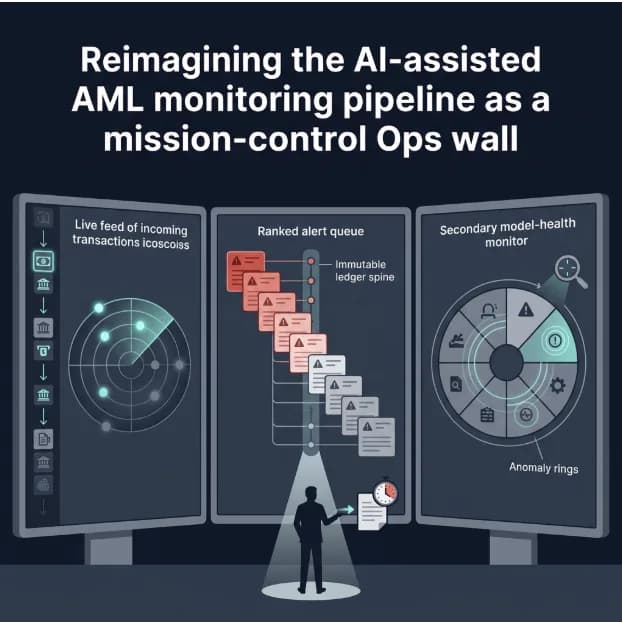
The mechanism is a triage layer that scores alerts on risk and explains each score, sitting in front of human investigation and never in place of it. Every alert, surfaced or not, is written to an action ledger that records its score, the factors behind it, and the disposition, so a deprioritised alert is retrievable, with its reasoning intact, months later when someone asks why it ranked low. Nothing is deleted. Things are ordered, and the ordering is accountable.
The filing decision stays with a person. The model narrows and prioritises the work, and it stops short of making the call that carries the regulatory deadline. Human oversight placed where the consequence is highest, on the filing decision itself, is what keeps the system on the right side of the line between assistance and abdication.
The part most programs under-build is proving the model does not have a blind spot. A triage model that performs beautifully overall can still systematically under-rank one typology, and an aggregate accuracy number will hide it completely. The model has to be evaluated per typology against an explicit standard, whether it surfaces structuring, layering, mule activity, and each known pattern, held to that standard alongside overall alert reduction. Making that evaluation repeatable across every model change, so a retrain is re-checked against the full typology coverage before being cleared on any headline metric, is the work a rubric-based evaluation engine like PRISM is built to carry. A false-positive cut that comes with an undetected typology gap is not a win. It is a missed filing you have not discovered yet.
Where it almost broke
A bank deployed an alert-scoring model and cut investigator workload substantially. The metrics were excellent: fewer alerts, faster clearance, lower cost per case. Then a review found the model had learned to deprioritise alerts on a particular cross-border pattern, because that pattern had been under-represented and rarely confirmed as suspicious in the training window. The model was not wrong on the data it had. It was confidently under-alerting a real typology, and at scale that meant suspicious activity was being pushed to the bottom of the queue where no one looked.
The fix was structural. Per-typology monitoring of the model’s own behavior was introduced, tracking whether each known pattern was being surfaced at expected rates, and treating an unexplained drop in coverage of any typology as a defect to investigate in place of a sign the noise was being cleaned up. A monitoring model has to be monitored, against the very patterns it exists to catch.
Fewer false positives and no missed filings are not in conflict, but reaching both at once depends on a discipline most volume-reduction pitches skip: AML transaction monitoring with AI has to make the queue smarter without making the record thinner. Rank, route, and explain, and keep every alert you chose not to chase, with the reason you chose not to, sitting in the record where an investigator or an examiner can find it.
If your false-positive reduction cannot show what it set aside and why, it has not reduced your risk. It has relocated it to a place you cannot see. The question worth asking of any monitoring system is whether every suppressed alert leaves a trail you would be comfortable defending, because that, and not the headline reduction, is what makes the program an outcome that survives scrutiny.
Related: Banking & Financial Services · Reserve Bank Innovation Hub: Automated grievance workflows with natural-language access and a complete audit record · IndusInd Bank Limited: AI-Powered Knowledge Source-Based Process Training and Query Resolution
Tell us the number you need to move.
…outcomes that survive scrutiny.