An Agentic AI Maturity Model: From Pilots to Operated Fleets
Most organisations building agents are stuck at the same stage without realising it. They have a pilot that works, maybe several, and they mistake having working pilots for having an agentic capability. The two are separated by a large amount of operational engineering that the pilot never required, and the gap between a demo that works and a fleet of agents operated reliably in production is where most agentic ambitions stall. An agentic AI maturity model is useful precisely because it names that gap, and shows that the distance from a first pilot to an operated fleet is longer and different from what the pilot suggests.
If you are building an agentic capability, knowing where you actually sit on the path to maturity is more valuable than another pilot. Organisations routinely overestimate their maturity because a working pilot feels like arrival, and then they hit the operational realities of operating agents at scale and discover they were near the beginning. A maturity model is not a certification exercise. It is a way to see honestly what you have built, what you have not, and what the next real step requires.
The stage most organisations are actually at
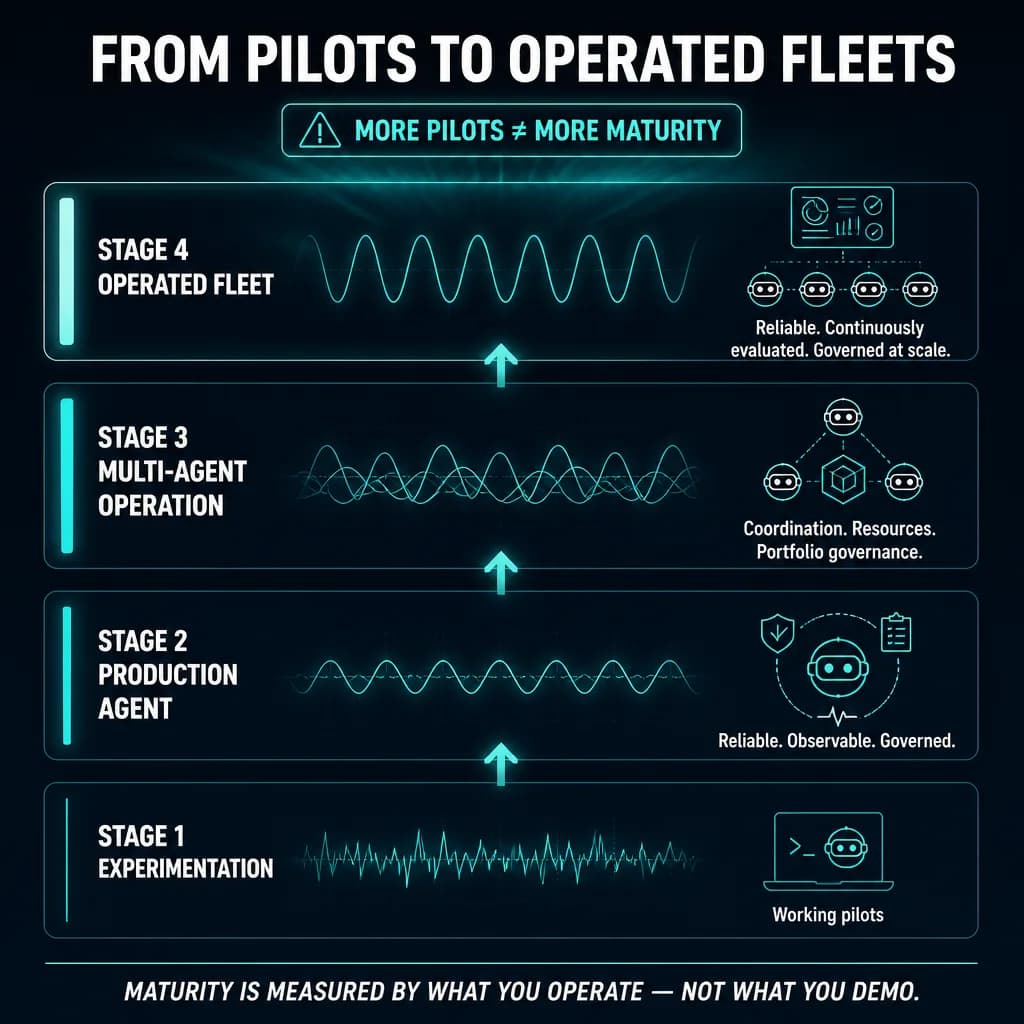
The first stage is experimentation: building pilots to see whether agents can do useful work. This stage is valuable and it is where most organisations are, and the trap is mistaking it for something further along. A pilot proves capability under controlled conditions. It does not prove that the capability can be operated reliably, governed defensibly, or operate at scale, because a pilot deliberately avoids the hard parts that make those things necessary. The pilot operates on cooperative inputs, limited volume, and an engineer watching closely, none of which survive contact with production.
The reason this stage is sticky is that each new pilot feels like progress while the organisation stays at the same maturity level. Building the tenth pilot does not advance maturity if none of the pilots have been operationalised, because the thing that separates experimentation from the next stage is not more pilots. It is the operational engineering that turns a working pilot into an ongoing system, and that engineering is a different kind of work that experimentation never forces you to do. An organisation with many pilots and nothing operationalised is experienced at experimentation and immature at operation, and confusing the two is how programs stall while feeling busy.
The stages that separate a pilot from a fleet
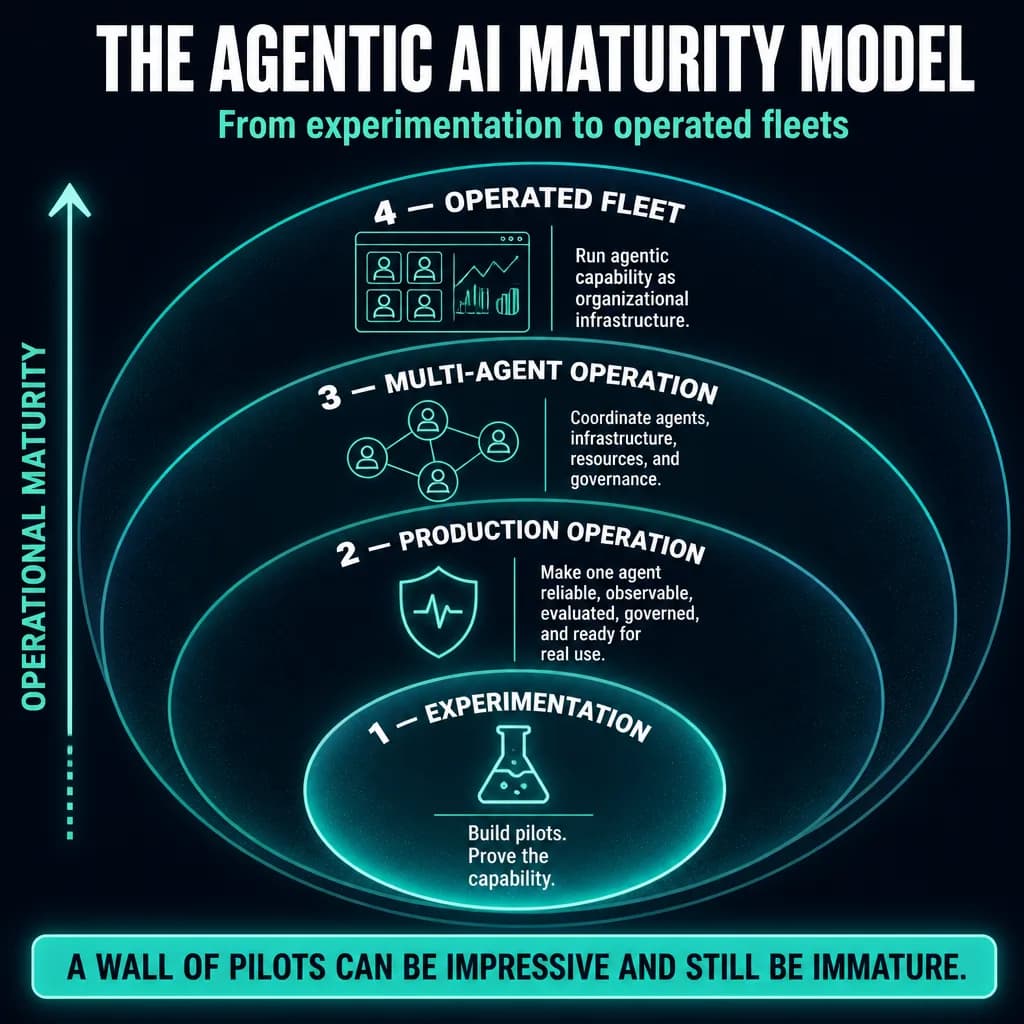
Past experimentation, maturity advances through the operational capabilities that operating agents in production actually requires. The next stage is production operation of a single agent: taking one pilot and doing the work that makes it reliable, observable, and governed in real use. This is where the monitoring, evaluation, and governance layers get built, and it is a substantial step, because a single agent operated properly requires the tracing to see what it does, the evaluation to know it still works, the guardrails to keep it in bounds, and the human oversight placed where consequences warrant. An organisation that has genuinely operationalised one agent has crossed the hardest conceptual gap, from proving capability to operating it.
The stage beyond that is operating multiple agents, a fleet, which introduces problems a single agent never had. Agents interacting, sharing infrastructure, and being managed as a portfolio raise coordination, resource, and governance questions at a new level, and the operational tooling has to mature from operating one agent to managing many. The most mature stage is treating agentic capability as an operated system at organizational scale: a fleet of agents, operating reliably, governed coherently, evaluated continuously, with the organizational structures of accountability and enablement that let the whole thing be operated as infrastructure rather than a collection of projects. Each stage is a real transition requiring capabilities the previous stage did not, and maturity is measured by which of these you have actually built, not by how impressive your best pilot is.
Using the model honestly, and its trade-off
A maturity model earns its value only through honest assessment, and the temptation is to place yourself further along than you are because the later stages sound better. An organisation that assesses itself as operating a fleet when it actually has several unoperationalised pilots learns nothing and plans wrongly, because the assessment is flattering rather than accurate. The point of locating yourself on the model is to see the specific next step you have not taken, which is far more useful than a generous self-rating that obscures the work remaining.
The trade-off the model surfaces is that advancing maturity is expensive and not always warranted, which is a real judgment rather than a call to climb every stage. Operationalising an agent costs substantially more than piloting one, and operating a fleet costs more still, so the right maturity level depends on what the organisation actually needs. Some capabilities warrant full operational maturity because their consequences and scale demand it. Others are legitimately served by a well-operate pilot, and pushing them to full fleet operation is over-investment. The model helps you decide where to advance and where to stop deliberately, rather than implying that maximum maturity is always the goal. Knowing you are at experimentation and choosing to stay there for a given capability is a valid decision. Believing you are further along than you are is not.
Where it almost broke
We worked with an organisation confident it had a mature agentic capability, on the strength of a portfolio of working pilots across several functions. The confidence did not survive examination. None of the pilots had been genuinely operationalised: they lacked the monitoring to know whether they still worked, the governance to operate defensibly, and the reliability engineering to survive real volume, and they were being operated in a semi-manual way that would not scale. The organisation was highly experienced at experimentation and had not built the operational capability that maturity actually requires, and it had been planning as though it were far further along.
The correction started with an honest assessment against the stages. Placing the organisation accurately, at experimentation rather than operation, made the next step concrete: take the highest-value pilot and do the operational engineering to operate it properly, building the monitoring, evaluation, and governance that operation requires. That single operationalised agent taught the organisation what the later stages actually demanded, and gave it a real foundation to build a fleet on, rather than a portfolio of demos mistaken for a capability. The lesson was that maturity is measured by what you have operationalised, and a wall of pilots can hide how early you actually are.
Maturity is what you operate
The reframe that unsticks agentic programs is measuring maturity by what has been operationalised rather than by how many pilots exist or how good the best one looks. An agentic AI maturity model makes the gap between a working demo and an operated fleet visible, and that gap, full of monitoring, governance, reliability, and organizational structure, is where the real capability is built. A portfolio of pilots can be genuinely impressive and genuinely immature at the same time.
The organisations that reach fleet-scale agentic capability are the ones that assessed themselves honestly, recognised experimentation for what it is, and did the unglamorous operational work that each subsequent stage requires. Locating yourself accurately on the path is worth more than another pilot, because it shows the specific next step and keeps you from mistaking activity for progress. Maturity is earned in operation, one operationalised agent at a time, and the model is how you tell how far you actually have to go.
Related: Agentic AI
Tell us the number you need to move.
…outcomes that survive scrutiny.