ATLAS, Explained: Turning SOPs Into On-Demand Learning That Sticks
Every large organisation has the same graveyard of training content. Thick SOPs nobody reads, slide decks built once and never opened, compliance modules clicked through as fast as the next button allows. The knowledge is technically documented and practically unlearned, and the gap between the two shows up as inconsistent work, failed audits, and onboarding that takes far longer than it should. The problem was never a shortage of documentation. It was that documentation does not transfer into competence on its own.
This is the gap ATLAS is built to close, and it is worth being precise about what the hard part actually is. Converting a document into a video is easy. Producing learning that people absorb, retain, and can be shown to have retained is a different problem, and it is the one that matters, because a training system that scales delivery while leaving retention unmeasured has simply automated the graveyard.
Why documentation does not become competence

An SOP is written for reference, not for learning. It is dense, linear, and assumes the reader already has the context to place it. Handing it to a new employee and expecting competence is optimistic, and the usual fixes scale badly. Instructor-led training depends on trainers, varies by who delivers it and where, and cannot cover a distributed multilingual workforce consistently. The knowledge stays locked in the format and the person delivering it.
So the real task is transformation, not delivery. The dense reference material has to become structured, digestible learning in the language each learner actually uses, and the system has to check whether the knowledge landed. Delivery at scale without retention measured is motion without progress, because you cannot tell whether anyone learned anything.
What ATLAS actually does
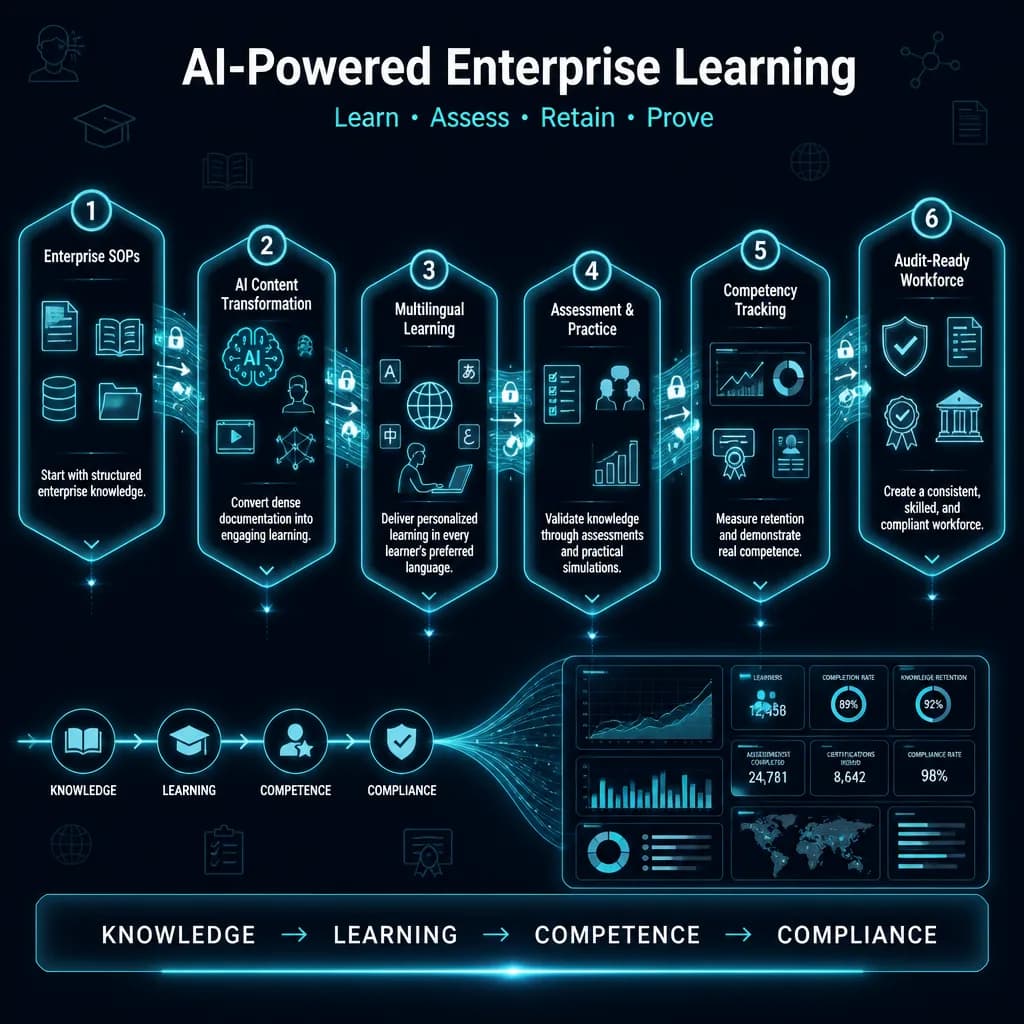
ATLAS turns SOPs, compliance manuals, and knowledge documents into short, on-demand learning delivered by an AI avatar of your best trainer, available around the clock in each learner’s own language, with assessments and role-play that test whether the knowledge stuck. The design goal is retention you can measure, not content you can count. A learner works through material built for learning, in their language, and then demonstrates understanding through assessment.
Deployed for a global pharmaceutical manufacturer’s training academy, this approach reached more than twenty thousand employees across languages, cut training content creation effort by around seventy percent, and reduced dependence on trainer-led sessions by half, while improving audit readiness through centralised learning records and competency tracking. The numbers that matter are the ones about consistency and retention: standardised training across geographies, and a record of who learned what, which is exactly what a regulated manufacturer needs when an auditor asks whether the workforce is competent on the procedures it follows.
The competency record is the load-bearing part
In regulated manufacturing, training is a compliance requirement. You have to be able to show that employees were trained on the procedures they perform and demonstrated understanding. So the assessment and competency-tracking layer is not a nice-to-have on top of the learning. It is the part that makes the system defensible, producing the record that proves competence rather than mere completion.
The near-miss to design against is a system that scales engaging content and measures only completion, letting the organisation believe its workforce is trained when it has only been exposed. The correction is to make assessment and demonstrated understanding the measure, so the record reflects retention. That is more demanding to build than click-through tracking, and it is the difference between a training system that produces a competency record an auditor accepts and one that produces a completion log that proves nothing.
ATLAS turns the training graveyard into learning that people actually absorb and that the organisation can prove they absorbed. The value is a consistently competent workforce and a defensible record of that competence, delivered at a scale trainers alone could never reach. An operator building enterprise learning designs for retention and its measurement from the start, because training that scales without sticking is expensive motion, and only learning you can measure produces the competency record behind outcomes that survive scrutiny.
Related: Atlas, Training Coach - PYZO · About Us · IndusInd Bank Limited: AI-Powered Knowledge Source-Based Process Training and Query Resolution
Tell us the number you need to move.
…outcomes that survive scrutiny.