Automated Research Tools in Production: Speed Versus Verifiable Truth
A research analyst used to spend two days assembling the picture and an hour writing it up. Automated research tools invert that ratio. Ask a broad question, and the system plans a line of inquiry, operates many searches, reads across dozens of sources, and returns a structured report with citations in the time it takes to get a coffee. The output looks like the two-day product. The question every enterprise has to answer is whether it can be trusted like the two-day product, and the honest answer is: sometimes, and you need to know which times.
These tools decompose a question into sub-questions, retrieve iteratively across the open web and connected sources, synthesise the findings, and present a report with references attached to claims. The capability that genuinely changed is autonomous multi-step research, the system deciding what to look for next based on what it just found, rather than answering from a single retrieval pass. That is a real advance in what can be automated. It also relocates the risk to a place that is harder to inspect.
Where the speed is real

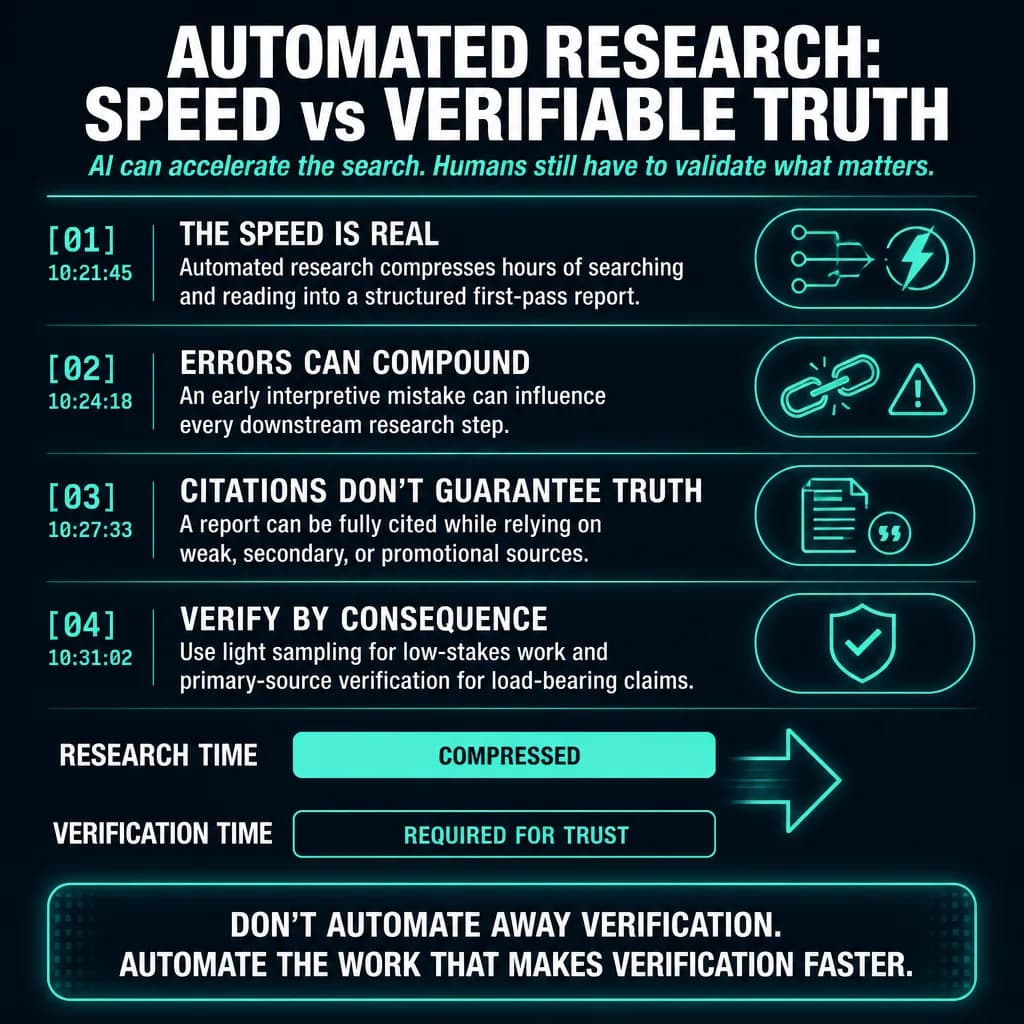
For breadth-first work, the value is immediate and large. Mapping an unfamiliar market, scanning a technology landscape, gathering regulatory background, building a first-pass literature survey, these are tasks where the cost was always the hours of finding and reading, and the tool compresses those hours honestly. An analyst who receives a structured starting map with sources attached is genuinely further ahead than one starting from a blank search box.
The output is best understood as a research accelerator that produces a first draft of understanding. Used that way, by someone who then verifies and extends it, the productivity gain is substantial and the risk is contained. The trouble starts when the first draft gets treated as the finished finding.
The failure modes that matter in production
Autonomy is what makes these tools powerful, and it is also what makes their errors hard to catch.
Consider the compounding problem. A multi-step research process makes a small interpretive choice early, retrieves down that path, and builds subsequent steps on the earlier conclusion. If the first step misread the question or anchored on a weak source, everything after it inherits the error, and the final report reads as coherent because it was built coherently on a flawed foundation. A single wrong answer is easy to spot. A well-structured report that is subtly wrong throughout is not.
Source quality is the second issue, and it is structural. These systems retrieve what is retrievable, which means abundant, well-indexed, SEO-optimised content ranks above primary filings, peer-reviewed work, and regulatory text. For a market question, the report often synthesises vendor marketing and press coverage into a confident consensus that reflects what is easy to find rather than what is true. For competitive intelligence, it assembles a picture largely from the competitor’s own positioning. The citations are real. The sources behind them are weak, and the report does not tell you that.
The third is the certainty distortion. Synthesis compresses, and compression strips qualification. A finding that was hedged in the source with sample limits and confidence bounds arrives in the report as a clean declarative sentence. An analyst who reads the report without opening the citations inherits a confidence the underlying evidence never supported. This is the quiet one, because it fails no citation check. Every link resolves. The problem is what got flattened on the way.
There is also the omission failure, which no citation mechanism addresses at all. The report tells you what it found. It cannot tell you what it missed, and a research answer built on an incomplete source set is confidently wrong in a way that leaves no trace in the references.
Operationalising this responsibly
The instinct is to treat verification as a manual re-check of every claim, which destroys the time saving and defeats the point. The workable model is tiered verification calibrated to consequence.
For low-stakes background scanning, the report stands with light sampling. For anything that will inform a decision, the load-bearing claims, the two or three findings the conclusion actually rests on, get traced to their primary sources and verified directly. For regulatory or compliance content, secondary synthesis is a starting point and the primary text is the requirement, always. The discipline is deciding the tier before you read the report, so the convenience of the output does not quietly lower the bar you would otherwise have held.
Source governance is the second control. In an enterprise setting, the tool should be pointed at vetted sources where possible, and analysts need to understand that a persuasive report assembled from weak sources is more dangerous than an obvious gap, because it invites trust it has not earned. Evaluating research output means assessing the quality of what was retrieved, not just the coherence of what was written. This is why we operate generated analysis through rubric-based evaluation in PRISM, with source quality and inferential faithfulness scored alongside surface accuracy, since a report can be fluent, fully cited, and wrong.
The trade-off is direct. These tools convert research time into verification time, and they only pay off if the verification is real. An organisation that adopts the speed and skips the verification has not made its analysts faster. It has made them confidently wrong at scale, and it will not find out until a decision made on a flawed report goes badly.
Where it fits
Strong fit for exploratory, breadth-first research where the output is a starting map and a human carries it forward: landscape scans, background briefings, hypothesis generation, and early literature discovery.
Weaker fit for anything feeding directly into a decision without a verification layer, for questions whose answer depends on primary sources by regulatory necessity, and for competitive or strategic work where the easily retrievable picture is precisely the misleading one. Teams setting evidence standards for AI-assisted research should write the tiered-verification rule into policy before the tool spreads through the analyst population informally.
Automated research earns its place as an accelerator in the hands of someone who treats the output as a first draft and verifies what the conclusion rests on. Used that way, it is a real gain. If your analysts have adopted one of these tools faster than your verification standards caught up, the useful exercise is deciding which categories of decision are allowed to rest on an unverified report, and the honest answer to that is very few.
Related: Data Architecture
Tell us the number you need to move.
…outcomes that survive scrutiny.