Automating Loan Document Checks Without Breaking Your Audit Trail
There is a specific way that loan-document automation goes wrong, and it is not the way teams expect. The model works. It reads the documents, checks completeness, and flags problems accurately. Then the first audit arrives, and the institution discovers it cannot reconstruct why a particular file was flagged or cleared three months ago, because the automation produced verdicts without preserving the reasoning behind them. The efficiency was real, and it came at the cost of an audit trail the lender is required to maintain.
This is the failure that matters when automating loan document checks, and it is why the audit trail has to be treated as a first-class output of the system rather than a byproduct. In lending, every decision about a loan file has to be reconstructable long after it was made, for internal audit, for the model-risk function, and for a regulator. Automation that speeds up the checking while degrading the traceability has traded a requirement the institution cannot give up for an efficiency it can achieve other ways.
Why the audit trail breaks
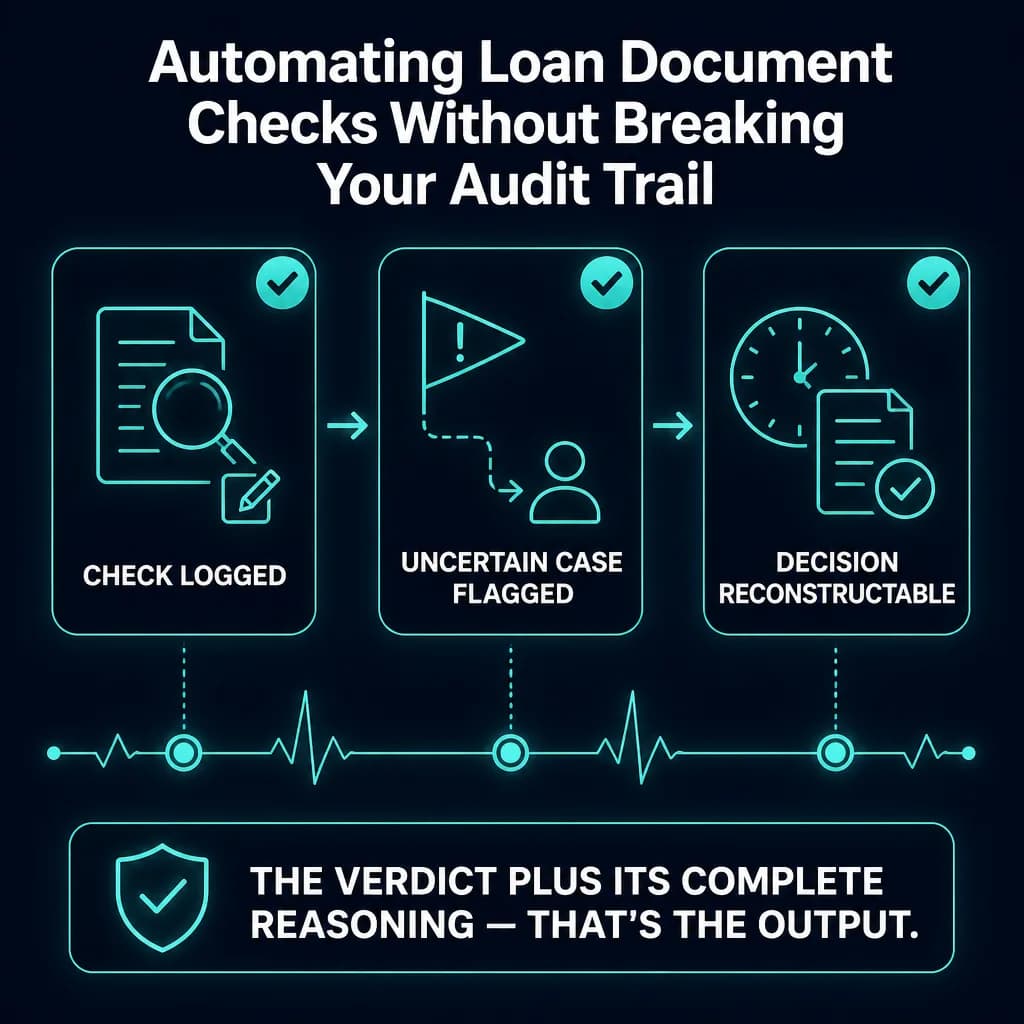
The audit trail breaks because it is easy to overlook. When a person checks a loan file, the reasoning lives in their notes and the process record. When automation replaces them, the reasoning has to be deliberately captured, and a system built for throughput rather than traceability will produce a clean verdict and discard the basis for it. The output looks complete. The record of how it was reached is thin, and no one notices until an auditor asks a question the system cannot answer.
So the design requirement is that every check the system performs is logged with its reason, structured so any past decision can be reconstructed in full. The verdict is not the output. The verdict plus its complete, reviewable basis is the output, and the second half is the part that keeps the institution defensible.
Building checks that preserve the trail
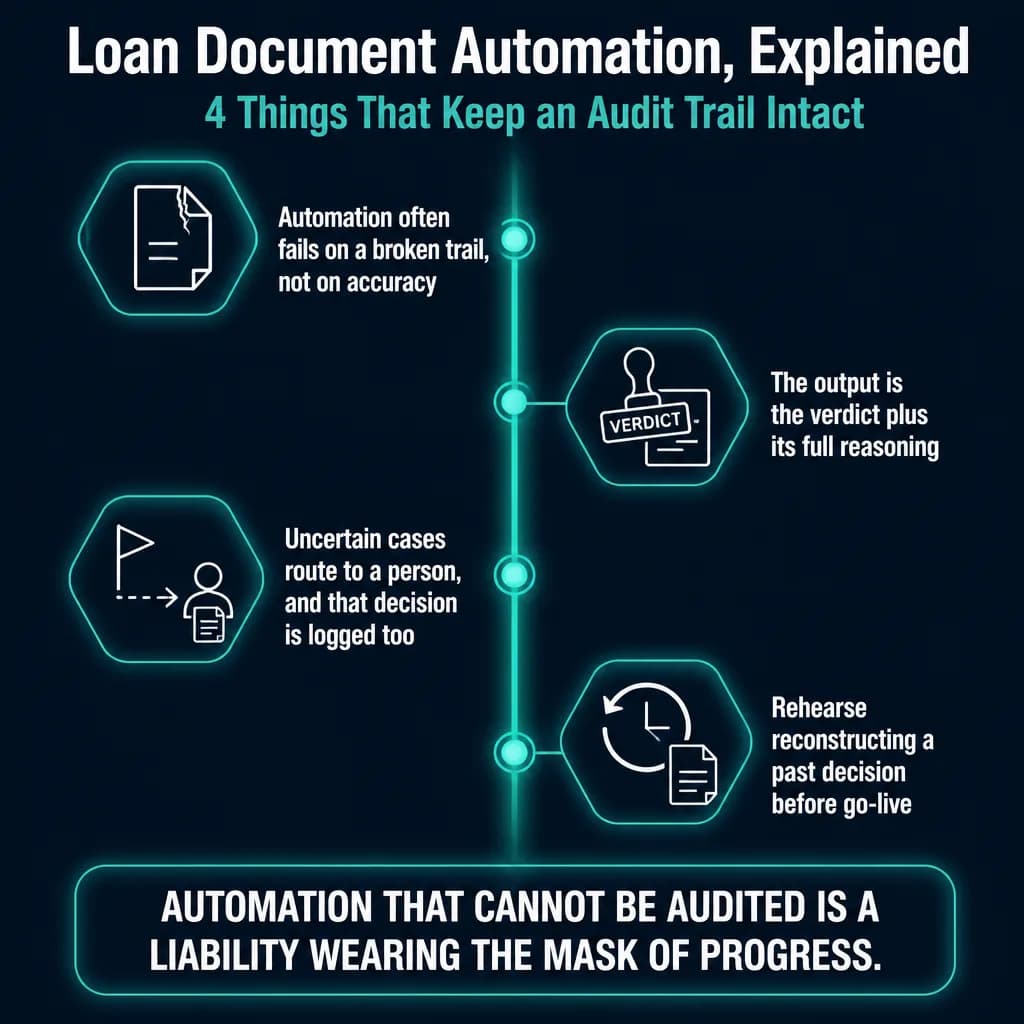
We engineer loan-document automation, using our guided validation capability, so that traceability is inseparable from the check. As the system validates each field and document, it records what it checked, what it found, and why it reached its conclusion, producing a trail that a reviewer can follow for any file. Uncertain cases are flagged and routed to a person, and that human decision is recorded too, so the boundary between automated and human judgement is itself part of the trail.
This is where an audit rehearsal earns its place before deployment. Take a decision the system made, and try to reconstruct it fully from the record: the inputs, the checks, the reasoning, the human sign-off where there was one. If the reconstruction is complete, the system will survive an audit. If it is thin anywhere, that gap is where the audit will fail, and it is far cheaper to find it in rehearsal than in front of a regulator.
The trade-off, and the near-miss
Preserving a complete audit trail costs something in throughput and storage, and a system optimised purely for speed would log less and operate leaner. That leaner system is the one that breaks under audit. We accept the overhead of full traceability, because in lending the audit trail is a requirement, and a fast checker that cannot be audited is not deployable however much time it saves.
The near-miss to design against is exactly the plausible one: automation that clears documents accurately and quietly under-records its reasoning, so the trail looks adequate until an auditor probes a specific decision it cannot reconstruct. The correction is to make the audit trail a designed, tested output, rehearsed against real decisions before launch, so the traceability is proven rather than assumed.
Automating loan document checks without breaking your audit trail means engineering traceability as a first-class output, so every decision the system makes can be reconstructed and defended long after it was made. The value is the efficiency of automation with the audit trail fully intact, which is the only version a regulated lender can actually deploy. An operator automating regulated workflows builds the trail into the check and tests it before go-live, because automation that cannot be audited is a liability wearing the mask of progress, and only the fully traceable system produces outcomes that survive scrutiny.
Related: About Us
Tell us the number you need to move.
…outcomes that survive scrutiny.