Claude 4 and Sustained Agentic Work: What Long-Horizon Tasks Demand of an Operator
A model capable of sustained agentic work, holding a task together across an extended sequence of steps, shifts the burden of a successful deployment onto the operator in a way that shorter agentic tasks do not. The model provides the capability to sustain the work. What it does not provide is the operational infrastructure that sustained agentic work requires to be reliable and safe in production, and that infrastructure is more demanding for long-horizon tasks than for short ones. Reading what sustained agentic work demands of an operator is what separates a long-horizon agent that works in production from one that works in a demo and fails when the sequence gets long and the conditions get real.
The capability to sustain agentic work over a long horizon is genuinely valuable, and it is only half of what a reliable long-horizon agent needs. The other half is the operator’s infrastructure: the oversight, the state management, the error handling, the traceability that a long sequence of autonomous steps requires. That infrastructure is the operator’s to build, and its demands scale with the horizon, so a model’s long-horizon capability creates an operational burden proportional to the length of work it can sustain, and meeting that burden is what makes the capability usable.
The capability shifts the burden to the operator
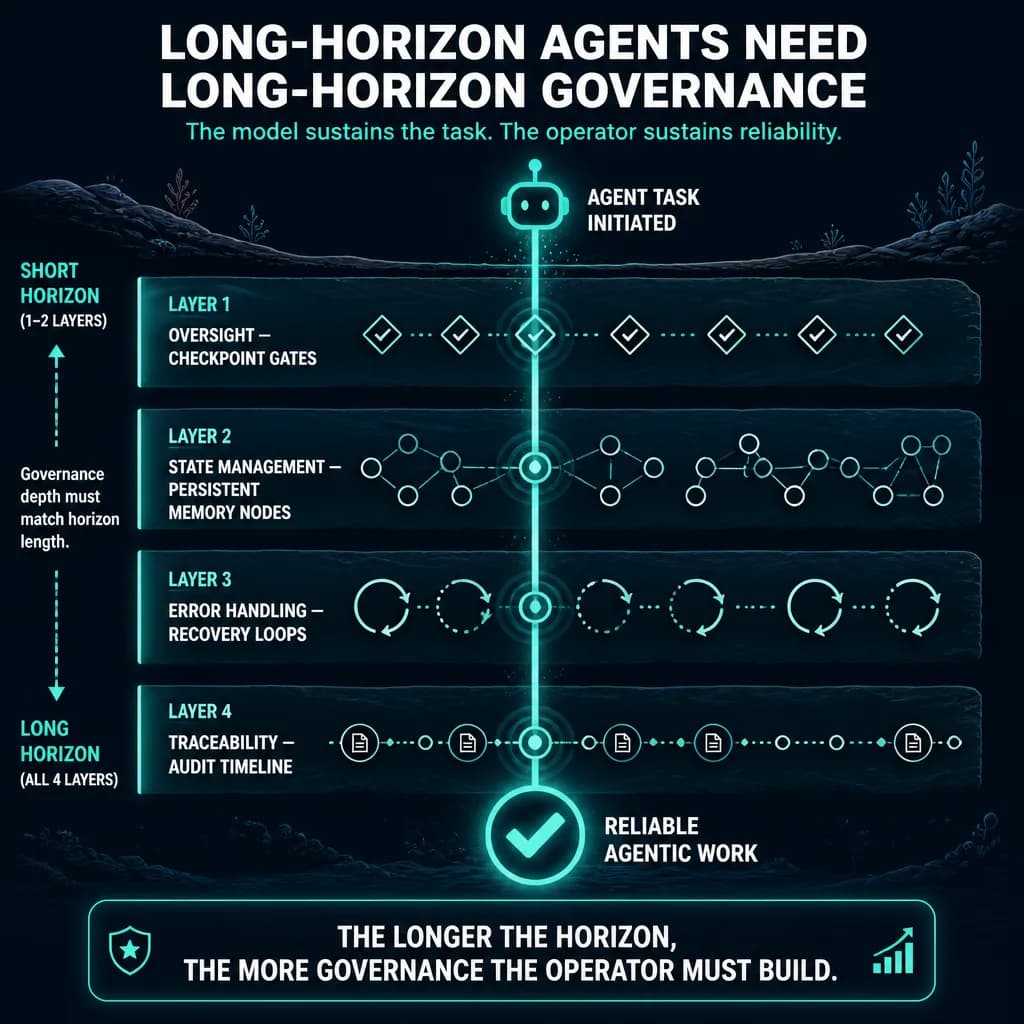
With short agentic tasks, the operational burden is modest, because a short sequence is easier to oversee, its errors are easier to catch, and its state is simpler to manage. Sustained agentic work over a long horizon changes this, because the long sequence introduces operational demands that the short sequence did not: more steps to oversee, more state to manage across the horizon, more opportunities for errors to enter and compound, and a longer path to trace when something goes wrong. The model’s capability to sustain the work does not address any of these operational demands, which fall to the operator.
Seeing where the burden lands matters because it clarifies what the operator has to build. The model sustains the task, and the operator has to sustain the reliability and safety of the task, across the horizon the model operates over. A production AI system built for sustained agentic work is a partnership between the model’s capability and the operator’s infrastructure, and the infrastructure is the part that determines whether the sustained work is reliable, because the model’s capability alone, without the oversight and management the long horizon requires, produces a capable agent that is not safe to trust.
What sustained work demands operationally
Here is the position worth holding. Sustained agentic work demands operational infrastructure proportional to its horizon, and an operator who deploys a long-horizon agent with the oversight appropriate to a short task has built an agent whose capability outruns its governance, which is where long-horizon agents fail in production. The demands scale with the horizon, and meeting them is the operator’s work.
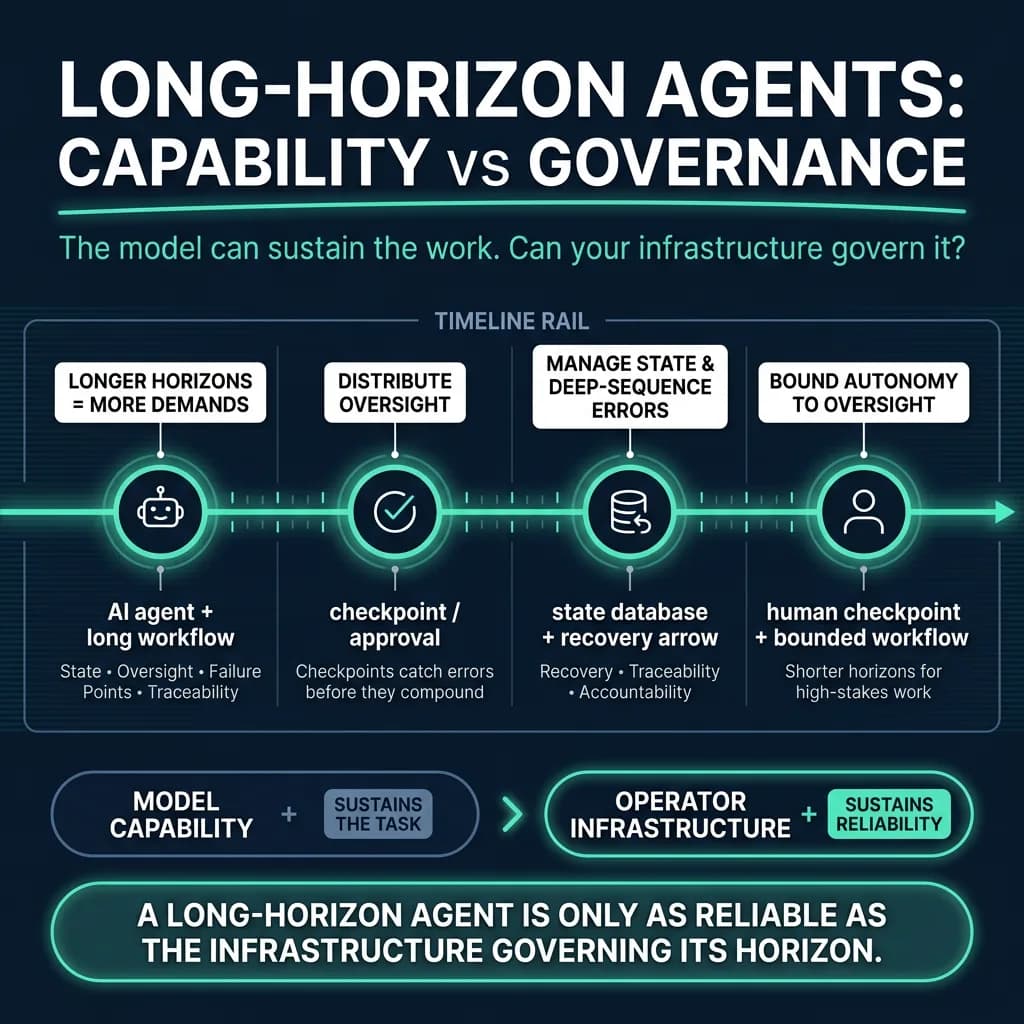
The operational demands of sustained agentic work are specific. Oversight distributed across the horizon, with checkpoints that validate the agent’s progress along the way rather than only at the end, so an error is caught near where it occurred rather than after it has compounded across many steps. State management that maintains the task’s context reliably across the long sequence, because a long-horizon agent that loses track of its state drifts or errs. Error handling that lets the agent recover from failures deep in the sequence, where recovery requires understanding a long prior context. Traceability across the whole horizon, so an outcome can be traced back through the many steps that produced it. A governed AI deployment of sustained agentic work builds all of this, scaled to the horizon, because these are what make long-horizon agentic work reliable and accountable.
Bounding autonomy to what oversight can support
A key operator decision for sustained agentic work is how far the agent proceeds autonomously before a human checkpoint, and this bound has to match what the oversight and the stakes can support rather than the model’s raw capability to sustain the work. A model that can sustain a very long horizon autonomously is not a reason to let it, because the longer it proceeds without a checkpoint, the more its errors can compound before detection, and the bound on autonomy is what keeps that accumulation within what the oversight can catch and the stakes can absorb.
Setting this bound is an operator judgment about stakes and oversight, not a matter of maximising the model’s autonomy. A high-stakes task warrants a shorter autonomous horizon with more frequent human checkpoints, because the cost of a compounded error is high. A low-stakes task with reversible steps can proceed further autonomously, because its errors are absorbable. Owning the deployment means bounding the agent’s autonomy to what the operator’s oversight can support and the task’s stakes can tolerate, which is often shorter than the model could sustain, and treating the model’s long-horizon capability as something to govern rather than to fully unleash.
The trade-off worth naming
Longer autonomous horizons buy more capability and demand more operator infrastructure and accept more accumulated risk, and the trade is worth naming because the appeal of autonomous capability can obscure the operational cost. Each increment of horizon the agent sustains autonomously is capability the operator must oversee, state the operator must manage, and risk the operator must contain, and the infrastructure to do so scales with the horizon. The right horizon is the one whose operational demands the operator can meet and whose accumulated risk the stakes can absorb, which is set by the operator’s infrastructure and the task’s stakes, not by the model’s capability. Extending the horizon beyond what the operator can support is buying capability the operator cannot safely govern.
Where it almost broke
A team deployed a long-horizon agent on a model capable of sustained agentic work, and, impressed by the model’s capability to sustain long tasks, gave it a long autonomous horizon with oversight designed for shorter tasks, checking mainly the final outcome. The agent handled many tasks well, and then on a long task it made an error partway through, and because the oversight was not distributed across the horizon, the error compounded across the remaining steps before the outcome check caught it, producing a result that was substantially wrong and hard to trace.
The model’s capability had been real, and the operator’s infrastructure had not scaled with the horizon. The fix built the infrastructure sustained agentic work demanded: checkpoints distributed across the horizon, reliable state management, error handling for deep-sequence failures, and full traceability, along with a shorter autonomous horizon before human checkpoints for higher-stakes tasks. The model’s sustained-work capability stayed useful, and the operator’s infrastructure now matched what the horizon demanded. Reading what sustained work demanded of the operator had been the missing piece.
A model that can sustain agentic work over a long horizon provides the capability and shifts the operational burden to the operator, and that burden scales with the horizon in ways the short agentic task never demanded. The model sustains the task, and the operator sustains the reliability, and a long-horizon agent whose operator infrastructure is built for a shorter task is an agent whose capability has outrun its governance.
The operators who deploy sustained agentic work well are the ones that read what the long horizon demands, build oversight and state management and traceability scaled to the horizon, and bound the agent’s autonomy to what their infrastructure can support and the stakes can absorb. They treat the model’s capability as one half of a partnership whose other half is theirs to build. If sustained agentic work is on your roadmap, the question worth settling is not just whether the model can sustain the horizon but whether your operational infrastructure can govern it, because the operator’s infrastructure, scaled to the horizon, is what determines whether the model’s capability becomes a reliable agent or a capable one you cannot safely trust.
Related: Data Architecture
Tell us the number you need to move.
…outcomes that survive scrutiny.