Claude Opus 4.1 for Enterprise Coding: Where It Earns Its Cost
A premium model applied to enterprise coding raises a question that the impressive coding demonstrations do not answer: where does it actually earn its cost, given that most coding work does not need a premium model and operating everything through one is paying for capability the work does not use? The demonstrations show the model handling hard coding problems brilliantly, which is real, and they invite the conclusion that you should route your coding work to it, which is expensive and mostly unnecessary. The useful analysis is not whether the premium model is good at coding but which coding work justifies its cost, because that is a narrower and more valuable question.
The pull toward the premium model for coding is strong because coding is high-value work and the model is visibly capable at it. What that pull obscures is that coding work spans an enormous range of difficulty, and a premium model earns its premium only on the harder end of that range. On routine coding tasks, which are most coding tasks, a cheaper model produces work that is just as usable, and routing that work to the premium model buys nothing but a larger bill. Knowing where the premium model earns its cost is what separates an economically sound coding deployment from one that overpays across the board.
Coding work is not uniform in difficulty

The case starts with an honest look at what enterprise coding work actually consists of. It is not a uniform stream of hard problems. It is a wide distribution: a large volume of routine work, boilerplate, straightforward implementation, standard patterns, and a smaller band of genuinely hard problems, complex logic, subtle debugging, architectural work, where capability makes a real difference. The premium model’s advantage shows up on the hard end and largely disappears on the routine end, where a cheaper model produces equally usable output.
Seeing this distribution reframes the deployment. The question is not whether the premium model is better at coding in general, because on the hard problems it is, but what fraction of your coding work is actually hard enough to need it, and the answer is a minority. Routing the routine majority to the premium model pays its premium for work that a cheaper model handles just as well. A production AI system for coding, costed properly, operates the routine bulk on a cheaper model and reserves the premium model for the harder problems where its capability earns the cost.
Where the premium actually pays
Here is the position worth holding. A premium coding model earns its cost specifically on hard problems where a cheaper model’s output would need enough correction that the cheaper model was a false economy, and identifying those problems is what makes the premium deployment economically sound rather than wasteful. The premium pays not because the model is better in general but because on hard problems the cheaper model’s work requires correction, rework, and debugging that costs more in engineer time than the premium model’s price.
This is the real economic calculation, and it is about total cost including human time. On a hard problem, a cheaper model might produce code that looks plausible and contains subtle errors an engineer then spends hours finding and fixing, and the premium model that produces correct code the first time is cheaper overall despite its higher price, because it saves the engineer time the cheaper model would have cost. On a routine problem, the cheaper model produces correct usable code and the premium model’s advantage vanishes, so its premium buys nothing. A governed AI deployment for coding routes by this calculation, sending to the premium model the problems where its correctness saves more engineer time than it costs.
Routing coding work by difficulty
Operationalising this means routing coding work by difficulty, which is harder than it sounds because difficulty is not always obvious upfront. Some routing can be structural: certain categories of work are reliably routine and go to the cheaper model, certain categories are reliably hard and go to the premium model. Some requires judgment: a problem that looks routine can turn out to be subtle, and a mechanism for escalating to the premium model when the cheaper model struggles catches those cases.
Building this routing well is the engineering that makes the premium coding deployment pay. Getting it wrong by over-routing to the premium model erodes the saving, and getting it wrong by under-routing sends hard problems to the cheaper model where they generate expensive rework. The routing has to reflect the real economics, difficulty and the engineer time at stake, and it benefits from monitoring, because the distribution of coding work shifts and the routing has to keep matching it. Owning the deployment means engineering the routing that sends each coding problem to the model where it is cheapest in total, not cheapest per token.
The trade-off worth naming
Routing coding work to cheaper models where possible trades a lower model cost for the risk of under-serving a hard problem that looked routine, and the trade is worth naming because getting it wrong is costly in a specific way. A hard problem misrouted to a cheaper model does not fail obviously. It produces plausible code with subtle errors that an engineer then pays to find and fix, and that cost can exceed what the premium model would have charged. The saving from routing to cheaper models is real and it depends on the routing correctly identifying which problems are genuinely routine, because a hard problem dressed as routine is where the false economy bites. The escalation that catches those cases is what protects the saving.
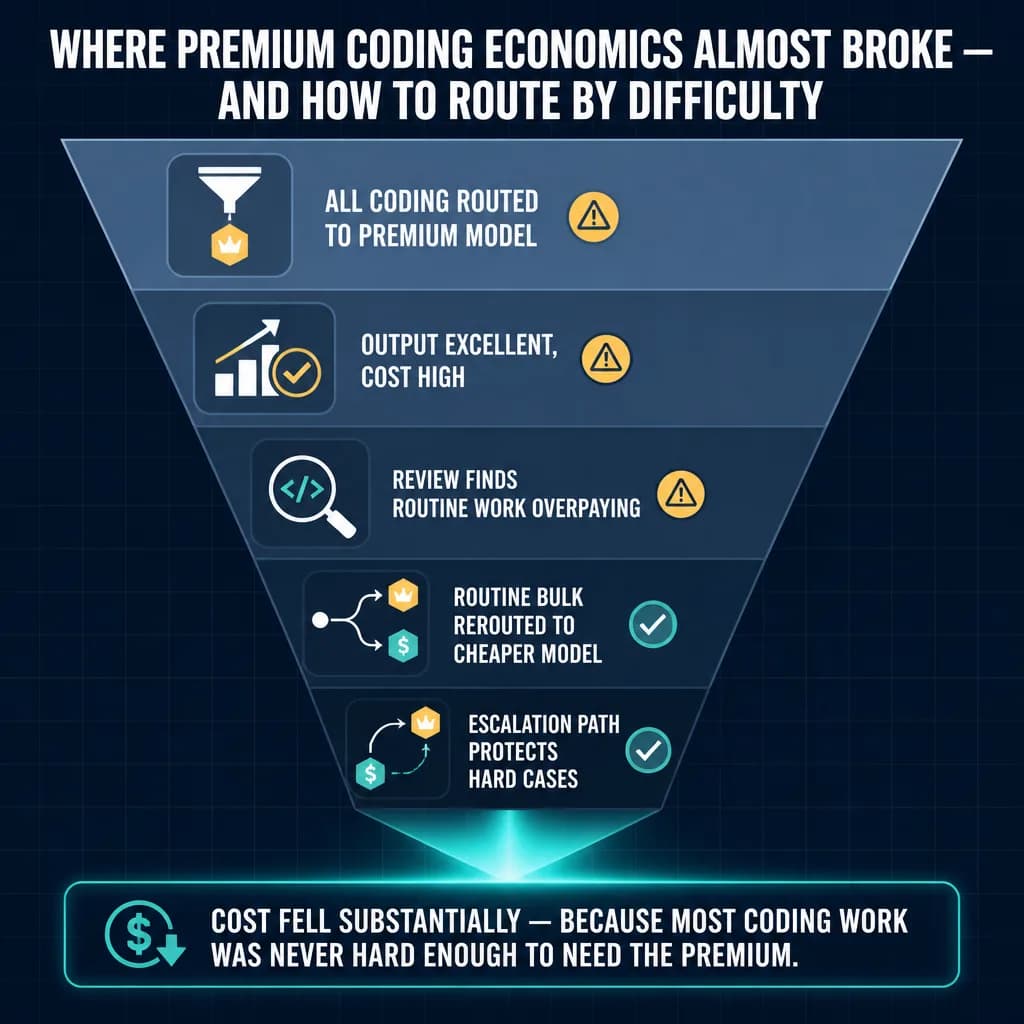
Where the economics almost broke
A team routed all coding work to a premium model, reasoning that coding was high-value and the best model was worth it. The coding output was excellent, and the cost was high, and a review found that most of the coding work being sent to the premium model was routine, work a cheaper model would have handled just as well, and the premium was being paid across the board for an advantage that only applied to a minority of the work.
The premium model had been the right tool for the hard problems and the wrong default for everything. The fix routed the routine bulk to a cheaper model and reserved the premium model for the hard problems, with an escalation path for routine-looking work that turned out to be subtle. Cost fell substantially, because most coding work is routine, and quality held on the hard problems, because those still went to the premium model. The premium model earned its cost where it was applied, once it was applied only where it earned it.
A premium coding model is worth its cost in a specific place, on the hard problems where its correctness saves more engineer time than its price, and it is a waste everywhere else, on the routine majority of coding work that a cheaper model handles just as well. The demonstrations that show it excelling at hard problems are accurate and misleading at once, accurate about the hard end and silent about how little of real coding work sits there.
The teams that deploy premium coding models economically are the ones that route coding work by difficulty, reserve the premium model for the problems where its capability saves engineer time, and operate the routine bulk on a cheaper model with an escalation path for the surprises. They cost the work in total, including the human time the cheaper model’s errors would consume. If you are deploying a premium model for coding, the question worth asking is not whether it is good at coding but what fraction of your coding work is hard enough to earn its cost, because that fraction, and not the model’s capability, is what determines whether the deployment pays.
Related: Data Architecture
Tell us the number you need to move.
…outcomes that survive scrutiny.