Claude Sonnet 4.5 and Long-Horizon Agents: Reading the Agentic Maturity Curve
A model that can sustain coherent work across a long horizon, maintaining a task over many steps without drifting or losing track, marks a specific point on a maturity curve that the enterprise should read carefully. Long-horizon agentic capability is where agents move from handling short, bounded tasks to sustaining extended work that unfolds over many steps, and a model that does this well opens a class of agent applications that shorter-horizon models could not support. It also raises the stakes of agentic reliability, because an agent operating over a long horizon has more steps at which it can go wrong and more distance to travel before a human notices, and reading where a model sits on the maturity curve is what tells you which agent applications it can safely support.
The pull toward long-horizon agents is the pull toward more autonomous, more capable automation, and it is warranted by the genuine progress in models’ ability to sustain extended work. What the pull obscures is that long-horizon capability and long-horizon reliability are not the same, and an agent that can sustain a long task is not automatically an agent you can trust to sustain it unsupervised. The maturity curve is about both, and reading it means understanding not just whether a model can operate over a long horizon but how reliably it does so and what oversight the long horizon still requires.
What long-horizon capability changes

Long-horizon capability lets an agent sustain a task across many steps, maintaining coherence, tracking state, and pursuing an objective over an extended sequence rather than a short bounded one. This is a real advance, because many valuable agent applications require extended work: a task that unfolds over many steps, involves many tool calls, and has to hold together across all of them. A model that drifts or loses track over a long sequence cannot support these applications, and a model that sustains coherence over the horizon can.
Seeing what this changes matters because it expands what agents can do and expands what can go wrong. A longer horizon means more steps, more tool calls, more opportunities for an error to enter and propagate, and more distance between an early mistake and the point where its consequences become visible. An error introduced early in a long-horizon task can compound across many subsequent steps before anyone notices, producing an outcome that is wrong in ways that are hard to trace back through the long sequence that produced them. A production AI system built as a long-horizon agent gains capability and inherits a longer, more error-prone sequence to govern.
Capability and reliability diverge on the long horizon
Here is the position worth holding. On the long horizon, agentic capability and agentic reliability diverge more than they do on short tasks, and a model that can sustain a long task is not the same as a model that sustains it reliably, because the long horizon gives unreliability more room to accumulate. Reading the maturity curve means distinguishing what a model can do over a long horizon from how reliably it does it, and the reliability is what determines whether you can trust the agent with extended autonomous work.
The reliability questions on the long horizon are specific. How consistently does the model maintain coherence across the full length of the task, not just the early steps? How does its error rate accumulate across a long sequence, does a small per-step error rate compound into a large end-of-task failure rate? How does it recover from errors that occur deep in a long task, where recovery requires understanding a long prior context? Does it maintain its grip on the objective across the horizon, or drift toward something adjacent? A model can be capable of long-horizon work and unreliable at it, and a governed AI deployment reading the maturity curve evaluates the reliability across the full horizon, because that is what determines the oversight the agent needs.
Oversight scales with the horizon
A long-horizon agent needs oversight that scales with the horizon, and this is where reading the maturity curve translates into deployment. A short-horizon agent can often be overseen by reviewing its outcome, because the sequence is short enough that an outcome review catches problems. A long-horizon agent needs oversight distributed across the horizon, because waiting until the end to check means an early error has had a long sequence to compound, and outcome review alone catches the problem too late.
The oversight for a long-horizon agent includes checkpoints along the horizon, where the agent’s progress is validated before it continues, so an error is caught near where it occurred rather than at the end. It includes a complete trace of the long sequence, so an outcome can be traced back through the many steps that produced it. It includes bounds on how far the agent proceeds autonomously before a human confirmation, matched to the stakes of the task. Owning the long-horizon agent means engineering oversight proportional to the horizon, because the longer the agent operates autonomously, the more oversight the sequence requires to stay safe, and reading the maturity curve tells you how much.
The trade-off worth naming
A longer horizon buys more autonomous capability and costs more oversight and more accumulated risk, and the trade is worth naming because the appeal of autonomy can obscure the cost. Each increment of horizon the agent operates over autonomously is an increment of capability and an increment of sequence in which errors can accumulate before detection. The right horizon for an agent is the one whose oversight you can build and whose accumulated risk the stakes can absorb, which is often shorter than the model’s raw long-horizon capability would allow. Extending the horizon to the limit of the model’s capability, without scaling the oversight to match, is buying autonomy at the cost of a reliability you have not secured.
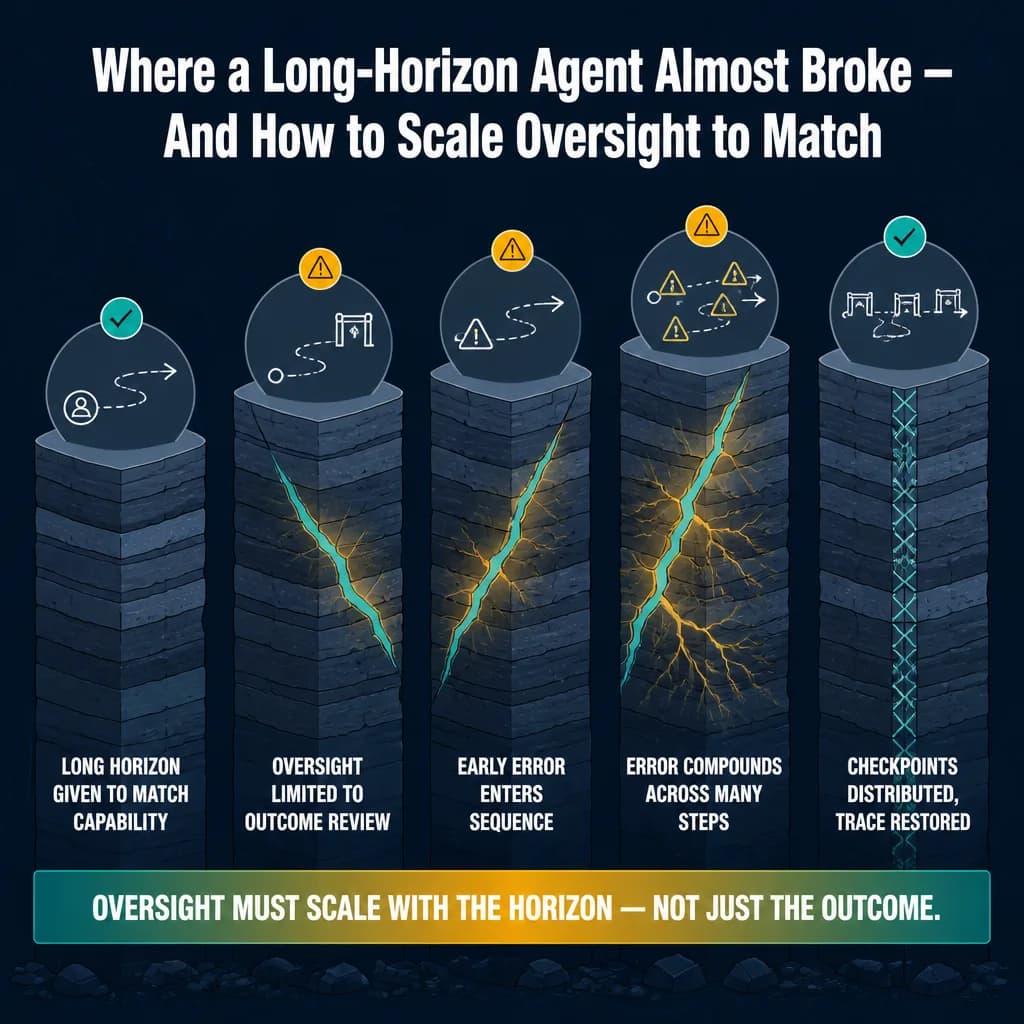
Where it almost broke
A team built a long-horizon agent on a model capable of sustaining extended work, and gave it a long autonomous horizon to match the model’s capability, with oversight that reviewed the agent’s final outcome. The agent handled many tasks well. Then a task arrived where the agent made an error early in the long sequence, and because the oversight only checked the outcome, the error compounded across many subsequent steps before it was caught at the end, by which point the agent had produced a substantially wrong result that was hard to trace back through the long sequence.
The model’s long-horizon capability had been real, and the oversight had not scaled with the horizon. The fix distributed the oversight across the horizon: checkpoints that validated the agent’s progress at intervals so an error was caught near where it occurred, a full trace of the sequence, and a shorter autonomous horizon before human confirmation for higher-stakes tasks. The agent’s long-horizon capability stayed useful, and the oversight now matched the horizon, catching errors before they compounded. Reading the maturity curve correctly meant matching the oversight to the horizon, not just extending the horizon to the model’s capability.
Long-horizon agentic capability is a meaningful point on the maturity curve, and reading it correctly means seeing that the capability to sustain a long task and the reliability to sustain it safely are different things that diverge as the horizon extends. The longer an agent operates autonomously, the more capable it is and the more room unreliability has to accumulate, and an agent given a long horizon without oversight scaled to match is an agent whose early errors have a long way to compound before anyone notices.
The teams that deploy long-horizon agents well are the ones that read the maturity curve on both capability and reliability, evaluate how reliably a model sustains work across the full horizon, and engineer oversight that scales with the horizon rather than checking only the outcome. They set the autonomous horizon to what the oversight and the stakes can support, not to the model’s raw capability. If a long-horizon agent is on your roadmap, the question worth settling is not just whether the model can sustain the horizon but how reliably it does so and whether your oversight scales with it, because the horizon’s length and the oversight’s reach together, not the model’s capability alone, determine whether the agent is safe to trust with extended autonomous work.
Related: Data Architecture
Tell us the number you need to move.
…outcomes that survive scrutiny.