Clinical Decision Support That Keeps the Clinician in the Loop
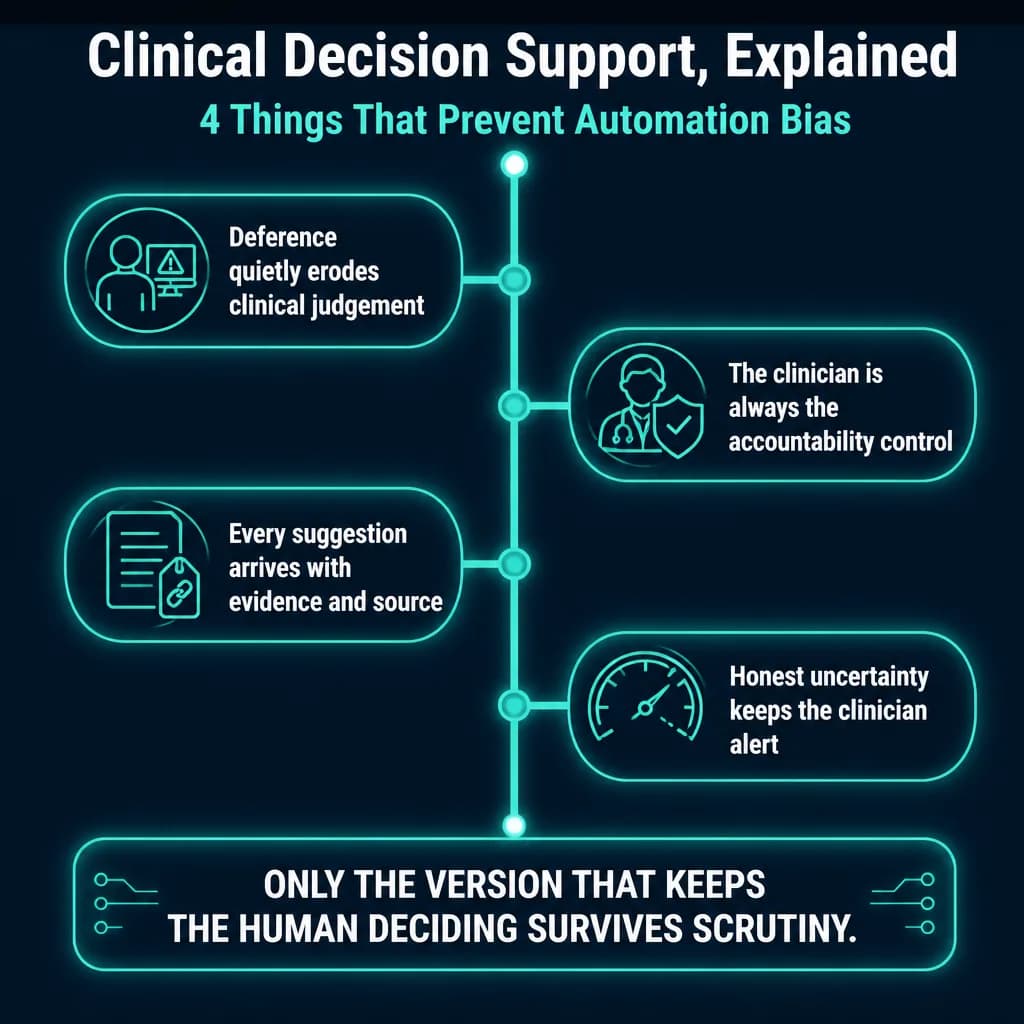
The most dangerous clinical decision support system is the one clinicians trust too much. A tool that surfaces a confident recommendation, day after day, trains the people using it to defer to it, and the deference builds quietly until the machine is effectively making decisions that a clinician is merely signing. When that system is wrong, and every system is sometimes wrong, the accountability for the outcome has gone soft, because no one fully owned the decision. Automation bias is the failure mode, and it hides inside a system that appears to be working well.
This is the problem any serious approach to clinical decision support has to solve before it solves anything else. The value of the technology is real: surfacing relevant evidence, flagging risks a busy clinician might miss, reducing cognitive load. The risk is that in delivering that value, the system displaces the clinical judgement it was meant to support, and quietly relocates accountability to a tool that cannot hold it.
The clinician is the accountability control
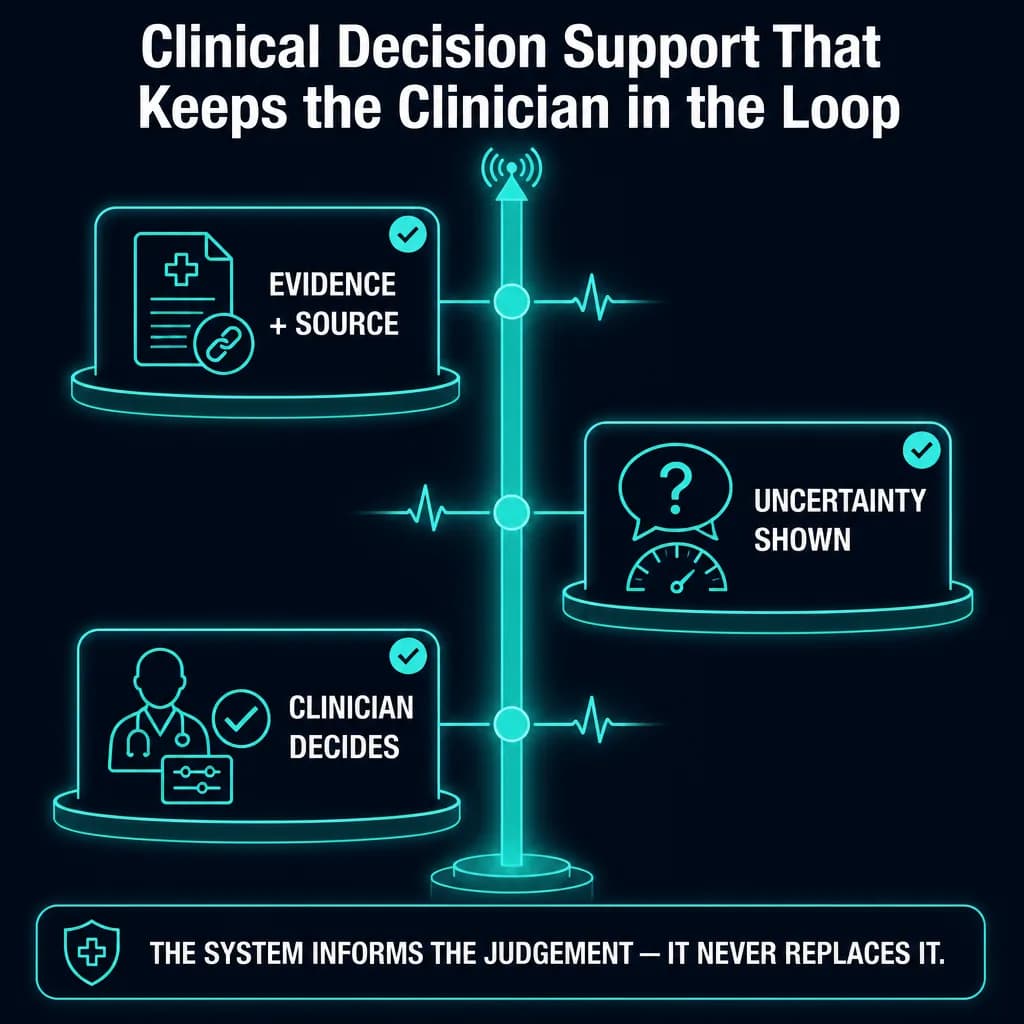
In a clinical setting, a person is answerable for the care of a patient, and that accountability cannot be delegated to software. So the design principle is firm: clinical decision support augments the clinician’s judgement, and the clinician owns the decision. The system is an input to a human decision, never a substitute for it, and the architecture has to make that relationship hold even under time pressure on a busy ward.
This shapes how the system presents itself. It offers evidence-backed suggestions with their sources attached, so the clinician can see the basis and weigh it, and it surfaces its own uncertainty honestly. Presenting a bare directive would invite exactly the deference that erodes judgement. Presenting reasoning with its evidence keeps the clinician engaged in the decision, which is the whole point.
Building support that resists automation bias
The engineering goal is a system that keeps the clinician thinking. Our knowledge and reasoning capability, COMPASS, answers clinical questions with responses traced to their sources, so a recommendation arrives with the evidence a clinician needs to evaluate it. The clinician reads the reasoning, checks the source, and decides. The system informs the judgement and leaves it with the person accountable for it.
Uncertainty handling is the load-bearing part. When the evidence is weak or the case is ambiguous, the system says so plainly, because a tool that projects false confidence on a hard case is the one that manufactures automation bias. A system honest about the limits of what it knows is a system a clinician stays alert around, and that alertness is a safety control.
Where it almost breaks
The near-miss to design against is subtle, because it looks like success. The system performs well, clinicians come to rely on it, and reliance shades into deference, until a confident suggestion on an unusual case is accepted without the scrutiny it needed. The tool did what it was built to do. The erosion of independent judgement was the hidden failure.
The correction is to build for engagement rather than compliance: sources on every suggestion, visible uncertainty, and no single unexplained recommendation a clinician can rubber-stamp. That design does less to reduce clicks than a system that simply outputs an answer, and it caps how much of the clinical workload can be automated. We accept that ceiling, because in clinical work preserving the accountable human judgement is worth more than the efficiency of removing it.
Clinical decision support that keeps the clinician in the loop is built to inform judgement and to resist the deference that would quietly displace it. Designing for engagement, evidence, and honest uncertainty is how the technology reduces load without loosening accountability. An operator building for healthcare treats the clinician as the load-bearing control from the first design choice, because a decision support system that makes clinicians trust it less critically is unsafe however capable it seems, and only the version that keeps the human deciding produces outcomes that survive scrutiny.
Related: About Us
Tell us the number you need to move.
…outcomes that survive scrutiny.