Clinical Decision Support With AI: Augmenting Diagnosis Without Overriding Judgment
Most clinicians have learned to click past the alert before they have finished reading it. The drug-interaction warning, the dosing flag, the reminder that fires on every third order, they have seen each one fire wrongly so many times that dismissing it has become a reflex. This is the uncomfortable starting point for any conversation about AI in clinical decision support: the channel through which a smarter system would deliver its insight is a channel clinicians have already been trained, by experience, to ignore.
That is the problem any AI-driven CDS tool inherits on day one. Better predictions do not help if they arrive through a mechanism the clinician has stopped trusting. And the failure is not the clinician’s. A system that cries wolf has taught a rational response. The engineering question is how to build support that earns the attention it asks for, and knows when not to ask, and the framing of clinician inattention sits well outside where the fix actually lives.
Why more accurate alerts can still make care worse

The intuitive fix is to improve the model. If the predictions are sharper, surely the alerts are more useful. Accuracy at the level of an individual prediction and usefulness at the level of a working clinician are different quantities, and conflating them is how good models produce bad deployments.
A CDS tool that is right ninety-five percent of the time still fires wrong one time in twenty. Operate that across a high-volume service and the absolute number of false alerts is large, large enough to rebuild the exact alert fatigue the tool was meant to escape. Worse, fatigue is not selective. A clinician numbed by a stream of low-value flags does not carefully preserve attention for the high-value one. The dangerous alert gets dismissed with the same reflex as the trivial ones. So the system can raise per-alert accuracy and still lower the quality of care, because what degrades is the clinician’s response to the whole channel.
This is the trade-off at the centre of clinical decision support, and it should be named without flinching: every alert spends a finite resource, clinician attention, and most CDS is designed as though that resource were free. It is not. An alert that fires when it should have stayed silent is a withdrawal from the account the system will need when something actually matters, and the framing of it as harmless caution sits well outside its real cost.
Designing for the override, not against it
The instinct of a safety-minded designer is to make alerts hard to dismiss. Force an acknowledgment. Require a reason. Make the clinician work to override. The logic seems sound; friction should reduce careless dismissal.
In practice, blanket friction backfires. When most alerts are low-value and all of them are hard to clear, clinicians do not become more careful; they become faster at whatever ritual the system demands, selecting the first dropdown reason without reading. The friction trains a new reflex, and the restoration of judgment sits well outside what it actually produces. The clinician’s ability to override is the load-bearing safety control of the entire system, the mechanism by which a human who knows the patient corrects a model that does not, and any attempt to engineer it out weakens the whole design.
So the design principle inverts. The goal is to make the alert worth not overriding, and the effort to make overriding hard sits well below that objective. That means firing less, with more context. An alert that explains why it fired, the specific values, the reasoning, the patient-specific factor that triggered it, gives the clinician something to evaluate in place of something to dismiss. And the override itself becomes signal: a pattern of clinicians overriding the same alert in the same situation is the system telling you the rule is wrong for this population, and a sign to retune it, and treating it as noise to suppress misreads what it actually is.
What governance looks like when the model can be wrong about this patient
A CDS model reasons from population-level statistics. The clinician reasons about the individual in front of them, the comorbidity that changes the calculus, the goal of care that makes the “indicated” intervention inappropriate, the context no structured field captured. These are the precise reason the clinician stays the decision-maker, and edge cases to be minimised sits well outside how they should be understood.
This reframes accountability cleanly. AI decision support augments diagnosis, and it stops short of making it. The clinician owns the decision, the model owns a recommendation, and the workflow must keep those roles distinct, so a suggestion never hardens into a default that takes effort to refuse. Where a recommendation carries real consequence, the oversight should match the stakes of the decision, heavier where harm is plausible and lighter where it is not, held above any uniform treatment of every flag as equally urgent.
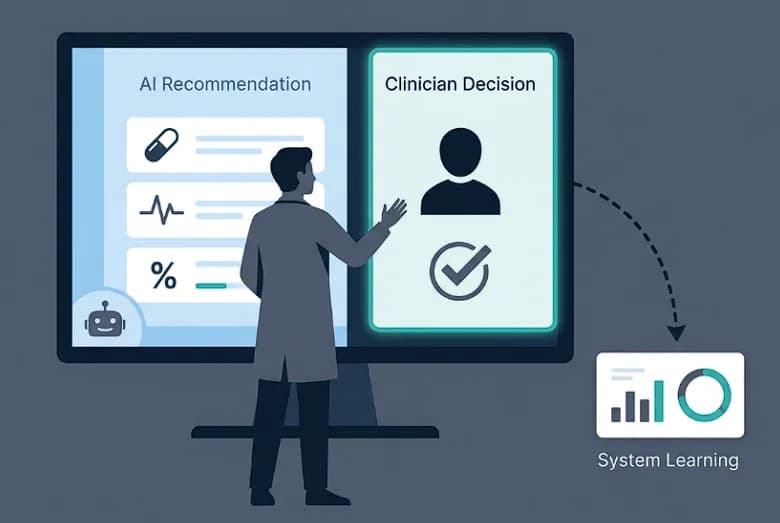
Validation, here, is not a one-time gate. A CDS tool’s value depends on its alert burden in this setting, with these patients and these workflows, a quantity no vendor benchmark captures. Treating evaluation as an ongoing discipline that tracks override rates and false-positive load, held together with headline accuracy, is what keeps a tool from silently decaying into background noise. A model that was useful at launch becomes wallpaper the moment its signal-to-noise ratio crosses the threshold where clinicians stop reading.
Where it almost breaks
A sepsis early-warning tool offers a clean illustration. A hospital deploys a model that flags patients at risk of deterioration, and at first it catches cases earlier. The model was tuned for high sensitivity, and on a busy ward it fires often, frequently on patients whose abnormal vitals had a known, benign explanation already obvious to the nurse at the bedside. Within weeks, the alert is being cleared reflexively. Then a genuine early deterioration is dismissed along with the noise. No one had been watching the override rate, which had quietly climbed toward total. The fix was structural. The alert was suppressed when the triggering signal was already explained in the chart, the clinician’s reasoning was surfaced when they overrode, and the override rate was put under active monitoring as the leading indicator of whether the tool still worked. The alert that mattered only mattered if the channel had not already been deadened.
AI in clinical decision support can genuinely improve decisions, surfacing the deterioration a busy team would have caught later, the interaction a tired clinician might have missed. It earns that only by respecting the one resource it most easily wastes. A CDS tool that fires constantly has added noise to a channel clinicians already distrust and called it vigilance, and the framing of that as safer care sits well outside what it actually delivers. The good ones fire rarely, explain themselves, and treat every override as information.
The question worth carrying into any CDS deployment is not how accurate the model is. It is how much clinician attention each alert costs, whether the system knows when to stay silent, and whether anyone is watching the override rate closely enough to notice the day the tool quietly stops being heard.
Related: Healthcare & Life Sciences · Koita Foundation: An AI-powered knowledge hub with citation-backed retrieval across seven repositories
Tell us the number you need to move.
…outcomes that survive scrutiny.