COMPASS, Explained: Making Institutional Knowledge Answerable
Every established organisation is sitting on knowledge it cannot use. Decades of decisions, policies, reports, standards, and expertise are spread across systems, documents, and the memories of long-serving people. The information exists, and reaching the right piece of it means knowing which system to search, which document holds the answer, and which person to ask. That map lives in a few experienced heads, and when they leave, the organisation keeps the data and loses the ability to find what it needs inside it.
This is the problem COMPASS addresses, and the distinction that matters is between storing knowledge and making it answerable. Most organisations have no shortage of stored knowledge. What they lack is the ability to ask a question in plain language and get a real, sourced answer drawn from across all of it. A search box that returns documents is not the same as a system that answers, and the gap between them is where institutional knowledge goes to waste.
Why search was never the solution
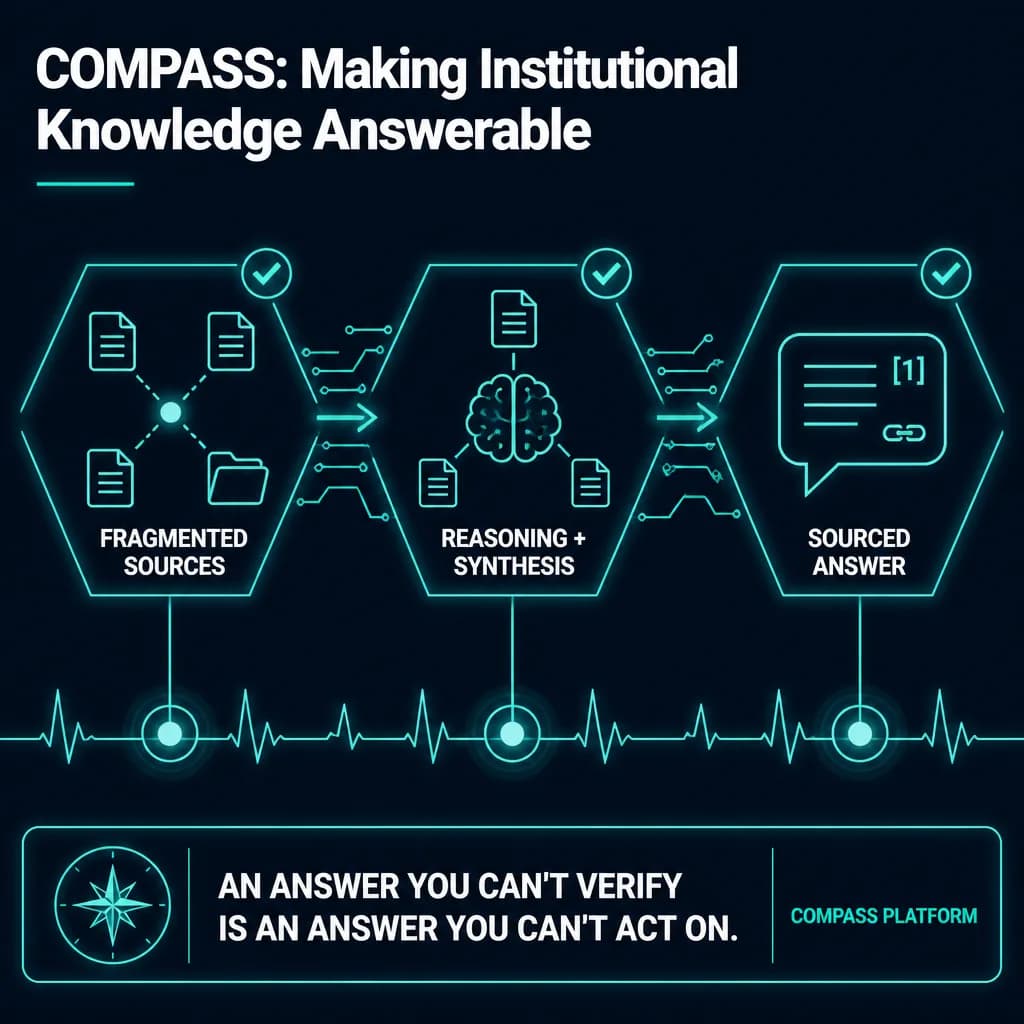
Keyword search finds documents containing a phrase. It cannot reason across sources, connect a decision to the standard behind it, or synthesise an answer from information spread across several repositories. It hands you a list of places the answer might be and leaves the work of reading, connecting, and interpreting to you. For a specific factual lookup that is adequate. For a real question, the kind that requires pulling together policy, precedent, and context, it fails, because the answer was never in one document to begin with.
So the harder capability is synthesis with provenance: reasoning across every source to produce an answer, and showing exactly where that answer came from. This is what separates a knowledge system that people trust and use from one they abandon after it returns ten documents and no answer.
What COMPASS actually does
COMPASS makes institutional knowledge answerable in plain language and puts it to work: generating reports, operating compliance audits, capturing decisions from meetings into systems like Jira or GitHub, and drafting documents on demand. Underneath, it combines retrieval across fragmented sources with a reasoning layer that connects and synthesises them, and it attaches sources to every answer.
Deployed as a knowledge intelligence platform unifying several repositories, this approach cut information discovery time by around eighty percent, unified seven-plus knowledge sources into a single layer, and returned answers with high source traceability through inline citations. The number that matters most is the traceability, because an answer you cannot verify is an answer you cannot act on, and inline citations are what turn a plausible response into a usable one. The system does not just find information faster. It makes the organisation’s own knowledge queryable and turns the answers into work.

Source attribution is the load-bearing part
The property that makes COMPASS trustworthy is that every answer carries its evidence. In an enterprise, acting on an unverifiable answer is a risk, and a knowledge system that responds confidently without showing its basis invites people to rely on assertions they cannot check. So source attribution is engineered into every response, letting the user confirm the basis before acting.
The near-miss to design against is a system that sounds authoritative and cites loosely, producing fluent answers that trace back to nothing solid. That system is worse than useless, because it is trusted and wrong. The correction is strict provenance: every answer tied to its sources, and honesty about confidence when the support is weak. That discipline is more demanding to build than a fluent chatbot over the same documents, and it is the difference between a knowledge system an enterprise can rely on and one it cannot.
COMPASS turns a warehouse of stored, unreachable knowledge into an answerable resource that survives the turnover of the people who once held the map. The value is an organisation that can ask itself a question and get a sourced answer, and then turn that answer into work. An operator building knowledge systems makes provenance the foundation, because institutional knowledge is only an asset when its answers can be trusted, and only sourced, verifiable answers produce outcomes that survive scrutiny.
Related: Compass, Business Analyst - PYZO · About Us · Koita Foundation: An AI-powered knowledge hub with citation-backed retrieval across seven repositories
Tell us the number you need to move.
…outcomes that survive scrutiny.