Consolidating the AI Tool Stack: Cutting Sprawl Without Losing Capability
Two years into serious AI adoption, most enterprises share a problem nobody planned for. The organisation is operating an assistant platform, a coding agent, a document tool, a research tool, several content generators, a voice platform, and a scatter of point tools adopted by individual teams, and the total is a sprawl that costs more than the sum of its licences and governs worse than any single tool. Each was adopted for a good reason. Together they are a redundant, ungoverned, expensive estate, and the instinct to consolidate is correct, while the way most consolidations get operated trades one problem for another.
AI tool sprawl is the natural result of a fast-moving space and decentralised adoption, and consolidation is the discipline of reducing that sprawl without losing the capability that justified it. The question is not whether to consolidate. It is how to cut redundancy, cost, and governance surface without cutting the capabilities teams actually depend on, and getting that balance wrong in either direction is expensive. This is an operating discipline the organisation has to build, and it starts with seeing the estate clearly.
Why sprawl costs more than its licences
The obvious cost of tool sprawl is the redundant spend, several tools doing overlapping jobs, each with its own licence. That is the smallest part of the real cost.
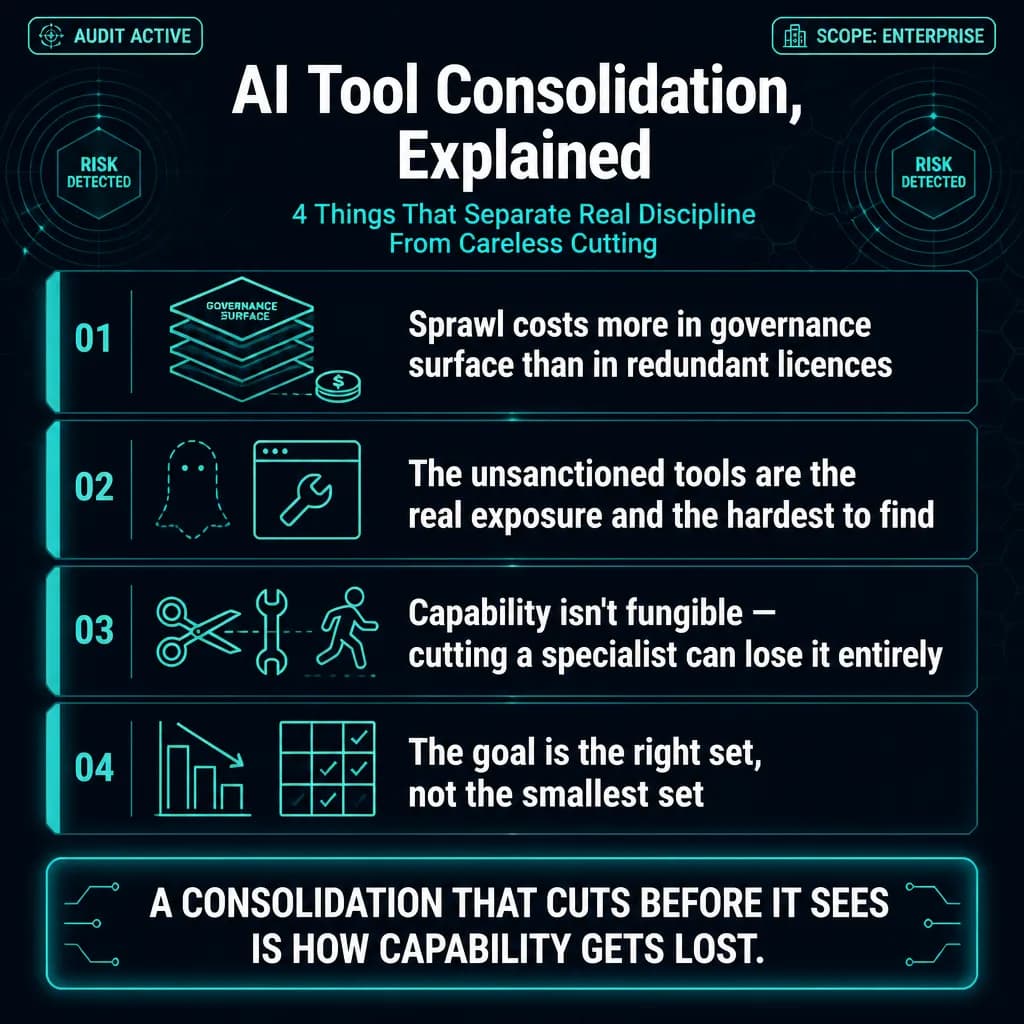
The larger cost is governance surface. Every tool is a separate data-handling agreement, a separate set of permissions, a separate integration, a separate place data leaves the organisation, and a separate thing to audit, and the governance burden scales with the number of tools whether or not anyone is actually governing them, which in a sprawl they usually are not. The unmanaged tools are the exposure, the point tool a team adopted without review, the free tier someone is pasting sensitive documents into, the integration nobody approved. Sprawl is not primarily a cost problem. It is a governance and risk problem wearing a cost problem’s clothes, and consolidation that chases only the licence savings misses most of the point.
The consolidation mistake that loses capability
The naive consolidation picks the tool with the broadest feature set, mandates it, and cuts the rest, and it fails because capability in this space is not fungible.
A general assistant platform and a specialised coding agent overlap on paper and are not substitutes in practice, and cutting the specialised tool to consolidate onto the general one loses the capability the specialist provided, which the team will either quietly work around or lose entirely, and both outcomes are worse than the sprawl. The organisations that consolidate badly optimise for the smallest number of tools rather than the right set, and they discover the lost capability after the specialists are gone and the teams that relied on them have degraded. The trade-off is real and it is the crux of the whole exercise. Fewer tools means simpler governance and lower cost and less capability if the cut is careless, so consolidation is not minimisation. It is finding the smallest set that preserves the capability the organisation genuinely uses, and that requires knowing which capabilities those are before cutting anything.
Operationalising consolidation
A disciplined consolidation operates in an order that protects capability while cutting sprawl.
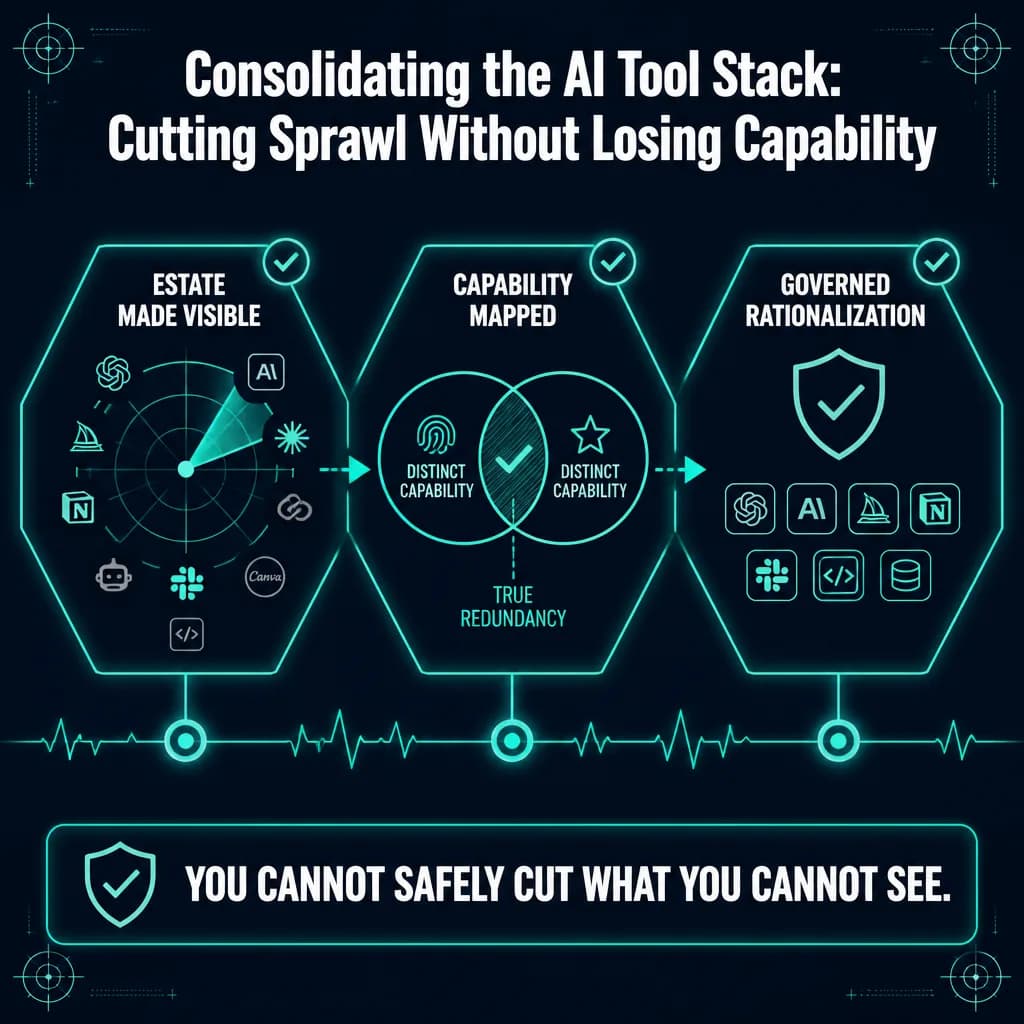
Visibility comes first, and it is the step most organisations skip and most need. You cannot consolidate an estate you cannot see, and the real inventory, every AI tool in use, including the unsanctioned ones, what data each touches, what capability each provides, and who depends on it, is the foundation the whole exercise rests on. The unsanctioned tools are both the highest risk and the hardest to find, which is exactly why the inventory matters. Capability mapping comes second, sorting tools by the capability they actually deliver rather than the category they are sold in, so genuine redundancy is separated from apparent overlap, and this is where careless consolidation is prevented, because it reveals which overlaps are real substitutes and which are distinct capabilities that look similar. Governed rationalisation comes third, cutting the genuine redundancy, bringing the unsanctioned tools into governance or replacing them, and keeping the distinct capabilities the organisation depends on, with the decision made on capability and risk rather than licence count alone.
This is the same estate-level discipline behind FORGE, where automation is managed as a governed portfolio with ownership and oversight rather than an accumulation of point solutions, and it applies to the AI tool stack directly. The governance layer matters as much as the tool count, because a consolidated estate that is actually governed, with consistent data handling, permission integrity, and audit across the tools that remain, is the real prize, larger than the licence savings. Teams working through governing the enterprise AI tool estate should treat visibility and capability mapping as the load-bearing steps, because a consolidation that cuts before it sees is how capability gets lost.
Where consolidation fits, and where restraint does
Consolidation is worth conducting for any organisation two years into adoption with an estate that grew by accretion rather than design, which describes most of them, and the return is governance and risk reduction as much as cost.
Restraint fits where consolidation would cut genuine distinct capability for the sake of a lower tool count, because a specialised tool a team depends on is not sprawl, it is capability, and cutting it to hit a number is the failure mode dressed as discipline. The point is the right set, governed well, not the smallest set, and an organisation that consolidates to a number rather than to a capability map has not solved the problem. It has traded a visible cost for a hidden capability loss.
Consolidating the AI tool stack is a real and worthwhile discipline, and its value comes from cutting redundancy and governance surface while protecting the capability teams depend on, which requires seeing the estate before cutting it. The organisations that consolidate well built the inventory and the capability map first and rationalised on capability and risk rather than licence count. If a consolidation is underway in your organisation, the exercise that determines whether it succeeds is the one most likely to be skipped: building the honest inventory of every AI tool actually in use, including the ones nobody approved, because you cannot safely cut what you cannot see.
Related: Data Architecture
Tell us the number you need to move.
…outcomes that survive scrutiny.