Consultant, Integrator, or Operator: Who Actually Owns Your AI in Production
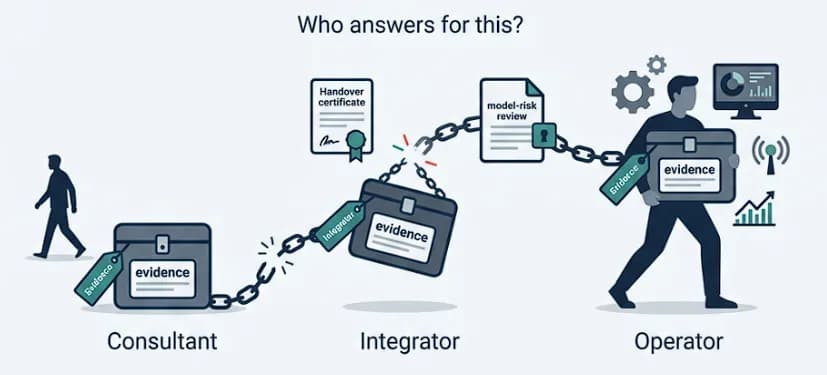
A sourcing decision is never really tested in the meeting where it gets made. It is tested months later, in a different room, when something has gone wrong and one question goes around the table: who answers for this? The procurement scorecard that picked the winning vendor said nothing about that moment. It scored capability, price, and references. It said nothing about who would be accountable for the system once it was live and being questioned.
That omission is how most enterprises end up with AI in production that no one owns. The choice between a consultant, an integrator, and an operator is usually framed as a choice between three kinds of supplier. It is actually a choice about where accountability lands the day the system goes live, and most buyers make that choice without realising they are making it.
The sourcing model is built to end. The system isn’t.
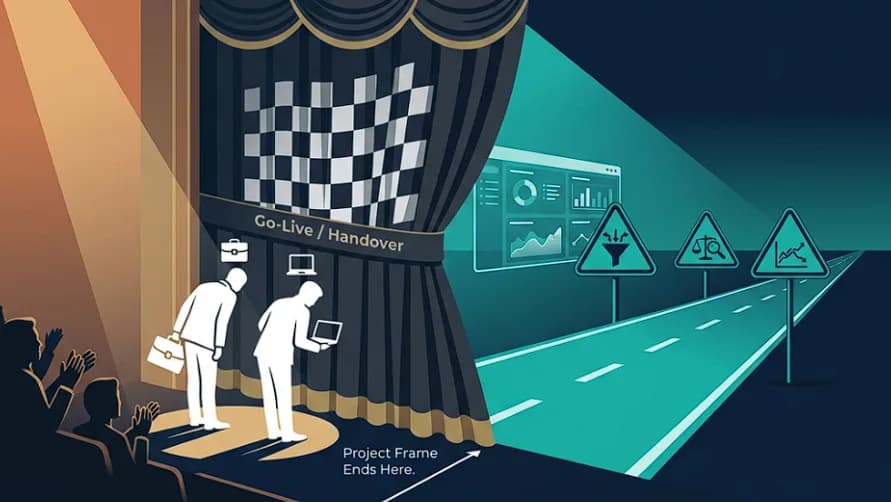
Enterprises buy AI the way they have always bought software. An RFP defines a scope. Milestones track delivery. User acceptance testing confirms the thing works. A sign-off transfers it to the business, and the engagement closes. This instrument is mature, well-understood, and exactly wrong for AI, because every part of it is designed to reach an ending.
AI systems do not end at go-live. They begin there. A model that passed acceptance testing on Monday is operating against a world that keeps moving after Monday. Inputs shift. Upstream systems change. The behaviour that was correct on the test set degrades in ways no one notices until a decision is challenged. The project frame treats go-live as the finish line. For an operating system, it is the starting line, and the contract you negotiated has already booked its own exit before the real work begins.
In regulated sectors this mismatch becomes acute, because the obligation does not transfer the way the contract assumes. A regulator does not care which vendor built the system or whether a handover certificate was signed. The question is who is accountable now, and that question never closes. The clean handoff written into your statement of work and the regulator’s standing demand are in direct conflict. One of them is going to lose, and it will not be the regulator.
Three models, one question: who can answer for the live system
Strip away the category labels and judge each model by a single test. When the system makes a decision someone challenges, who is able to explain it, correct it, and stand behind it?
A consultant is gone before that question can be asked. The strategy was the deliverable, and it left when the consultant did. Accountability never attached to anyone, because the engagement was built around advice, and the live system sat well outside its scope. You own the consequences of a system you were guided toward but never handed the means to operate.
An integrator transfers accountability to your team at sign-off. On paper this looks like ownership. In practice your team inherits a system it did not engineer and cannot fully explain, and the explanation gap surfaces at the worst possible time. There is a real difference between passing acceptance testing and surviving a model-risk review. Acceptance testing asks whether outputs are correct on a known set. A risk committee asks you to reconstruct why one specific past decision was made and show the controls that governed it. A handover certificate satisfies the first standard and leaves the second one unowned.
An operator keeps accountability with the party that can act on it. The team that engineered the system operates it, monitors it, and answers for it in production, inside your environment. Accountability stays attached to the people with the means to honour it, which is the only place it does any good. This is the difference between deploying AI, which is now easy, and operationalising it, which is the work.
The trade-off, named honestly
The operator model has a real cost, and it is not only the invoice. You do not fully internalise the capability on day one. For the operating life of the system you are working with an external party who carries the accountability, and an enterprise that wants every capability in-house may read that as a dependency where a service is intended. That instinct is sometimes right. If you operate a mature engineering organisation with its own model-risk and monitoring discipline, and the workload sits outside regulatory scrutiny, internalising it is the correct call and an operator is overhead you do not need.
Where it is the wrong call is precisely where the stakes are highest. Picture an integrator-delivered document-validation system in a lender, signed off and live. Nine months later a model-risk review asks the in-house team to reconstruct a single past decline. The team cannot, because they operated the system but never engineered its reasoning, and the controls were assumed in place of designed. The programme pauses. The clean handover that read as a win in the project review is the exact reason no one in the building can answer the question. An operator engineers that review into the system before it ships, because the people who built it are the people who will be in the room defending it.
The honest reframe is this. When you compare a consultant, an integrator, and an operator, you are not comparing three ways to deliver the same thing. You are deciding whether your AI in production will have an owner the day a regulator, an auditor, or your own board starts asking why. Pick on capability alone and you will get a system that works until it is questioned. Pick on accountability and you get the only thing that holds up afterward: outcomes that survive scrutiny.
Related: About Us
Tell us the number you need to move.
…outcomes that survive scrutiny.