Context Engineering: Managing the Window as a Production Resource
The context window is finite, and treating it as if it were not is the source of a class of production failures that get blamed on the model. An agent has a limited context window, and what goes into it, the instructions, the retrieved information, the history, the tool results, competes for that limited space, which means managing the context window is a resource-management problem that determines what the agent can attend to. Context engineering is managing the context window as the finite production resource it is, deciding what goes into it and how, because a context window filled carelessly degrades the agent’s performance, and managing it deliberately is what keeps the agent working as its context grows. The window is a resource to be managed, not an unlimited space to fill.
If you build agents, the context window is a resource whose management determines the agent’s performance, and treating it as unlimited, filling it with whatever might be useful, degrades the agent as the window fills with content that competes for its attention. What goes into the context window, and how it is managed as the agent operates, determines what the agent can effectively attend to, and managing it deliberately is what keeps the agent performing. Understanding the context window as a finite resource and how to engineer its use is what lets you manage it as a production resource rather than filling it until the agent degrades.
Why the context window is a resource
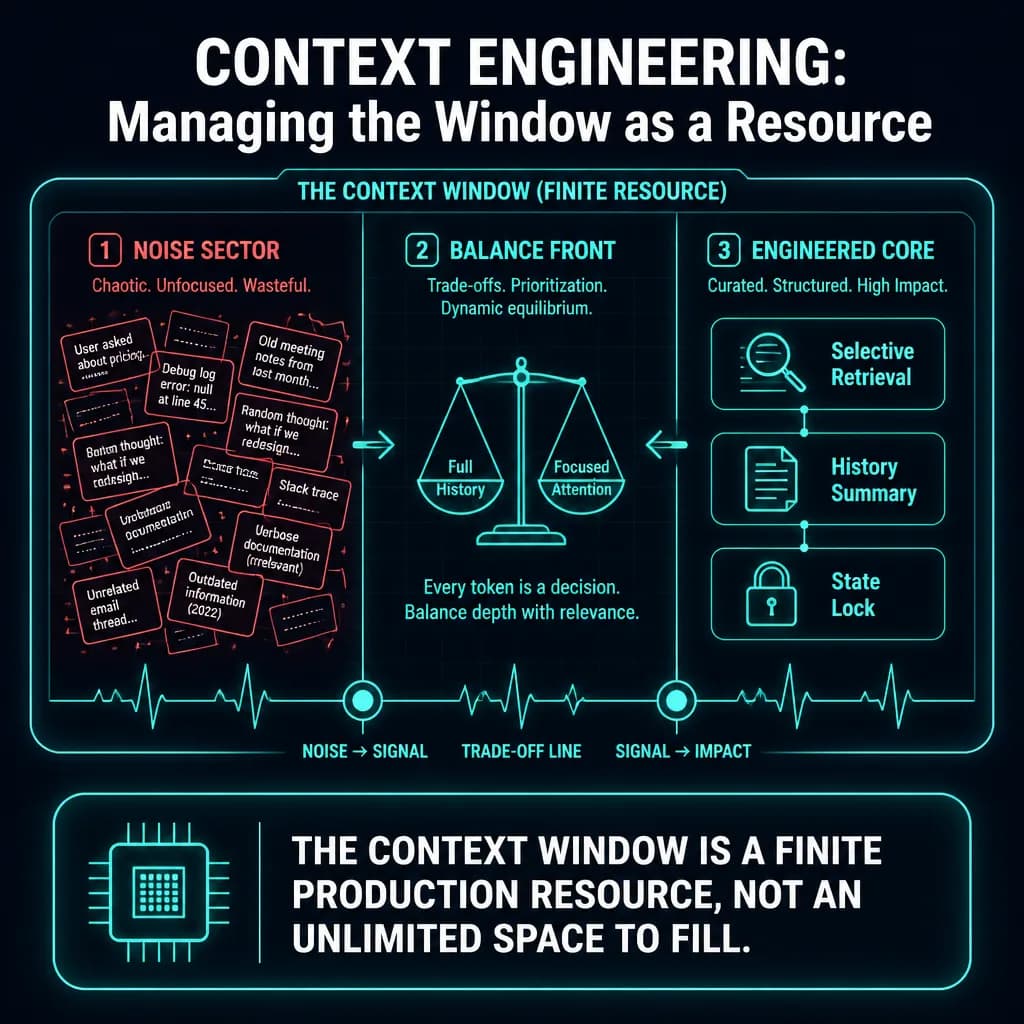
The context window is finite, holding a limited amount of information, and everything the agent needs to attend to has to fit within it, the instructions that define the agent’s behaviour, the retrieved information it works from, the history of the interaction, the results of its tool calls, all competing for the limited space. This makes the context window a resource, because the space is limited and the demands on it compete, so what goes into it is a resource-allocation decision, and filling it with one thing leaves less room for another. The window’s finiteness means the agent cannot attend to unlimited information, and managing what occupies the window is managing what the agent can attend to.
Treating the window as unlimited degrades the agent, because a window filled with more information than the agent can effectively attend to leads to context degradation, the agent’s attention thinning across a full context and its performance dropping as the relevant information is diluted by the irrelevant. A window filled with the whole history, all the retrieved information, and every tool result is a window where the relevant information competes with a mass of less relevant content, and the agent’s performance degrades because it cannot attend well to the relevant information buried in the full context. This is worsened by long-lived agents whose context accumulates over the interaction, and by retrieval that adds information to the context, both of which fill the window if not managed. The context window is a resource because it is finite and its demands compete, and filling it carelessly degrades the agent, which is why the window has to be managed as the resource it is.
Engineering the context window
Managing the context window means deciding deliberately what goes into it and how, so the window holds what the agent needs to attend to without being filled with content that degrades its attention. This means being selective about what enters the context, including the information relevant to the current task and excluding the irrelevant, so the window holds the relevant content rather than everything that might be useful, which keeps the agent’s attention on what matters. The selective retrieval that pulls the relevant information rather than everything is part of this, keeping the retrieved content in the window relevant, and the management of the history, keeping what the agent needs and summarising or dropping what it does not, keeps the history from filling the window.
Engineering the context window also means managing it as the agent operates and the context grows, because the window that is well-managed at the start of an interaction can fill as the interaction proceeds, so the management is ongoing, keeping the window holding the relevant content as the agent accumulates history and information. Summarising the history to keep its essence without its full length, dropping information no longer relevant, and prioritising the most relevant content when the window is under pressure are the techniques that keep the window managed as it fills. The engineering is deciding what occupies the finite window at each point, so the agent’s limited attention is spent on the relevant content, which is what keeps the agent performing as its context grows. Engineering the context window is managing what enters it and keeping it holding the relevant content as the agent operates, which is what keeps the agent’s finite attention on what matters rather than diluted across a carelessly filled window.
The trade-off, and managing the window deliberately
Managing the context window costs engineering and involves trade-offs about what to include, and naming these keeps the management deliberate. Building the context management, the selective inclusion, the history summarisation, the ongoing management as the context grows, is real engineering, more than filling the window with whatever might be useful, and it involves the trade-off of deciding what to include and exclude, which risks excluding something the agent needed or including something that degrades its attention. Managing the window means making these inclusion decisions deliberately, balancing including enough for the agent to have what it needs against excluding enough to keep the window from degrading the agent’s attention.
The trade-off in what to include is real, because including more information gives the agent more to work from and risks degrading its attention, and including less keeps the attention focused and risks omitting something needed, so the management balances these for the agent’s actual needs. This connects to the cost of the context, because what occupies the window is also what is processed, so managing the window affects the cost and latency as well as the attention, and a leaner window is cheaper and faster as well as better attended. The deeper point is that the context window is a resource to be managed deliberately, and managing it, deciding what occupies it and keeping it holding the relevant content, is what keeps the agent performing as its context grows, where filling it carelessly degrades the agent. Managing the window deliberately, balancing what to include for the agent’s needs and keeping it holding the relevant content as the agent operates, is what makes the context window a managed resource rather than a space filled until the agent degrades.

Where it almost broke
We operated an agent whose context window was filled without much management, including the full history, all the retrieved information, and the accumulated tool results, and the agent’s performance degraded as its context grew, because the window filled with content that diluted the agent’s attention to the relevant information. The agent that performed well early in an interaction degraded as the interaction proceeded and the context accumulated, because the window filled with history and information that competed for the agent’s attention, burying the relevant content in a mass of less relevant context. The context window had been treated as unlimited space to fill, and filling it had degraded the agent.
The correction engineered the context window. We became selective about what entered the context, including the information relevant to the current task and excluding the irrelevant, and managed the window as the agent operated, summarising the history to keep its essence without its full length and dropping information no longer relevant, so the window held the relevant content as the context grew. We balanced the inclusion to give the agent what it needed without filling the window with content that degraded its attention. The agent’s performance stopped degrading as its context grew, because the window now held the relevant content rather than everything, keeping the agent’s attention on what mattered. The lesson was that the context window is a finite resource, and managing it deliberately, keeping it holding the relevant content as the agent operates, is what keeps the agent performing where filling it carelessly degrades it.
Manage the window as a resource
The reframe that keeps agents performing as their context grows is treating the context window as a finite resource to be managed rather than an unlimited space to fill. Context engineering manages what enters the window and keeps it holding the relevant content as the agent operates, because the window is finite and filling it carelessly dilutes the agent’s attention to what matters. A window filled with everything that might be useful degrades the agent as the relevant information competes with a mass of less relevant content.
The teams whose agents perform as their context grows are the ones that engineered the context window, were selective about what entered it, managed it as the agent operated, and kept it holding the relevant content rather than everything. The context window is a resource whose management determines what the agent can attend to, and treating it as unlimited degrades the agent as the window fills. Managing the window deliberately, keeping the agent’s finite attention on the relevant content rather than diluting it across a carelessly filled context, is what makes the context window a managed production resource rather than a space filled until the agent degrades.
Related: Agentic AI
Tell us the number you need to move.
…outcomes that survive scrutiny.