Continuous Evaluation Pipelines: Catching Regression Before Your Users Do
Evaluation that happens once, before deployment, tells you the agent worked at that moment, and a non-deterministic system operating in a changing world can regress after that moment in ways a one-time evaluation never sees. The agent’s dependencies change, its inputs drift, a prompt gets updated, and the system that passed evaluation last month can be failing now, with nothing watching because the evaluation was a gate the agent already cleared. Continuous evaluation pipelines operate the evaluation continuously against the operating system, catching regression when it happens rather than discovering it through users, and they exist because a system that can regress after deployment needs evaluation that continues after deployment.
If you operate an agent, the question is not only whether it worked when you deployed it but whether it is working now, and a one-time pre-deployment evaluation cannot answer the second question. The agent operates in conditions that change, and its performance can drift or break as they do, which means catching that regression requires evaluation that operates continuously against the operating system, not once before it went live. Building continuous evaluation is what turns evaluation from a deployment gate into an ongoing operational capability that catches regression before users do, which is the difference between finding a regression in your pipeline and finding it in a complaint.
Why one-time evaluation is not enough
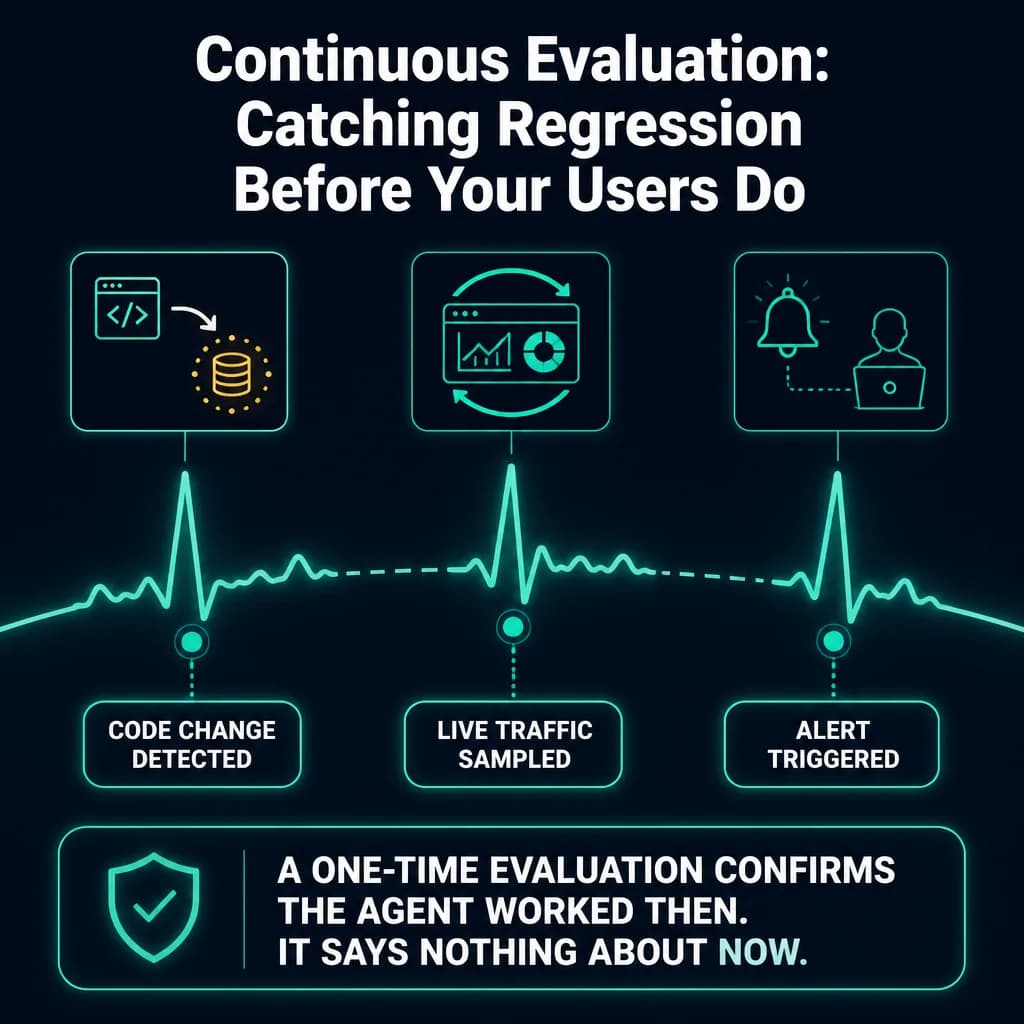
Pre-deployment evaluation answers whether the agent works before it goes live, which is necessary and insufficient, because the agent’s performance is not fixed after deployment. A non-deterministic system’s correctness is a distribution that can shift, its dependencies can change, its input distribution can drift away from what it was evaluated on, and any change to the system, a prompt update, a model change, a modified tool, can regress performance in ways the original evaluation did not test. The agent that passed evaluation at deployment is not guaranteed to keep passing, because the conditions that made it pass can change, and a one-time evaluation that treated passing as a permanent property misses the regression that occurs after.
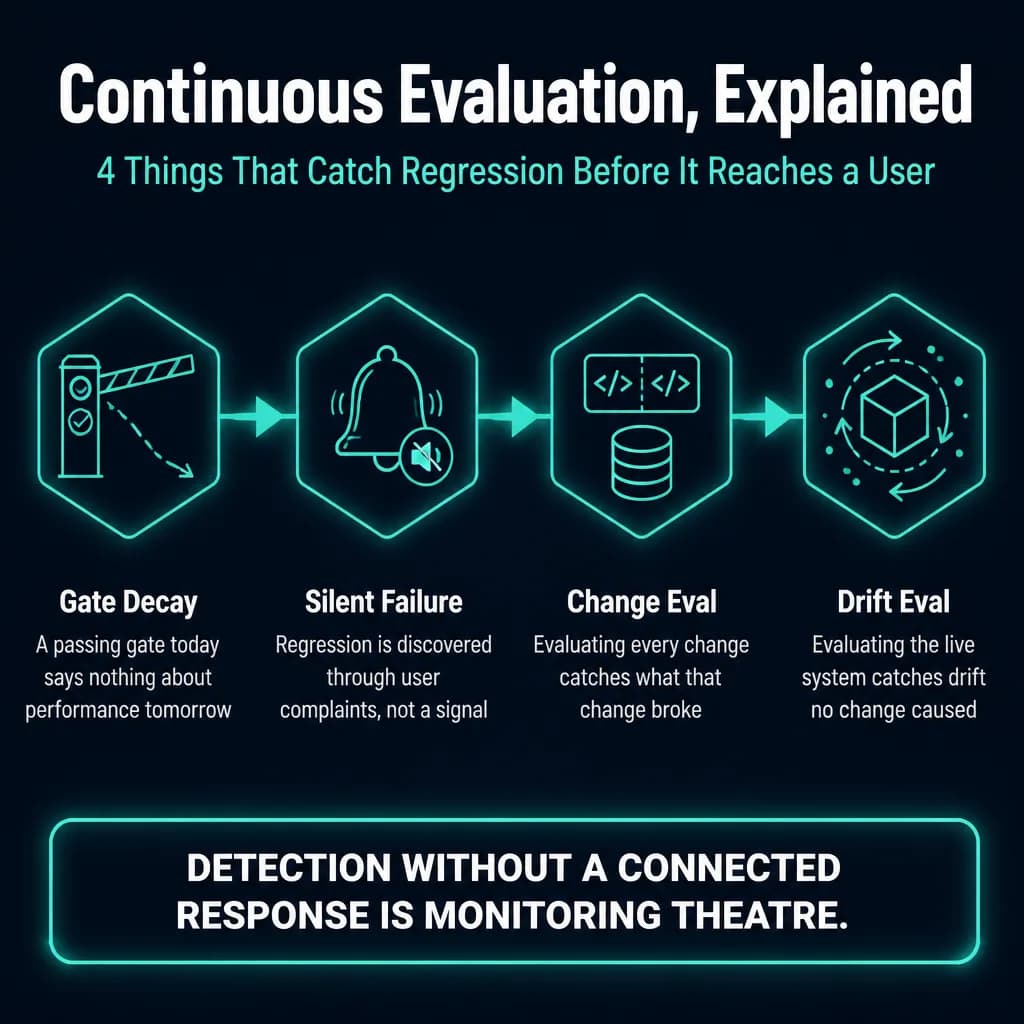
The cost of relying on one-time evaluation is that regression, when it happens, is discovered through its consequences rather than through evaluation, which means users hit the degraded performance and the organisation learns about the regression from the downstream effects, complaints, errors, bad outcomes, rather than from a signal that caught it when it happened. This is the silent failure problem at the level of ongoing operation: the regression does not announce itself, the agent keeps operating while performing worse, and without continuous evaluation watching, the degradation continues undetected until its consequences surface. Catching regression when it happens, rather than through its consequences, requires evaluation that operates continuously, which is what a one-time gate cannot provide.
How continuous evaluation works
Continuous evaluation operates the evaluation harness continuously against the operating system, so that regression is caught when it happens rather than discovered later. This takes two connected forms. Evaluation on every change operates the harness whenever the system is modified, a prompt update, a model change, a tool modification, so that a change that regresses performance is caught before it reaches users, which is what makes it safe to change the system, because you learn immediately whether the change improved or broke it. This is the regression detection that lets a team iterate on the agent with confidence, catching the regression a change introduces at the moment of the change.
Evaluation on the live system operates against the agent as it operates, sampling real production behaviour and scoring it continuously, so that regression from drifting conditions, changing dependencies, or shifting inputs is caught even when the system itself was not changed. This catches the regression that no change introduced, the drift that happens because the world around the agent changed, which evaluation-on-change would miss because nothing in the system changed. Both forms depend on the golden dataset and the continuous scoring infrastructure, and together they provide the coverage that catches regression whether it comes from a change to the system or from drift in its conditions. Continuous evaluation is the pipeline that operates these continuously, turning evaluation from a one-time gate into an ongoing signal that catches regression when it occurs.
The trade-off, and acting on the signal
Continuous evaluation costs more than one-time evaluation, and naming that cost is what justifies it against the alternative. Operating the evaluation continuously, on every change and against the live system, consumes compute, often model compute for the scoring, and requires the infrastructure to operate the evaluation continuously and the maintenance to keep the golden dataset current so the evaluation stays connected to reality. This is real ongoing cost, more than evaluating once at deployment, and it is the cost of catching regression when it happens rather than through its consequences, which for any consequential agent is the cheaper option, because the cost of a regression caught in the pipeline is a fix and the cost of one caught through users is an incident.
The signal is only valuable if the organisation acts on it, which is the discipline that makes continuous evaluation worth its cost. A pipeline that detects regression and does not trigger a response is detection without action, and the value of catching regression when it happens is realised only if the detection leads to investigation and fix, which means continuous evaluation has to be connected to the response, alerting when regression is detected and feeding into the process that investigates and addresses it. This connects to incident response, where continuous evaluation is often the detection that catches the regression an incident response then handles, and the two together are what turn a detected regression into a resolved one. Continuous evaluation that no one acts on is monitoring theatre, and continuous evaluation connected to a response is what catches regression before users do and does something about it, which is the capability the pipeline exists to provide.
Where it almost broke
We operated an agent evaluated thoroughly before deployment, which passed and went live, and evaluation stopped there, treating the passing as the confirmation that the agent worked. Over time the agent’s performance regressed, partly from a prompt change made to improve it that subtly degraded other cases, and partly from drift in the inputs it was seeing, and none of this was caught, because there was no evaluation operating after deployment to catch it. The organisation learned about the regression through downstream effects, the degraded outcomes reaching users, which meant the regression had been live and undetected for a period before its consequences surfaced and were traced back.
The correction built continuous evaluation. We operated the evaluation harness on every change, so a change that regressed performance was caught before it reached users rather than after, and against the live system, sampling production behaviour continuously so drift-driven regression was caught even without a change. We connected the evaluation to alerting and the response process, so a detected regression triggered investigation and fix rather than sitting as an unread signal. The agent’s regressions started getting caught when they happened, in the pipeline, rather than through users, which turned degradations from incidents discovered late into fixes made early. The lesson was that one-time evaluation confirms the agent worked once, and catching the regression that happens after requires evaluation that continues after deployment.
Evaluate continuously or discover regression through users
The reframe that keeps agents reliable over time is operating evaluation continuously against the operating system rather than once before deployment, so regression is caught when it happens rather than discovered through its consequences. Continuous evaluation pipelines catch the regression a change introduces and the regression that drift causes, connect the detection to a response, and turn evaluation from a one-time gate into an ongoing capability. A system that can regress after deployment needs evaluation that continues after deployment, or the regression surfaces through users.
The teams whose agents stay reliable are the ones that evaluated continuously, on every change and against the live system, and connected the detection to the response that fixes what it catches. One-time evaluation confirms the agent worked at deployment and says nothing about whether it works now, and the regression that happens after goes undetected until its consequences surface. Operating the evaluation continuously, and acting on what it catches, is what lets an organisation find its regressions in the pipeline rather than in a complaint, which is the difference between catching regression before users do and learning about it from them.
Related: Agentic AI
Tell us the number you need to move.
…outcomes that survive scrutiny.