Controlling Hallucinations in Medical AI: Grounding Every Clinical Claim
A medical AI system produces a confident, fluent, clinically plausible statement that is simply not true, and the standard response is to add a disclaimer telling users to verify outputs. This is the industry’s most common answer to hallucination in medical AI, and it is close to useless, because it puts the entire burden of catching a failure on the user, at the exact moment the failure is hardest to catch. A hallucination that reads as authoritative and clinically plausible is designed, by its nature, to survive the scrutiny a disclaimer asks the user to apply. Telling a clinician to verify does not make the false statement easier to spot. It shifts responsibility for a system-level problem onto the person least positioned to detect it, and calls that a safety measure.
The framing error is treating hallucination as a user-awareness problem, solvable by warning users to be careful. That framing is convenient for the system’s builder, because it converts a hard engineering problem into a disclaimer, and it fails for a specific reason: the danger of a medical hallucination is precisely that it does not look like an error. It is fluent, confident, and plausible, which means the clinician reading it has no natural signal that it is wrong, and a disclaimer telling them to verify everything is both impractical at the volume of outputs and ineffective against a failure engineered to look correct. Controlling hallucination is an engineering problem to be solved with constraints on what the system can produce, not a communication problem to be handled with a warning.
Why disclaimers fail against the failure they warn about
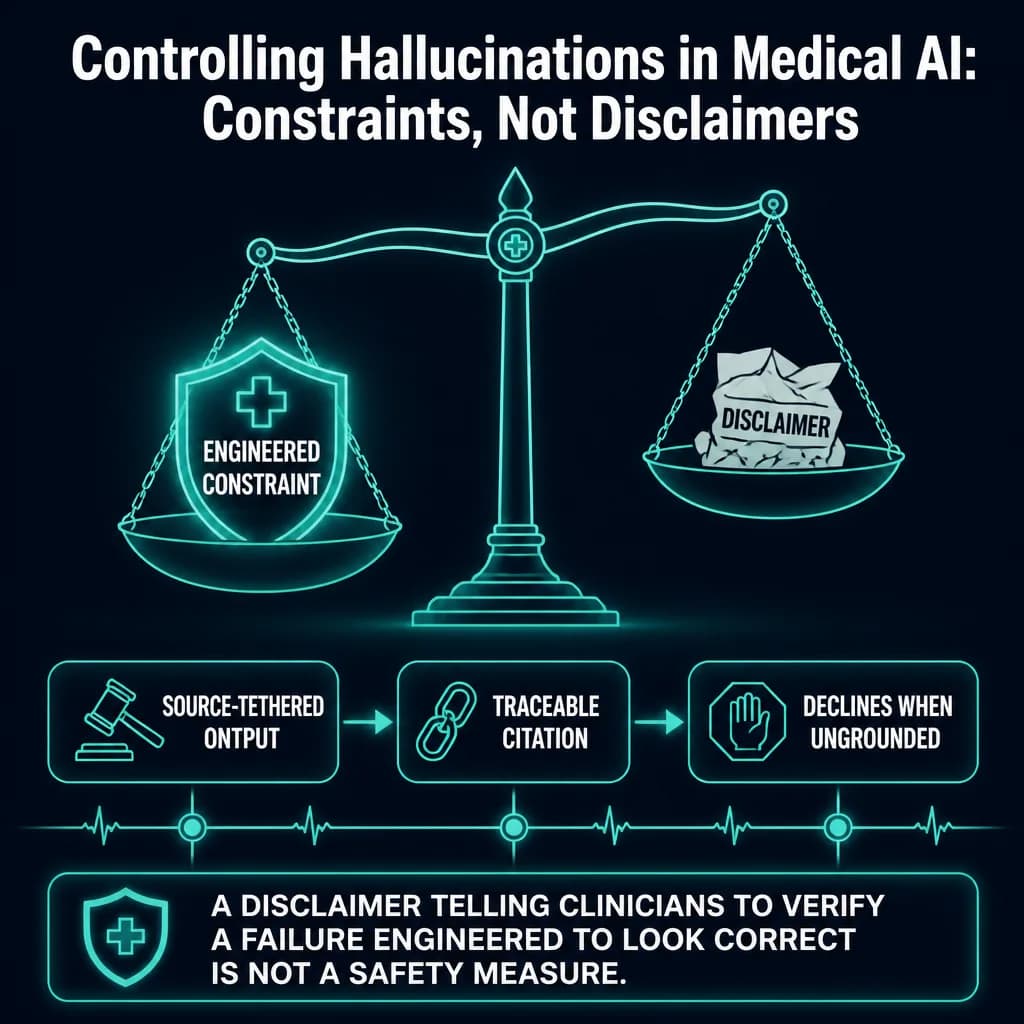
A disclaimer works when the user can act on it, which requires the user to be able to distinguish the outputs that need scrutiny from the ones that do not. Against hallucination, this condition does not hold. The whole problem with a hallucination is that it is indistinguishable, on its face, from a correct output. It carries the same fluency, the same confidence, the same plausibility. A clinician cannot tell, from the output alone, which statements are grounded and which are fabricated, which means a disclaimer to verify everything asks them to apply full scrutiny to every output, which is impossible at scale and pointless in principle, because the hallucination is built to pass that scrutiny.
This connects to the recurring danger across medical AI: the fluent, confident, wrong output that does not look like an error. A disclaimer does nothing to address this danger, because it does not change the output’s appearance or give the clinician a way to catch it. It relocates the responsibility for catching an undetectable failure onto the person reading, and their inability to catch it is exactly the problem. A safety measure that depends on the user detecting a failure specifically engineered to be undetectable is not a safety measure. It is a liability disclaimer wearing the costume of one.
The deeper issue is that a disclaimer treats hallucination as an acceptable property of the system to be managed by warning, rather than a defect to be engineered against. In most domains, that might be a tolerable posture. In medical AI, where a hallucinated statement can inform a clinical decision, treating the system’s tendency to fabricate as something the user should watch for, rather than something the system should be built not to do, misplaces the responsibility at the level of the architecture.
What controlling hallucination actually requires
Controlling hallucination means constraining what the system can produce so that its outputs are grounded, rather than warning users about outputs that are not. This is harder than a disclaimer, which is why disclaimers are popular, and it is the actual work.
The central technique is grounding the system’s outputs in verified sources rather than letting it generate freely from its training. A system that answers from a constrained, trusted knowledge base, and that can point to the source of what it produces, is architecturally less able to fabricate than one generating open-endedly, because its outputs are tied to something verifiable rather than synthesised from patterns. This is the constrained answer surface that limits what a system can produce, applied as a hallucination control: the system is built so that its outputs come from grounded sources, and so that a claim without a source is caught rather than presented.
It also means the system surfacing its own grounding, so that a clinician can see what an output is based on and trace it, which turns verification from an impossible blanket scrutiny into a targeted check against a cited source. And it means the system being built to express uncertainty and to decline rather than fabricate when it does not have a grounded answer, because a system that says it does not know is safer than one that generates a plausible answer to a question it cannot ground. The uncertainty surfaced rather than hidden is a hallucination control, because the fabrication often happens exactly where the system should have declined.
The accountability sits with the system’s design, not the user’s vigilance. A medical AI that hallucinates and relies on the clinician to catch it has been built to fail and warned about; a medical AI constrained to ground its outputs has been built to fail less, which is where the responsibility belongs.
The trade-off, named plainly
Constraining a system to ground its outputs costs capability. A system that answers only from verified sources, declines when it cannot ground an answer, and surfaces its grounding is more limited than one that generates freely across everything its training covers. It will answer fewer questions, decline more often, and feel less capable than an unconstrained system that produces a fluent answer to everything, including the things it fabricates. That is a real trade, and the unconstrained system will look more impressive precisely because it does not refuse and does not hedge, which are the behaviours that make the constrained system safe.
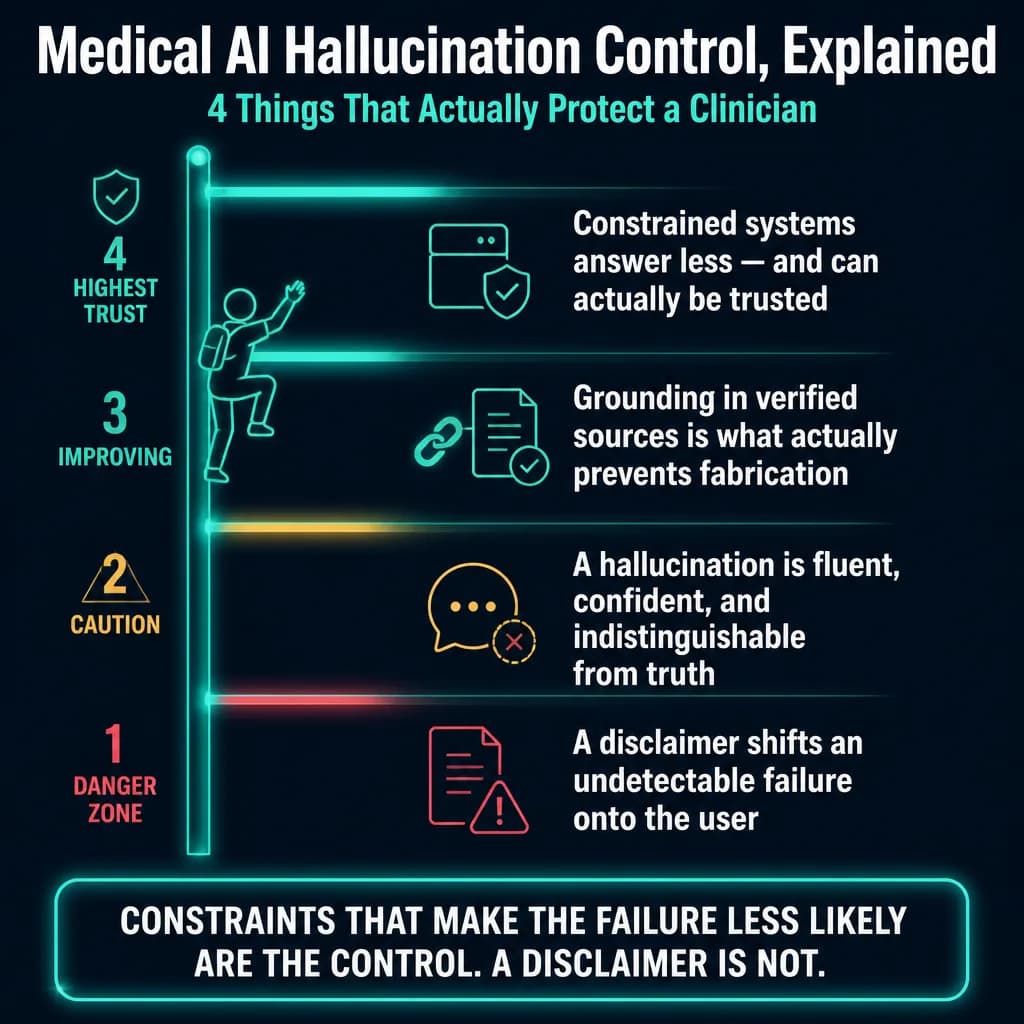
The position worth stating plainly: a medical AI system should be constrained to ground its outputs and to decline rather than fabricate, accepting reduced capability and more frequent refusals, rather than generating freely and relying on disclaimers to manage the hallucinations that result. A system that produces confident answers to everything, with a disclaimer to verify, has chosen the appearance of capability over safety and pushed the cost of that choice onto the clinician. The capability given up by constraining the system is capability that could not be trusted anyway, because it came bundled with fabrication the user cannot detect. A disclaimer is not a hallucination control. Constraints are, and the reduced capability they impose is the cost of a system whose outputs can be trusted rather than one whose failures the user is warned to catch.
Where it almost breaks
A health system deploys a medical AI tool that generates freely across a broad range of clinical questions, producing fluent, confident, helpful answers, and manages the risk of hallucination with a disclaimer instructing clinicians to verify all outputs. The tool is impressive and widely used. Then a clinician acts on an output that was fluent, confident, and plausible, and wrong, a fabricated statement the clinician had no way to distinguish from a correct one, because it looked exactly like the tool’s accurate outputs. The disclaimer had told the clinician to verify, but verification against a failure engineered to look correct, at the volume of outputs the tool produced, was never realistic. The tool had been built to fabricate and warned about, which had placed the burden of catching an undetectable failure on the clinician. The correction was to constrain the system: ground its outputs in verified sources, surface the grounding so clinicians could trace claims, build it to decline rather than fabricate when it could not ground an answer, and treat hallucination as a defect to engineer against rather than a property to disclaim. The tool answered fewer questions and its outputs became something a clinician could trust rather than something they were warned to doubt.
Controlling hallucination in medical AI is an engineering discipline, not a disclaimer. It means constraining the system to ground its outputs in verified sources, to surface what those outputs are based on, and to decline rather than fabricate when it cannot ground an answer, so that its outputs can be trusted rather than watched with a suspicion no clinician can sustain at scale. That costs capability and produces more refusals, and the unconstrained alternative will always look more impressive, because it answers everything, including the questions it fabricates answers to. A disclaimer telling clinicians to verify a failure engineered to look correct is not a safety measure. Constraints that make the failure less likely are.
The question to bring to any medical AI is not whether it warns users to verify its outputs. It is whether its outputs are constrained to grounded sources, whether it surfaces what it is basing a claim on, whether it declines rather than fabricates when it cannot ground an answer, and whether hallucination has been engineered against rather than disclaimed. That is the difference between a system that manages hallucination with a warning and one whose outputs survive scrutiny because they were constrained not to fabricate.
Related: Healthcare & Life Sciences · Koita Foundation: An AI-powered knowledge hub with citation-backed retrieval across seven repositories
Tell us the number you need to move.
…outcomes that survive scrutiny.