Credit Model Monitoring and Drift Detection Through the Economic Cycle
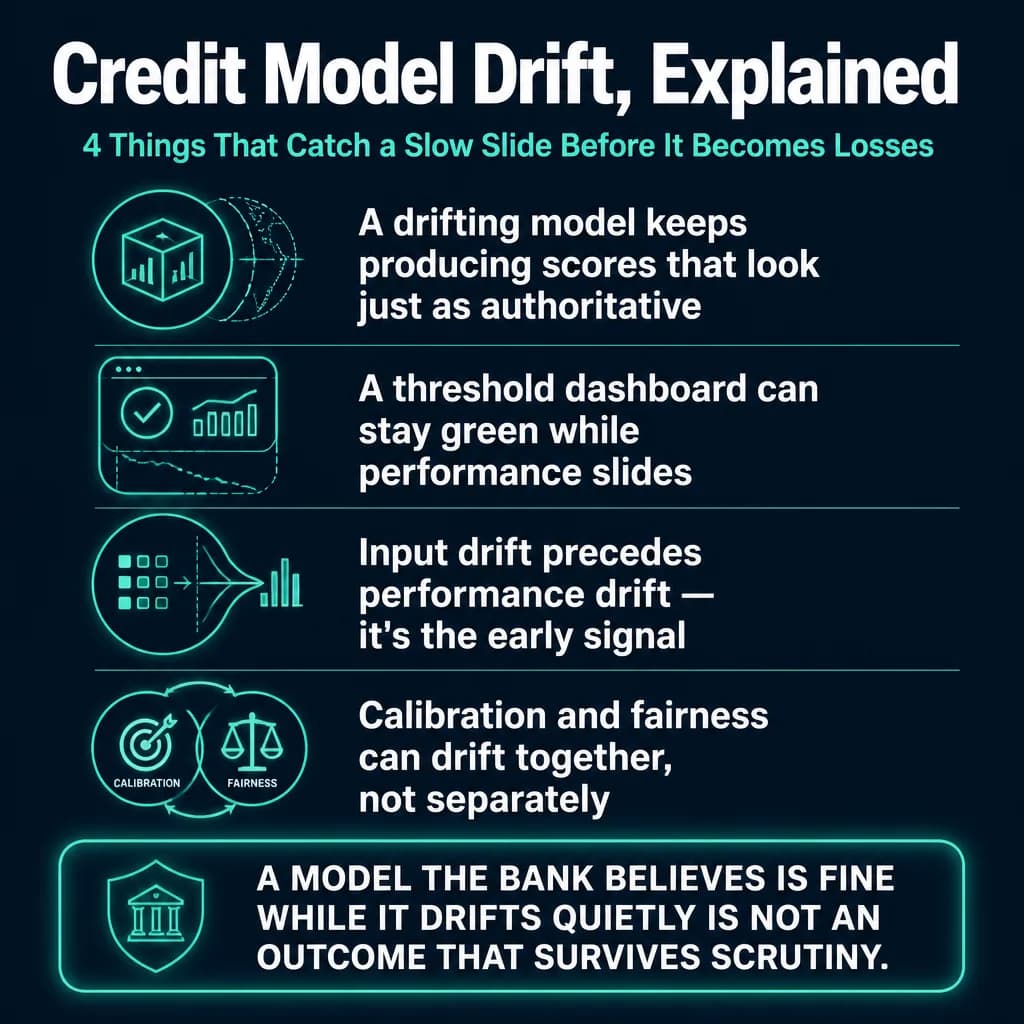
A credit model is trained on the past and deployed into the future, and the gap between the two is where credit models fail. A model built on data from a stable or expanding economy learns the relationships that held under those conditions, and when the economy turns, those relationships shift, sometimes gradually and sometimes sharply, while the model keeps applying the patterns it learned from a world that no longer exists. The model does not announce that it has become unreliable. It keeps producing scores that look exactly as authoritative as they did when they were accurate, which is what makes credit model drift through the economic cycle so dangerous. Credit model monitoring and drift detection is the discipline of knowing, continuously, whether a model still reflects the world it is operating in, so the bank catches the divergence before it becomes a portfolio of decisions made on relationships that no longer hold.
The reason this is hard is that drift in credit is often slow and correlated with exactly the conditions in which the bank can least afford to be wrong. A model degrading gradually as the cycle turns is degrading precisely when accurate credit decisions matter most, and a monitoring approach that only catches sudden breaks will miss the slow slide into unreliability.
The constraint that owns the workflow

Credit models sit under model-risk management obligations that make ongoing monitoring a requirement rather than a good practice. A deployed model has to be monitored for continued performance and validated over its life, because the expectation is that the bank knows whether its models still work, not just that they worked at validation. Credit decisions carry the fairness and explainability obligations that apply to all credit, and a model drifting out of calibration can drift into both worse performance and worse fairness at once. The bank is accountable for decisions made on a degraded model, so a model that has silently become unreliable is producing decisions the bank owns and cannot defend. And the monitoring itself has to be reconstructable, so the bank can show it was watching its models and acted when they drifted.
The failure modes are specific to the economic cycle. Silent degradation, where the model’s accuracy erodes gradually as conditions change and no single day looks alarming, so the decline goes unnoticed until the losses arrive. Calibration drift, where the model’s scores stop meaning what they used to, so a given score no longer corresponds to the risk it once did. And the fairness drift that accompanies performance drift, where a model balanced at validation becomes unbalanced across groups as the population and conditions shift.
The position: monitor the trend and the inputs, not just the outputs
Here is the stance I would hold against monitoring that watches only headline performance. Effective drift detection has to watch the trend and the input distribution, not just the current output metric, because the failures that hurt most in credit are the slow slides, and a slow slide is invisible to a monitor that only checks whether today’s performance crossed a threshold. A model can degrade meaningfully over two quarters without any single day tripping an alarm set on absolute performance, and by the time the absolute number finally crosses the line, the bank has already made a large volume of decisions on a model that was quietly failing the whole time.
The reasoning is about how credit model drift actually manifests. The economic cycle turns gradually, and the model’s inputs shift with it, employment patterns change, spending behavior changes, the mix of applicants changes, and these input shifts precede the performance degradation, because the model starts seeing data unlike its training before its predictions visibly fail against outcomes that have not yet materialised. Credit outcomes are also lagging, defaults surface months after the decisions that produced them, so a monitor waiting for performance to degrade against realised outcomes is waiting for information that arrives too late to prevent the bad decisions. Watching the input distribution for drift, and watching performance as a trend rather than a threshold, catches the divergence early, while the bank can still act. A monitor that only fires when absolute performance breaks will always fire after the damage, because in credit the damage precedes the measurable break.
Engineering inside the constraint
Monitoring watches at multiple points rather than only the final output. Input drift detection tracks whether the data the model is now seeing has diverged from the data it was trained on, so a shift in the applicant population or the economic conditions surfaces as a signal before it shows up as degraded performance. This is the early-warning layer, because input drift precedes performance drift, and catching it gives the bank time to investigate and act before the decisions go bad. Performance is monitored as a trend, watching the direction and rate of change rather than only whether an absolute threshold has been crossed, so a gradual slide is caught as a slide rather than waited out until it becomes a cliff.
Calibration is monitored specifically, checking whether scores still correspond to the risk they are supposed to represent, because a model can maintain its rank-ordering while its calibration drifts, so that the scores still sort applicants correctly but no longer mean what the bank’s cutoffs assume. Fairness is monitored alongside performance across protected segments, because drift can degrade fairness as it degrades accuracy, and a model sliding out of calibration can slide into disparate outcomes the bank owns. All of this is written to a reconstructable monitoring record, so the bank can show it was watching and demonstrate when it detected drift and what it did.
The monitoring is structured around an explicit standard for what constitutes acceptable performance, calibration, and fairness, with drift on any of them treated as an event to investigate, operate continuously, which is the work a rubric-based evaluation engine like PRISM is built to carry, so a model’s ongoing behavior is measured against the full standard rather than a single accuracy number. When drift is detected, human judgment owns the response, deciding whether to recalibrate, retrain, or intervene, because the decision to act on a drifting model carries consequences that a person has to weigh.
Where it almost broke
A bank monitored its credit models with a dashboard tracking their performance against a set of thresholds, and the dashboard stayed green through a period of changing economic conditions. The thresholds were set on absolute performance, and no single day breached them. What the dashboard did not track was the trend or the input distribution, so it missed that the model’s performance had been sliding steadily for two quarters and that the applicant data had drifted meaningfully from the training distribution. By the time performance finally crossed a threshold and the alarm fired, the model had been making decisions on eroding accuracy for months, and a portfolio of those decisions was already producing losses that better monitoring would have prevented.
The dashboard was watching the right metric the wrong way, checking whether performance had broken rather than whether it was breaking. The fix was to add input-drift detection as an early-warning signal, to monitor performance as a trend rather than only against absolute thresholds, and to watch calibration and fairness alongside accuracy, so a gradual slide surfaced as a slide the bank could act on early. A credit model monitor that only catches cliffs will miss every slope, and in credit through the economic cycle, the slopes are where the losses come from.
Credit model monitoring and drift detection through the economic cycle is the discipline of always knowing whether a model still reflects the world it operates in, so the bank catches the divergence between a model’s learned past and its lived present before that divergence becomes a portfolio of bad decisions. The failures that matter in credit are the slow ones, the gradual slides that track the turning cycle, and catching them requires watching the trend and the inputs rather than waiting for absolute performance to break, because in credit the break arrives after the damage. A model that looks fine on a threshold dashboard can be failing steadily underneath it.
A bank monitoring its credit models should ask whether its monitoring would catch a slow slide across two quarters or only a sudden break, because the slow slide is the one that turns the cycle into losses. A model the bank believes is fine because nothing has crossed a threshold, while it drifts quietly out of the world it was built for, is not an outcome that survives scrutiny.
Related: Banking & Financial Services · Reserve Bank Innovation Hub: Automated grievance workflows with natural-language access and a complete audit record · IndusInd Bank Limited: AI-Powered Knowledge Source-Based Process Training and Query Resolution
Tell us the number you need to move.
…outcomes that survive scrutiny.