Cursor in the Enterprise: An AI Code Editor’s Real Production Trade-offs
Engineering leaders measure delivery in features shipped, defects escaped, and incidents survived. AI code editors are usually sold against the first of those and evaluated against the first alone, which explains why so many enterprise rollouts report enthusiasm from developers and no measurable change in delivery outcomes six months later. The interesting question about an AI code editor concerns which part of the engineering lifecycle absorbs the work it saves.
Cursor and tools in its category embed model assistance into the editor itself, with repository context available to the model. That context is the meaningful capability shift. Suggestion quality rises sharply once the system can read the surrounding codebase, follow existing conventions, and reason across files instead of completing the current line.
What the repository context actually buys

Three categories of work compress substantially. Boilerplate and scaffolding, where the answer is known and typing it is the only cost. Mechanical refactoring across many files, where correctness is checkable and the tedium is the barrier. Orientation in unfamiliar code, where an engineer joining a service can ask the codebase questions and get situated in hours rather than days.
That third one is undervalued in most business cases. Onboarding time and cross-team mobility are persistent constraints in large engineering organisations, and reducing the cost of understanding someone else’s system has compounding effects on how work can be allocated.
The gains narrow as the work becomes more novel. For genuinely new architecture, unusual domain logic, or performance-sensitive code, the assistant produces plausible code that reflects common patterns from public repositories, which is frequently the wrong answer for a specific system with specific constraints.
The trade-off nobody prices
Generated code arrives faster than reviewed code. The bottleneck moves downstream to review, and review capacity is fixed in the short term because it depends on senior engineers who are already the scarcest resource in the organisation.
The subtler shift concerns how review is performed. Engineers review their own handwritten code with a mental model of every decision they made. They review generated code by reading it, which is a weaker form of scrutiny, and the code often looks idiomatic enough to pass a quick pass. Defects that survive this are typically not syntax errors. They are incorrect assumptions about system behaviour, missed edge cases specific to your data, and security patterns that are conventional in public code and wrong in your threat model.
Volume compounds it. A reviewer facing significantly larger diffs applies proportionally less attention per line, which is well understood in engineering practice and reliably ignored in AI tooling business cases. Organisations that adopt without expanding review capacity trade delivery speed for defect escape rate, and the second number surfaces a quarter or two later in incident reviews.
Enterprise controls that decide the outcome
Code egress is the first governance question, and it is more consequential than most procurement processes treat it. The editor sends source context to a model endpoint to function. What leaves, where it is processed, how long it is retained, and whether it can influence training are contractual questions with direct IP consequences. Proprietary algorithms, security implementations, and unreleased product logic all live in the repositories that engineers open every day.
Provenance is the second. Generated code carrying licence obligations creates exposure that surfaces during diligence, acquisition, or open-source compliance review, long after the commit. Automated licence scanning in the pipeline is the practical control.
The third is enforcement architecture. Guidance about where AI assistance is permitted has no effect at the point of writing. Controls belong in CI: mandatory human approval for defined sensitive paths, security scanning that cannot be bypassed, and test coverage gates that apply regardless of how the code was produced. This is the same discipline we apply to evaluation gates in automated pipelines, and it is the difference between a governed rollout and an unbounded one.
Where it fits
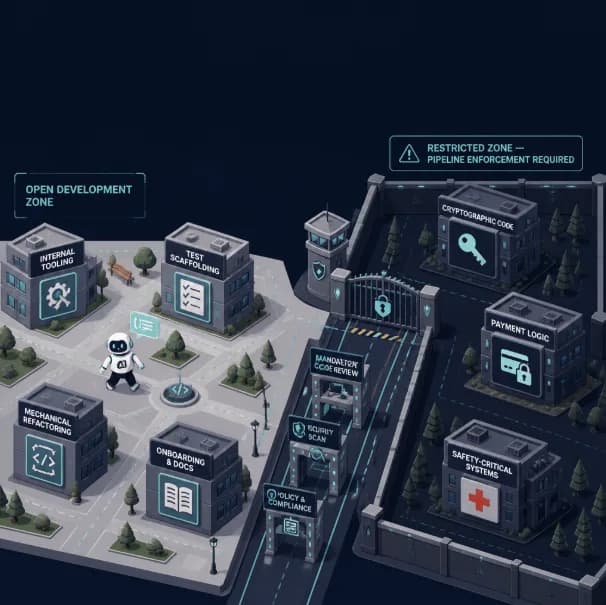
Strong fit: internal tooling, test authoring, scaffolding, large mechanical refactors, and onboarding into unfamiliar services. The productivity gain there is real and the risk profile is manageable.
Weaker fit: cryptographic and authentication code, payment and settlement logic, safety-critical systems, and any component where a subtle behavioural error is expensive to detect. Those paths deserve explicit policy with pipeline enforcement behind it. Teams working through production readiness for AI-assisted engineering should start by classifying paths before enabling access.
(Codebase as an urban district map with zoning laws)
The organisations seeing durable value from AI code editors expanded review capacity and hardened their pipelines at the same time they granted access. If your rollout is measuring adoption and velocity today, the more revealing metric is what happened to defect escape rate over the following two quarters.
Related: Data Architecture
Tell us the number you need to move.
…outcomes that survive scrutiny.