Customer-Support Agents Compared: Deflection, Escalation, and Accountability
Customer support is the function where AI agents get deployed fastest and evaluated most misleadingly. The number everyone leads with is deflection, the share of contacts the agent resolves without a human, and it is easy to raise and easy to celebrate and a poor measure of whether the deployment actually worked. A support agent that deflects a high percentage of contacts while mishandling the ones that mattered, escalating badly, or committing the organisation to things it should not have, is a failure with an excellent headline metric. The comparison worth making across support agents is not which one deflects most. It is which one handles deflection, escalation, and accountability together, because those three determine whether the agent helps customers or quietly damages the relationship.
A customer-support agent handles inbound customer contacts through conversation, understanding the issue, resolving it against the organisation’s systems and knowledge, and either completing the resolution or handing off to a human. The capability that genuinely changed is that these agents became good enough to resolve real issues rather than deflect with canned responses, which is what makes them worth deploying and what makes their failures more consequential. Comparing them on deflection alone measures the easy part and ignores the parts that decide the outcome.
Why deflection is the wrong headline

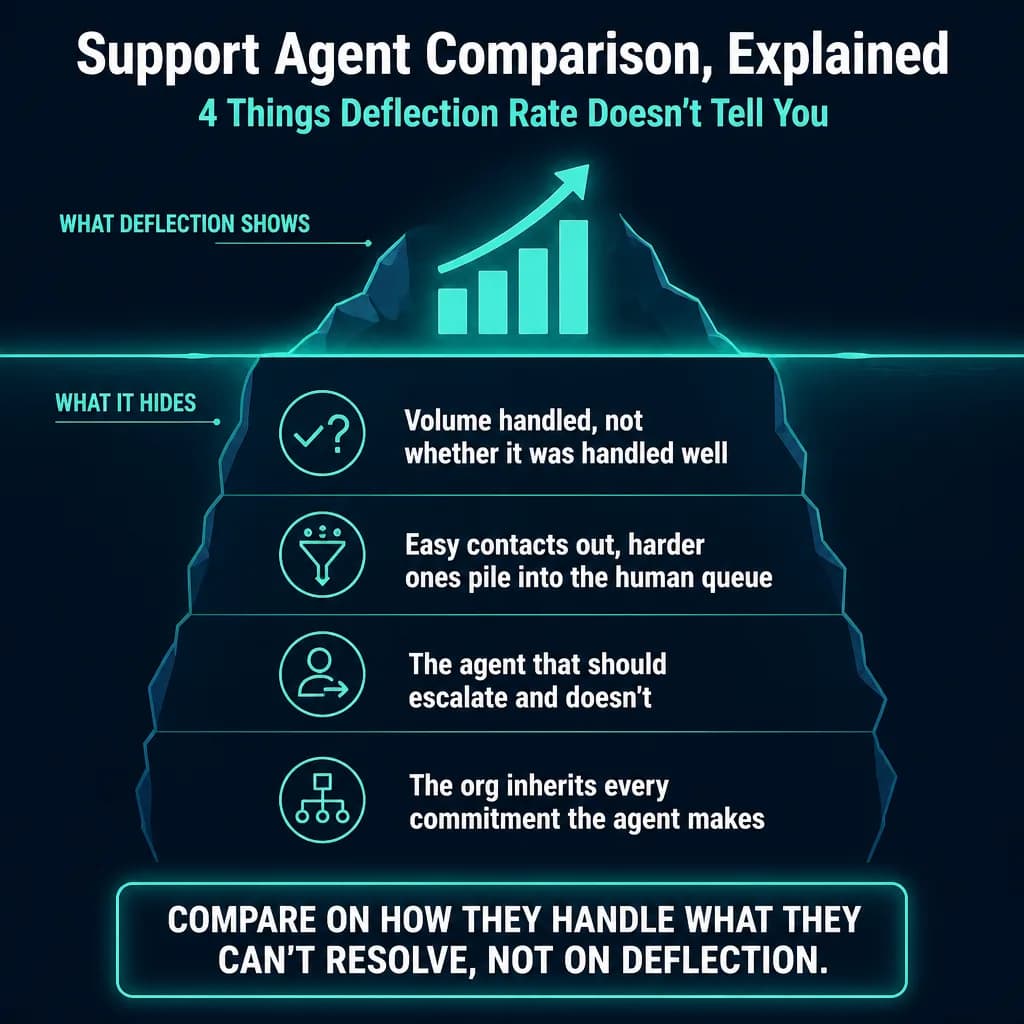
Deflection measures how many contacts the agent handled without a human, and it says nothing about whether it handled them well.
An agent raises deflection by resolving the easy, common contacts, which is genuine value, and the same number rises if the agent resolves contacts badly, giving wrong answers confidently, closing issues that were not actually resolved, or handling matters it should have escalated. Two agents with identical deflection rates can deliver opposite customer experiences, one resolving well and escalating cleanly, the other resolving poorly and failing to escalate, and the deflection number cannot tell them apart. There is also a mix-shift the metric hides: the agent deflects the simple contacts, so the ones reaching human agents are on average harder, and average handling time for the human queue rises, which a cost model built on deflection alone will misread as the agent working while the economics quietly shift. Deflection is a real signal about volume and a poor signal about quality, and a comparison that leads with it optimises for the wrong thing.
Escalation is where support agents actually differ
The capability that separates a good support agent from a dangerous one is how it handles the contacts it cannot resolve, and this is where the real comparison lives.
An agent needs to recognise when a contact exceeds its ability, on complexity, on detected frustration, on sensitivity, and hand off cleanly, carrying the full context so the customer does not repeat themselves, because a bad escalation that drops the customer back to the start is worse than no agent at all. The harder and more important case is the agent that should escalate and does not, continuing confidently past the point where it had the answer, mishandling a matter that needed a human, and leaving the customer worse off and often unaware until the resolution fails. Detecting that failure requires monitoring for it specifically, and an agent evaluated only on deflection is rewarded for exactly the behaviour, low escalation, that this failure produces. The trade-off is direct. An agent that escalates readily is safer and deflects less, and one that escalates reluctantly deflects more and fails harder when it should have handed off, so the escalation threshold is a deliberate risk decision that a deflection target actively pushes in the wrong direction.
Accountability is the constraint the agent cannot hold
A support agent acts on the organisation’s behalf, and what it says and commits to becomes the organisation’s responsibility, which is a constraint the comparison has to include.
An agent that misstates a policy, quotes a wrong price, makes a commitment the organisation cannot honour, or gives incorrect regulated information has created a liability, and in many contexts the customer’s record of what the agent said carries real weight. The organisation remains accountable for every resolution the agent delivers, which means the agent’s authority to commit has to be bounded, with consequential commitments, refunds, exceptions, regulated statements, gated or constrained rather than left to the agent’s judgment. This is the same governed-autonomy discipline that governed autonomy in customer operations treats as core, and it applies to the comparison directly: an agent’s ability to act is only safe to the extent its authority is bounded and its consequential actions are gated.
Operationalising the comparison
Continuous evaluation is the control that makes the real comparison possible, assessing agents against defined criteria across resolution quality, escalation behaviour including the calls they should have escalated and did not, and accountability boundaries, rather than against deflection alone. This is the evaluation discipline behind PRISM, where agent behaviour is scored against rubrics that capture quality and escalation rather than volume, and teams comparing support agents should build that evaluation before scaling, because the failures that matter, poor resolution and missed escalation, are precisely the ones deflection metrics hide. The trade-off carried out is that a support agent is worth deploying for the genuine resolution it delivers, and worth comparing on how it handles the contacts it cannot resolve and the commitments it should not make, because those are where the customer relationship is actually won or damaged.
Where it fits
Strong fit for high-volume, resolvable, bounded contacts where the intent range is contained and a human is reachable at the edge, account and status queries, common issues over a known knowledge base, structured transactional support.
Weaker fit for complex, sensitive, or high-stakes contacts where judgment carries the outcome, for any deployment optimised on deflection without escalation and accountability evaluation, and for matters where a wrong commitment carries real consequence and no gate bounds the agent’s authority. Those need the escalation boundary and the accountability limits designed before scale, because the agent’s fluency makes its failures more convincing, not less.
Customer-support agents are worth deploying for the genuine resolution they now deliver, and worth comparing on the parts deflection hides, because a high deflection rate can mask poor resolution, missed escalation, and unbounded commitments that damage the relationship the agent was meant to serve. The organisations getting value from them evaluated escalation and accountability alongside resolution and treated the escalation threshold as the deliberate risk decision it is. If a support agent comparison is underway in your organisation, the more revealing exercise than ranking deflection rates is auditing how each agent handles the contacts it cannot resolve, because that is where the difference between a helpful agent and a costly one actually shows.
Related: Data Architecture
Tell us the number you need to move.
…outcomes that survive scrutiny.