Designing the Handoff: When a Voice Agent Should Escalate to a Person
Everyone has been the caller stuck in the loop. You say “representative,” the voice agent offers to help with something you never asked about, you repeat yourself louder, and the system routes you back into its own menu. The agent is behaving exactly as configured. The call is still a small disaster. That distance between a system that functions and a call that ends well is the whole problem of voice agent escalation, and most teams design for it last, after the happy path already demos cleanly.
If you operate a voice agent against real call volume, escalation is where the economics and the customer experience collide, usually at cross purposes. Every call a human handles carries the cost the automation was meant to remove. Every call the agent traps carries a cost that surfaces later as a complaint, a churned customer, or a regulator’s question. The escalation decision sits on that seam. Get it wrong in either direction and the deployment underperforms, quietly on the cost side and loudly on the experience side.
The metric that quietly rewards trapping people

Most voice programs optimise containment rate, the share of calls resolved without a human. It is easy to measure and easy to put in a board deck, which is precisely why it distorts behaviour. Optimise containment directly and you build a system that resists letting people out, because every escalation counts against the number you are judged on. The predictable outcome is a frustrated caller held one turn too long, then another, while the agent protects its score at the expense of the resolution.
Containment measured on its own tells you how often a human was avoided. It says nothing about whether the caller’s problem got solved. A caller who gives up and hangs up counts as contained. So does the caller who received a confident wrong answer and left believing it. The signal worth optimising pairs containment with resolution and with post-escalation outcome, because a voice agent that escalates at the right moment is delivering the result, and a voice agent that never escalates is frequently failing silently at scale.
When escalation is genuinely the right call
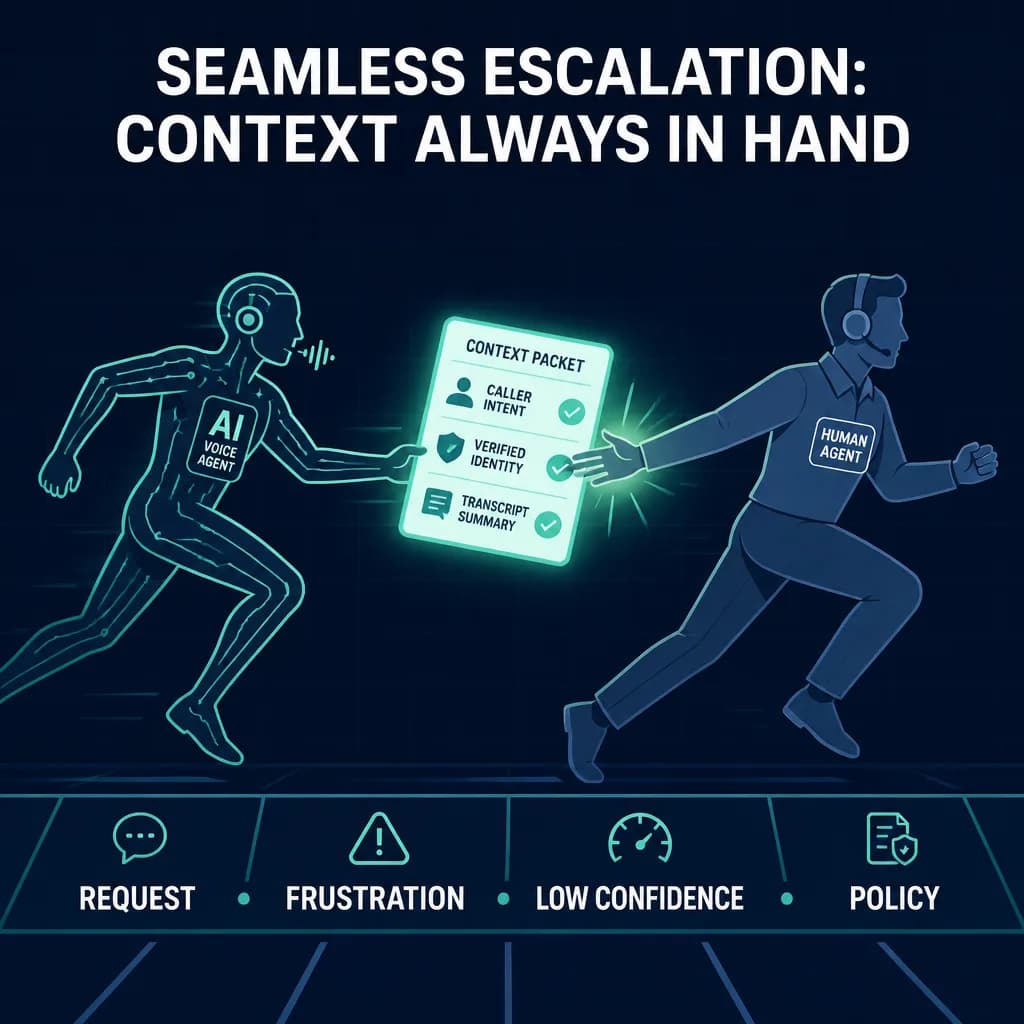
There are a handful of triggers a well-engineered agent should treat as escalation events rather than problems to reason through. An explicit request for a human is the clearest one, and honoring it immediately is table stakes, because the caller who has to ask three times has already lost trust in the system. Detected frustration is the next, inferred from repeated rephrasing, rising sentiment signals, or the same intent failing twice. Low speech-recognition confidence matters more in voice than in text, because a misheard account number or a mangled name compounds into a wrong action the caller cannot easily see. Out-of-scope intent belongs to a human by definition. And some interactions escalate by policy: a vulnerable customer, a formal complaint, or a regulated decision that requires human accountability is a compliance boundary before it is a design choice, which is why we treat these as governance thresholds engineered into the flow rather than judgment calls the model makes live.
The engineering discipline here mirrors placing human oversight by consequence. You do not escalate everything, which destroys the economics, and you do not escalate nothing, which traps people. You define the specific conditions that warrant a person and route only those.
The handoff is where escalation usually fails
Deciding to escalate is the easy half. The half that breaks in production is the transfer itself. A cold transfer dumps the caller onto a human with no context, so the person on the line asks them to explain everything again from the top. The escalation technically succeeded and the experience failed completely, because from the caller’s seat, restarting with a human means the previous five minutes were wasted.
A warm handoff carries state across the boundary. The human agent receives a compact context packet: what the caller wanted, what the agent already attempted, the verified identity, the relevant account state, and a short transcript summary. Building that packet is real work. It means the agent has been maintaining structured state throughout the call, which is the same state-management discipline that keeps any agent auditable, applied to a live conversation with a person waiting on the line. Skip it and every escalation restarts from zero, which callers experience as the system giving up on them.
This is the class of problem our EVIO calling platform is engineered around, where the escalation logic and the context handoff are treated as core call infrastructure rather than a fallback bolted on when the agent gets stuck.
Where it almost broke
We operated a voice agent whose containment numbers looked excellent for weeks. CSAT told a different story, and the trace explained the gap. Callers requesting a human were being offered “let me try to help with that first,” which the design counted as a retained call. Many of those callers hung up rather than fight the system, and every abandoned call had been recorded as a success. The metric was green while the experience decayed.
The fix changed the incentive and the plumbing. Explicit human requests escalated on the first ask. Frustration and repeated failure became escalation triggers rather than reasons to try again. And every escalation now carried a context packet, so the human opened the call already knowing what happened. Containment fell by a few points. Resolution and CSAT rose sharply, because the calls that reached a person got solved instead of restarted.
Escalating well is the capability
The instinct to minimise human involvement comes from a real cost pressure, and applied without precision it produces voice agents that guard their containment score while callers quietly give up. Sound voice agent escalation reverses the frame. The goal is escalating at the right moment, to the right person, with the context that makes the handoff feel like continuity rather than a restart.
The teams whose voice deployments hold up are the ones who stopped measuring how often they avoided a human and started measuring whether the caller left with their problem solved. An agent that knows exactly when to step aside, and hands off cleanly when it does, earns more trust than one that never lets go. That judgment, engineered into the call flow and monitored against real outcomes, is what separates a voice agent people tolerate from one they would choose to use again.
Related: Agentic AI
Tell us the number you need to move.
…outcomes that survive scrutiny.